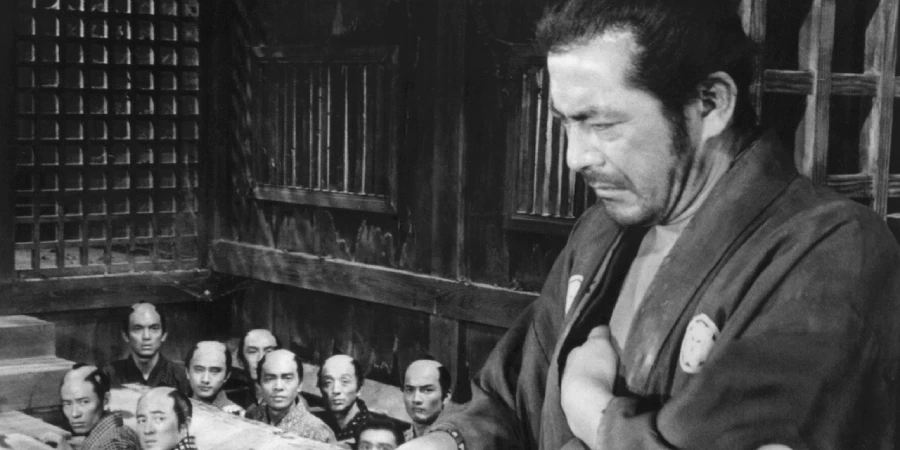

Akira Kurosawa’s Sanjuro (1962) is a samurai drama with a comedic edge, starring the legendary Toshiro Mifune. A loose sequel to Yojimbo (1961), the film blends satire, sword-fighting brilliance, political corruption, and character-driven storytelling.
Detailed Summary
The Young Idealists and the Wrong Suspect
The film begins with nine naive samurai students who believe they have uncovered corruption within their clan. They meet a rough, unkempt ronin who overhears their conversation. This swordsman, later introduced as Sanjuro (Mifune), discreetly warns them that they are being manipulated and that the men they accuse of corruption are actually innocent. His suspicion proves correct, immediately showing his sharp intuition versus their idealism.
The Rescue of the Clan Chamberlain
Sanjuro saves the students from their own disastrous attempt to expose the “corruption.” After the Chamberlain is arrested by truly corrupt officials, the group hides in a temple. Sanjuro takes charge, despite continually mocking their lack of strategy and romanticized view of samurai honor. A key point here is how the film contrasts honor as ideology versus honor as action, with Sanjuro embodying the latter.
Lady and Daughter of the Chamberlain
Sanjuro’s rescue plan involves saving the Chamberlain’s wife and daughter. These women become the moral center of the story, often rebuking Sanjuro’s violent methods. One key moment is when the Lady tells him, “You swing your sword too much.” This is a rare critique of a samurai hero, hinting at moral consequences of violence.
The Local Assassin: Hanbei Muroto
Sanjuro faces off intellectually and militarily with Hanbei Muroto, an opposing samurai leader who admires him. Hanbei is tragic: skilled yet trapped by loyalty to corrupt elites. His fascination with Sanjuro makes him both an enemy and the closest thing Sanjuro has to a friend. Their tense rivalry drives the story to its climax.
Movie Ending
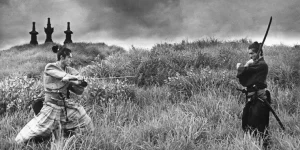
The corrupt officials are exposed, the Chamberlain is rescued, and order is restored. However, the final act does not celebrate victory. Hanbei attempts to escape and challenges Sanjuro to a duel. Sanjuro wins with one of the most famous sword strikes in cinema history: a single slash followed by an explosive spurt of blood.
The scene shocks the young samurai, who expected a glorious, honorable duel. Sanjuro scolds them for idolizing violence, saying they do not understand the cost of killing. He then walks away, refusing praise or reward.
The ending reveals the moral paradox at the heart of the film: Sanjuro’s skill is needed, yet his existence is tragic because it is defined by violence. The final moment is not triumphant but sober, underlining Kurosawa’s critique of romanticized samurai ideology.
Are There Post-Credits Scenes?
No, Sanjuro does not contain any post-credits scenes.
Type of Movie
A character-driven samurai drama with sharp satire and thoughtful commentary on violence and honor. Though it includes humor, it remains a morally serious and visually iconic samurai film.
Cast
- Toshiro Mifune as Sanjuro
- Tatsuya Nakadai as Hanbei Muroto
- Yuzo Kayama as Iro (one of the young samurai)
- Takashi Shimura as Councilor Kikui
- Keiju Kobayashi as the Chamberlain
Film Music and Composer
The score was composed by Masaru Sato, a frequent Kurosawa collaborator. His music combines tension with playful undertones, matching the film’s mix of wry humor and dangerous stakes.
Filming Locations
- Shot primarily at Toho Studios in Tokyo.
- Outdoor sequences were filmed in woodland areas near Mount Fuji to emphasize natural beauty contrasted with bloody samurai conflict.
- The limited settings highlight the tension and strategy, making the story feel both intimate and intense.
Awards and Nominations
While not a major awards contender internationally at the time, Sanjuro later became critically acclaimed and is frequently featured on lists of the greatest samurai films ever made, especially for its iconic final swordfight.
Behind the Scenes Insights
- Toshiro Mifune developed Sanjuro’s signature mannerisms—scratching, yawning, casual posture—to subvert the “ideal samurai” stereotype.
- The final blood burst was created by pressurizing real liquid through a tube; the unexpected violent effect shocked even Kurosawa, who kept it.
- The film was originally not planned as a sequel to Yojimbo; Sanjuro was added later during rewrites.
- The female characters were intentionally written as morally superior to critique male samurai culture.
Inspirations and References
- Loosely based on a short story by Shugoro Yamamoto, titled Peaceful Days, but heavily rewritten.
- Kurosawa inserted themes inspired by Zen Buddhism, especially the idea that action must serve peace, not ego.
Alternate Endings and Deleted Scenes
- Early scripts featured Sanjuro refusing to fight Hanbei and leaving, but Kurosawa changed it to confront the cost of violence more painfully.
- Some dialogue scenes with the young samurai were cut to maintain pacing, emphasizing Sanjuro’s presence.
Book Adaptations and Differences
In the original novella, the protagonist is not a wandering ronin but a more refined samurai. Kurosawa radically changed him into a wild, cynical, anti-heroic drifter, turning the story into a deeper critique of samurai values.
Memorable Scenes and Quotes
Key Scenes
- Sanjuro rescuing the Chamberlain’s wife with a nonviolent trick.
- The ambush at the storehouse, showcasing strategic brilliance.
- The final duel, the most famous single sword strike in cinema.
Iconic Quotes
- “You swing your sword too much.” – The Chamberlain’s wife
- “There’s no help for it. I’m a ronin.” – Sanjuro
- “Killing’s easier than you think.” – Sanjuro
Easter Eggs and Hidden Details
- The wild patterned kimono Sanjuro wears contradicts traditional samurai modesty.
- A scene of the young samurai bowing awkwardly is meant to mock over-formal bushido behavior.
- Hanbei is dressed more traditionally to highlight his misguided “honor.”
Trivia
- Nakadai (Hanbei) later starred as the lead in Kurosawa’s Ran (1985).
- The blood spray effect is now legendary and often imitated in modern samurai films.
- The movie was more popular in Japan than Yojimbo, though the latter is better known globally.
Why Watch?
Because Sanjuro is both entertaining and intellectually sharp, offering fast-paced swordplay, subtle humor, and one of cinema’s most unforgettable endings. It challenges what samurai honor truly means without losing its sense of fun.
Director’s Other Movies
- Rashomon (1950)
- Seven Samurai (1954)
- Throne of Blood (1957)
- Yojimbo (1961)
- Red Beard (1965)
Recommended Films for Fans
- Harakiri (1962)
- The Sword of Doom (1966)
- Zatoichi (1989)
- Ran (1985)
- Twilight Samurai (2002)