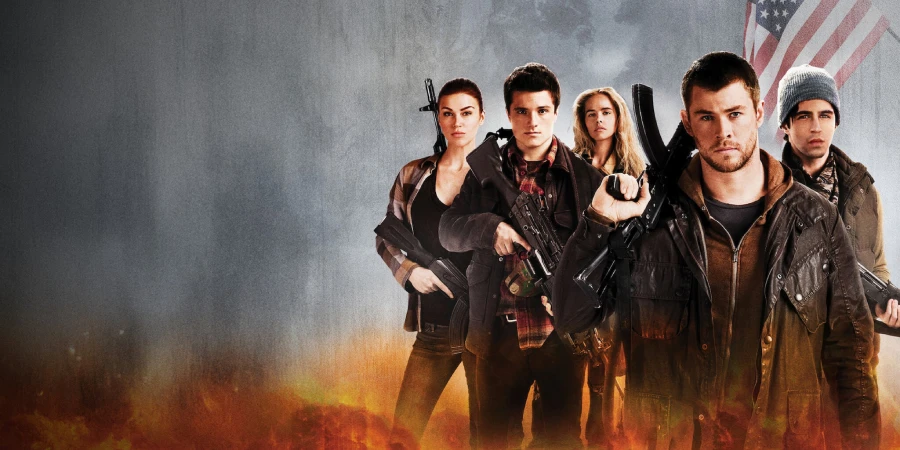

Red Dawn (2012) is a modern remake of the 1984 Cold War classic, reimagined for the post-9/11 era. Directed by Dan Bradley, the film delivers a fast-paced invasion story focused on survival, resistance, and patriotism.
Detailed Summary
The Opening: A World on the Brink
The film opens with global instability. The United States is suffering from economic collapse, energy shortages, and military overextension. North Korea, empowered by political alliances and access to advanced weapons, emerges as an unexpected global threat.
Two brothers are introduced:
- Jed Eckert, a former Marine
- Matt Eckert, his younger brother and high school football player
Their relationship forms the emotional backbone of the movie.
The Invasion Begins
Without warning, North Korean paratroopers descend into Spokane, Washington. Schools, neighborhoods, and streets are attacked in minutes. Civilians are captured, infrastructure collapses, and the U.S. military is caught completely off guard.
This sequence is one of the film’s most intense moments, portraying how quickly normal life disappears.
Jed, Matt, and a group of teenagers narrowly escape into the nearby forests.
Formation of the Wolverines
Hiding in the mountains, the group slowly realizes that:
- The U.S. government has collapsed locally
- Communications are down
- Martial law is enforced by foreign troops
Inspired by their school’s football mascot, they name themselves the Wolverines.
At first they struggle with hunger, fear, and inexperience. Over time, Jed trains them using his Marine background, transforming frightened teenagers into guerrilla fighters.
Guerrilla Warfare and Moral Conflict
The Wolverines begin conducting ambushes, sabotage missions, and supply raids. Their attacks turn them into a symbol of resistance, spreading hope among surviving civilians.
However, the emotional cost rises quickly:
- Friends are captured and executed
- Civilians suffer reprisals
- The group questions whether their actions are helping or worsening the situation
The film emphasizes that resistance comes with painful consequences.
The Enemy Commander
Captain Cho, the North Korean officer hunting the Wolverines, becomes increasingly obsessed with destroying them. His role adds complexity by showing the psychological toll of occupation on both sides.
As the Wolverines grow more effective, Cho tightens his grip on the town, leading to brutal confrontations.
Internal Losses and Escalation
Several members of the group are killed or captured during missions. Each death hardens the survivors and pushes Jed into full leadership mode.
The story shifts from survival to sacrifice. The Wolverines are no longer trying to escape; they are fighting to weaken the occupation.

Movie Ending
In the final act, the Wolverines learn that the U.S. military has begun a counteroffensive elsewhere in the country. Their mission becomes clear: delay enemy forces long enough for reinforcements to arrive.
Jed leads the group in a high-risk ambush designed to draw attention away from civilian evacuation routes. During the battle:
- Several Wolverines are killed
- Matt is wounded
- Jed is critically injured
In a quiet but powerful moment, Jed realizes he will not survive. He instructs Matt to take command, symbolically passing leadership to the younger generation.
Jed dies from his wounds after ensuring the group escapes.
The film ends with a time jump. The occupation has been pushed back, and the Wolverines are remembered as the spark that ignited the resistance.
A memorial plaque honors the fallen fighters. Matt narrates that freedom was not restored by soldiers alone, but by ordinary people who refused to surrender.
The ending emphasizes legacy over victory and reinforces the film’s central message: resistance begins with ordinary citizens.
Are There Post-Credits Scenes?
No. Red Dawn (2012) does not include any mid-credits or post-credits scenes. The story concludes entirely before the credits roll.
Type of Movie
Red Dawn is an action-driven war thriller that blends military invasion fiction with survival drama, focusing heavily on patriotism, resistance warfare, and youthful sacrifice.
Cast
- Chris Hemsworth – Jed Eckert
- Josh Peck – Matt Eckert
- Josh Hutcherson – Robert Kitner
- Adrianne Palicki – Toni Walsh
- Isabel Lucas – Erica Martin
- Jeffrey Dean Morgan – Colonel Andy Tanner
- Will Yun Lee – Captain Cho
Film Music and Composer
The score was composed by Ramin Djawadi, best known for his work on Game of Thrones and Iron Man.
His music emphasizes tension and momentum, using heavy percussion and militaristic themes to support the film’s combat-driven tone.

Filming Locations
The movie was primarily filmed in:
- Michigan (Detroit and surrounding areas)
- Mount Clemens and Rochester Hills
These locations doubled for Spokane, Washington. Abandoned factories and urban decay were intentionally used to enhance the feeling of occupation and societal collapse.
The snowy forests and rural terrain played a crucial role in reinforcing the guerrilla warfare atmosphere.
Awards and Nominations
The film did not receive major awards recognition. However, it earned nominations for:
- Teen Choice Awards – Choice Action Movie
- Saturn Awards – Best Action or Adventure Film (nomination)
Behind the Scenes Insights
- The original villains were China, but the film was digitally altered to make North Korea the invading force to avoid international controversy.
- Over 300 visual effects shots were modified during post-production to change uniforms, flags, and dialogue.
- Chris Hemsworth filmed this shortly before becoming globally famous as Thor.
- Director Dan Bradley previously worked as a second-unit director on the Bourne films, influencing the movie’s handheld combat style.
- Many cast members underwent military-style boot camp training.
Inspirations and References
The film draws inspiration from:
- Red Dawn (1984)
- Cold War invasion fiction
- Guerrilla warfare case studies
- Post-9/11 American military anxiety narratives
It modernizes the original concept for a globalized 21st-century threat environment.
Alternate Endings and Deleted Scenes
No official alternate ending has been released.
Deleted scenes include:
- Extended character backstories for the Wolverines
- Additional town-occupation sequences
- A longer confrontation between Jed and Captain Cho
These were removed mainly to shorten runtime and maintain pacing.
Book Adaptations and Differences
The film is not based on a novel, but it is a remake of the 1984 movie.
Major differences from the original include:
- Updated geopolitical context
- Younger character focus
- More grounded realism
- Less Cold War ideology and more survival emphasis

Memorable Scenes and Quotes
Key Scenes
- The paratrooper invasion of the high school
- The first Wolverine ambush in the forest
- Jed training the group in combat survival
- The final sacrifice during the last battle
Iconic Quotes
- “Wolverines!”
- “Freedom doesn’t come cheap.”
- “A fight worth fighting is never easy.”
Easter Eggs and Hidden Details
- The Wolverines mascot mirrors the original 1984 film.
- Several lines of dialogue are directly lifted from the original script.
- The town memorial plaque mirrors the ending shot of the 1984 version.
- Background radio chatter references real Cold War-era invasion drills.
Trivia
- The movie was filmed in 2009 but released in 2012 due to political re-editing.
- Josh Peck lost over 25 pounds for the role.
- The remake had a budget nearly double that of the original film.
- Real military advisers were used during combat choreography.
Why Watch?
If you enjoy:
- Survival-based war stories
- Red-vs-blue resistance narratives
- Fast-paced invasion scenarios
- Emotion-driven action films
then Red Dawn (2012) offers a tense and straightforward experience. It may not be subtle, but it is sincere in its themes of unity, courage, and sacrifice.
Director’s Other Works
- Legion (2010) – second-unit director
- The Bourne Ultimatum (2007) – second-unit director
- Quantum of Solace (2008) – second-unit director
Recommended Films for Fans
- Red Dawn (1984)
- Olympus Has Fallen (2013)
- Act of Valor (2012)
- Lone Survivor (2013)
- Battle: Los Angeles (2011)
- 13 Hours: The Secret Soldiers of Benghazi (2016)