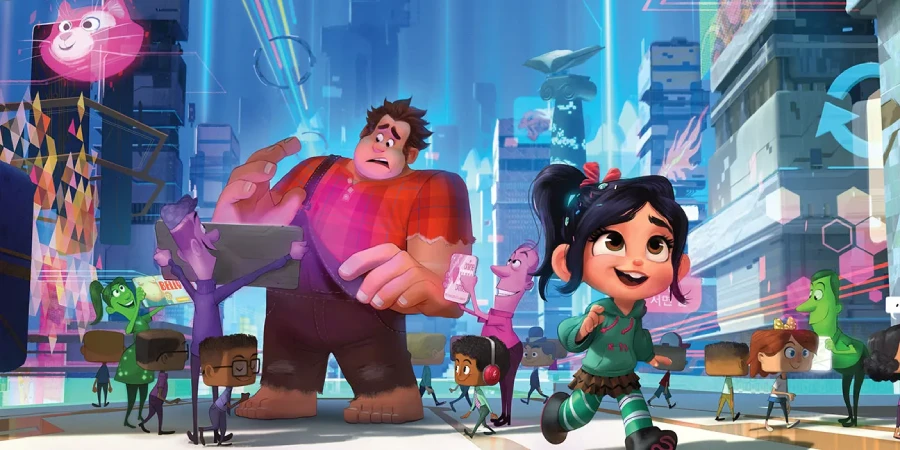

Disney’s Ralph Breaks the Internet (2018) expands the world introduced in Wreck-It Ralph (2012), taking audiences from the warm, nostalgic world of arcade machines into the chaotic, endlessly interconnected universe of the internet.
Detailed Summary
Ralph and Vanellope’s Comfortable Routine
Ralph and Vanellope von Schweetz have settled into a peaceful friendship. Every night after the arcade closes, they hang out, joke around, and enjoy life. But while Ralph is perfectly happy with this routine, Vanellope feels restless. She wants something new, something unpredictable, something beyond Sugar Rush’s limited tracks.
This early contrast between them plants the narrative’s emotional core: What happens when best friends want different things?
The Accident That Starts It All
Trying to cheer up Vanellope, Ralph builds a secret bonus track in Sugar Rush. But things go sideways—players fighting over the controls cause the arcade machine’s wheel to break. Worse, the manufacturer no longer makes replacements.
If they don’t get a new wheel, Sugar Rush will be unplugged.
The only place to find a replacement: eBay, accessed through the arcade’s brand-new Wi-Fi router.
Entering the Internet
Ralph and Vanellope step into the internet, visualized as a sprawling metropolis filled with websites, pop-up ads, trending hubs, influencers, and search engines. Disney’s world-building shines here; the internet feels chaotic yet coherent.
They find the Sugar Rush steering wheel on eBay, but misunderstanding how auctions work, they accidentally bid $27,001.
Now they need to find a way to earn actual money online.
BuzzTube, Slaughter Race, and Diverging Dreams
To pay off their eBay debt, Ralph becomes an online phenomenon with the help of Yesss, the algorithmic head of BuzzTube. His goofy videos go viral, earning likes he can convert into cash.
Meanwhile, Vanellope discovers Slaughter Race, an open-world racing game full of surprises, danger, and infinite possibilities. She immediately falls in love with it—and with the idea of living a life far beyond her predictable arcade existence.
This is where the emotional tension spikes: Ralph wants to keep things the same. Vanellope wants to grow.
Ralph’s Insecurity and the Virus
Fearing he’s losing Vanellope, Ralph makes a devastating mistake: he goes to the Dark Web and buys a virus designed to slow down Slaughter Race, hoping it will convince her the game isn’t safe.
But the virus doesn’t just slow things—it copies Vanellope’s glitch (her insecurities). That infection spreads across the entire internet, spiraling out of control.
Ralph’s neediness, manifested in millions of monstrous Ralph clones, threatens to literally destroy the whole digital world.
This is the emotional climax: Ralph must confront the consequences of clinging too tightly to someone he loves.
Movie Ending
The virus-generated Ralph clones combine into a massive, terrifying Ralph-kaiju, representing Ralph’s unhealthy dependence on Vanellope. He finally apologizes, admitting he feared losing her. The giant Ralph monster, powered by insecurity, only calms once Ralph acknowledges his flaws and lets Vanellope make her own choices.
Vanellope, touched by his honesty, forgives him.
Vanellope chooses to leave the arcade and permanently move to Slaughter Race, becoming part of its chaotic racing crew. Ralph returns to the arcade without her, beginning a more independent life.
But their friendship doesn’t end:
- They FaceTime across networks.
- They share stories about their new lives.
- Ralph learns to be proud of Vanellope’s independence rather than afraid of it.
The emotional takeaway is clear:
Real friendship doesn’t fade when people grow apart. It evolves.
And this ending is surprisingly mature for a kids’ movie, tackling themes of insecurity, self-worth, and the bittersweet reality of change.
Are There Post-Credits Scenes?
Yes—two notable ones:
- Mid-credits scene: A baby Moana scene used in early trailers but cut from the film, reinserted as a comedic “meta” gag.
- End-credits scene: A joke scene where Ralph “Rickrolls” the audience with Never Gonna Give You Up.
These are humorous bonus moments rather than story continuations.
Type of Movie
The film is an animated adventure–comedy with strong emotional themes about friendship and personal growth. It blends heartfelt storytelling with clever, satirical world-building of the internet.
Cast
- John C. Reilly – Ralph
- Sarah Silverman – Vanellope von Schweetz
- Gal Gadot – Shank
- Taraji P. Henson – Yesss
- Jack McBrayer – Felix
- Jane Lynch – Calhoun
- Alan Tudyk – KnowsMore
Film Music and Composer
The score was composed by Henry Jackman, who returned from the first film. The soundtrack includes the emotional spotlight song “A Place Called Slaughter Race” performed by Vanellope and Shank, a playful parody of Disney’s princess ballads but also an earnest character moment.
Filming Locations
As an animated movie, Ralph Breaks the Internet wasn’t filmed on physical sets. However, production took place primarily at Walt Disney Animation Studios in Burbank, California.
The importance of this “location” lies in the immense technical effort:
- The internet city required one of Disney’s largest digital environments ever.
- Slaughter Race alone needed more assets than most entire Disney features.
- Animators collaborated with real tech companies (eBay, Pinterest, Google, etc.) to authentically portray their platforms.
Awards and Nominations
- Oscar Nomination – Best Animated Feature
- Golden Globe Nomination – Best Animated Feature
- Annie Award Nominations – Including Character Animation, Production Design, and Voice Acting
The movie was acclaimed for its emotional depth and its creative portrayal of the internet.
Behind the Scenes Insights
- The Disney Princess sequence required approval from every princess’s original voice actress and creative team.
- Most of the original Disney princess voice actors returned to reprise their roles.
- The design of the internet city took inspiration from real-world megacities like Tokyo and New York.
- Slaughter Race is partly inspired by Grand Theft Auto aesthetics but softened for a Disney audience.
- Gal Gadot personally shaped Shank’s personality with the directors, wanting her to feel both tough and warm.
- Hundreds of custom websites and avatars were created, many only visible for a few frames.
Inspirations and References
- Loosely inspired by the evolution of online culture from 2012–2018
- Slaughter Race references open-world games (GTA, Need for Speed)
- BuzzTube blends YouTube and BuzzFeed influence
- The film’s emotional arc echoes real-life stories of childhood friends growing apart as they find new passions
Alternate Endings and Deleted Scenes
Several deleted concepts include:
- An earlier version where Vanellope temporarily returns to Sugar Rush before making her final decision
- A plotline where Ralph gets trapped in a “clickbait factory” for an extended sequence
- Additional scenes in the Dark Web that were cut for pacing and tone
- A more dramatic final fight that was replaced with the metaphorical Ralph-kaiju version for emotional clarity
No fully animated alternate ending exists, but script drafts indicated darker consequences for Ralph’s actions before the final tone was chosen.
Book Adaptations and Differences
The film is not based on a specific book but has junior novels and graphic storybooks. These adaptations:
- Simplify the virus storyline
- Shorten Slaughter Race sequences
- Reduce the emotional tension to make it more child-friendly
Memorable Scenes and Quotes
Key Scenes
- Ralph and Vanellope’s dramatic auction scene at eBay
- The first chaotic race in Slaughter Race
- The Disney Princess meeting, an instant fan favorite
- Ralph going to the Dark Web
- The Ralph-kaiju climax and emotional reconciliation
- Vanellope’s “A Place Called Slaughter Race” song
Iconic Quotes
- “There’s no law saying best friends have to have the same dreams.”
- “I’m a bad guy, but I’m not a bad guy.”
- “It’s called the dark net. Not the naptime net.”
- “Just because it’s new doesn’t mean it’s bad.”
Easter Eggs and Hidden Details
- Dozens of hidden Disney characters appear as background internet avatars.
- Stan Lee makes a cameo in the Oh My Disney section.
- The “Deep Web” visual design subtly mirrors the original Tron.
- A storefront advertises “Luxo Mops,” referencing Pixar’s Luxo lamp.
- The eBay item numbers often encode jokes from Disney animators.
Trivia
- Over 500,000 individual crowd characters were created for internet scenes.
- Ralph’s viral videos reference real YouTube trends.
- The princess room scene required more simulation work than some entire Disney films.
Why Watch?
Because it’s a clever, emotionally grounded sequel that respects its characters while expanding its universe boldly. The film mixes humor, satire, heartfelt themes, and visually inventive world-building. And its portrayal of friendship evolving with personal growth is one of Disney’s most mature messages.
Director’s Other Movies
- Zootopia (2016)
- Wreck-It Ralph (2012)
- Zootopia 2 (2025)