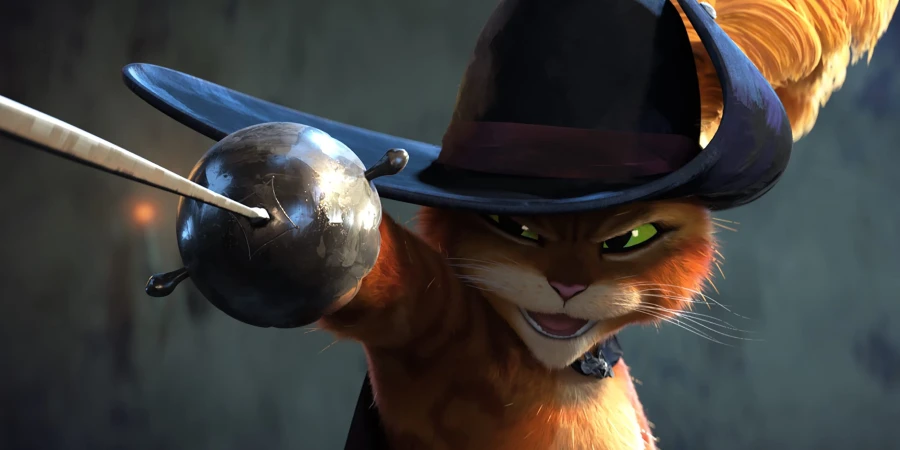

Puss in Boots: The Last Wish (2022) is one of those rare sequels that not only surpasses the original but also introduces deeper themes, stunning animation styles, and surprisingly emotional storytelling.
Detailed Summary
Puss’s Legendary Life Count Drops… Hard
The film begins with Puss in Boots soaking in the glory of being a fearless, swashbuckling hero. But when he dies (again) during a battle with a giant monster, the doctor informs him that he has used eight of his nine lives. This revelation shakes him. For the first time, Puss fears death.
This fear becomes literal when the Wolf appears—later revealed to be Death himself—warning Puss that his final life makes him vulnerable. The intensity of these scenes marks a significant tonal shift for a DreamWorks film.
The Last Wish Quest Begins
Hiding in Mama Luna’s cat-filled home, Puss is found by Perrito, a naive but cheerful therapy-dog-in-disguise. After learning about the Wishing Star—a magical MacGuffin capable of granting any wish—Puss decides to reclaim his lost lives.
However, other parties are chasing the same wish:
- Kitty Softpaws, Puss’s former partner and almost-fiancée
- Goldilocks and the Three Bears Crime Family
- Jack Horner, now a magic-obsessed mob boss
Each faction wants the wish for personal reasons, which leads to a high-stakes, multi-team chase.
Trust, the Trio, and Confronting Fear
As Puss, Kitty, and Perrito journey together, Puss’s ego begins cracking. There’s tension between Puss and Kitty due to past betrayal, and flashbacks reveal Puss’s difficulty with vulnerability.
Goldilocks’s loving bear family reveals its own emotional subplot: Goldi wishes for a “real family,” despite already having a loyal one.
The Wolf Closes In
The Wolf stalks Puss throughout the journey with chilling whistles and the promise of confronting him at the end. These scenes make it clear that the film uses Death not as a villain, but as an inevitable truth Puss must accept—a surprisingly mature narrative for an animated adventure.
Movie Ending
The climax takes place at the Wishing Star, where all groups clash in a chaotic, beautifully animated battle.
The Big Twist: Puss Doesn’t Use the Wish
When Puss finally touches the map leading to the wish, he is confronted again by the Wolf. This time, instead of fleeing, Puss chooses to fight.
The battle is symbolic: Puss accepting that life is valuable precisely because it is limited. He decides:
- He does not want the wish anymore.
- He wants to live his one remaining life to the fullest.
This shift in mindset is what finally satisfies Death. The Wolf tells Puss he will not kill him… for now. He’ll see him again someday, and that natural inevitability is enough.
Goldilocks Chooses Her Real Family
During the chaos, Baby Bear almost dies. Goldilocks realizes the family she already has is her real family and relinquishes her wish.
Jack Horner’s End
In comic villain fashion, Jack Horner is defeated by the fairy tale creatures he tried to exploit, ending up in a karmically appropriate demise.
Puss and Kitty’s Relationship
Now humble and honest, Puss admits why he ran from Kitty before:
He was afraid of settling down and being vulnerable.
This time, Kitty gives him another chance—no proposals yet, but a genuine fresh start.
The Final Journey
The film ends with Puss, Kitty, and Perrito sailing off together. Their destination is subtly revealed:
They are headed to Far Far Away—a nostalgic connection to the Shrek universe, teasing future appearances.
Are There Post-Credits Scenes?
There is no traditional post-credits scene. However, the final shot of the film (before credits) already acts as a teaser by showing Puss sailing toward Far Far Away.
Type of Movie
The film is a stylized fantasy adventure-comedy with heartfelt themes and a surprisingly mature psychological core. It blends action, humor, and emotional depth in a unique animated format.
Cast
- Antonio Banderas as Puss in Boots
- Salma Hayek Pinault as Kitty Softpaws
- Harvey Guillén as Perrito
- Wagner Moura as The Wolf (Death)
- Florence Pugh as Goldilocks
- Olivia Colman as Mama Bear
- Ray Winstone as Papa Bear
- Samson Kayo as Baby Bear
- John Mulaney as Jack Horner
Film Music and Composer
The score was composed by Heitor Pereira, blending flamenco, orchestral action cues, and emotional character themes. The soundtrack enhances the film’s mix of stylish action and heartfelt moments, with “Fearless Hero” becoming the standout musical motif symbolizing Puss’s inner struggle.

Filming Locations
This is a fully animated film, so there are no physical filming locations.
However, the visual style of the movie was highly influenced by:
- European fairy tale architecture
- Spanish Golden Age art
- Painted textures inspired by Spider-Man: Into the Spider-Verse
The painted, brushstroke-style action sequences give the movie its distinct look.
Awards and Nominations
The film was widely praised and received multiple major nominations, including:
- Academy Award Nomination: Best Animated Feature
- Golden Globe Nomination: Best Animated Feature
- Annie Awards: Multiple Wins & Nominations (animation industry’s top awards)
Critics frequently cited its animation, emotional depth, and thematic sophistication.
Behind the Scenes Insights
- The Wolf was originally envisioned as a traditional bounty hunter, but the team realized making him Death personified would elevate the story.
- Antonio Banderas recorded many of his emotional scenes multiple times to find the right balance of vulnerability for Puss.
- The animation team blended 2D hand-painted effects with 3D models to create the stylized look.
- Perrito’s character was initially much more comedic, but the team rewrote him as an emotional grounding force for Puss’s arc.
- Florence Pugh recorded Goldilocks’s lines while filming other projects, often between action scenes.
Inspirations and References
- The movie continues from DreamWorks’ Shrek universe, drawing heavily on fairy tales and nursery stories.
- Puss’s introspection and fear of death references classic Westerns and samurai films where aging heroes face mortality.
- The “Wishing Star” concept mirrors classic fables like Pinocchio and folklore about wish-granting cosmic forces.
- The Wolf’s dual-sickle design was inspired by Grim Reaper iconography.
Alternate Endings and Deleted Scenes
- An alternate ending had Puss actually using the wish to restore his lives, but this was scrapped early because it undermined the film’s core message.
- A deleted comedic subplot involved Perrito being temporarily adopted by the Bear family.
- Early scripts included more scenes showing Puss’s eight past deaths, but they were trimmed to avoid pacing issues.
Book Adaptations and Differences
The film is not a direct adaptation of a book, but the character Puss in Boots originates from classic European fairy tales.
Compared to traditional lore:
- This version of Puss is much more heroic and adventurous.
- The story heavily expands the character’s emotional depth and mythology.
Memorable Scenes and Quotes
Key Scenes
- Puss facing the Wolf for the first time, realizing he is truly afraid.
- The map-changing sequences that alter the landscape based on who holds it.
- Goldilocks discovering what family really means during the Wishing Star collapse.
- Puss’s final confrontation with Death.
- Puss choosing to live his last life authentically.
Iconic Quotes
- “I am Puss… in Boots!”
- “Fear… me, if you dare.” (The Wolf/Death)
- “You’re not afraid of anything. I’m just here for the end of your story.”
- “I only ever had one life… but I am enough.”
- “We’re more than a team. We’re a family, ain’t we?”
Easter Eggs and Hidden Details
- The map’s environments reflect the personality of the holder—symbolic of each character’s inner world.
- A Shrek silhouette and Far Far Away cameo appear briefly on wanted posters.
- Jack Horner’s collection includes classic magical artifacts from Shrek and other fairy tales.
- The Wolf whistles the tune associated with the Grim Reaper in old folklore.
Trivia
- The Wolf’s animation was deliberately less stylized than other characters to make him more unsettling.
- Perrito’s name means “little dog” in Spanish.
- This is the first DreamWorks film to use the new stylized action animation inspired by comic-book aesthetics.
- The film went viral for its surprisingly mature themes, sparking online analyses comparing Puss to existential literary heroes.
Why Watch?
Because it’s not “just a kids’ movie.” It’s a beautifully animated action-adventure that blends humor, emotional storytelling, and artistic creativity.
If you enjoy films that combine heart, style, and smart writing, this movie is worth every minute.
Director’s Other Movies
- The Croods: A New Age (2020)
- Various DreamWorks projects in story departments