
Purple Rain is not just a movie; it is a feature-length music video that doubles as a cultural coronation. This semi-autobiographical film cemented Prince as a global superstar. Ultimately, it captures his electrifying stage presence and tortured artistic soul in a whirlwind of neon, lace, and emotional turmoil.
Detailed Summary
Introducing The Kid
We meet The Kid, a prodigiously talented but arrogant musician leading his band, The Revolution, at Minneapolis’s famed First Avenue nightclub. His performances are magnetic, drawing huge crowds. However, he is locked in a fierce rivalry with Morris Day and his band, The Time, who consistently upstage him with their flashy, crowd-pleasing funk.
The Kid’s genius is shadowed by his ego. He is emotionally withdrawn and refuses to play new music written by his bandmates, Wendy and Lisa, creating tension within his own group.
Apollonia’s Arrival
A beautiful and ambitious newcomer named Apollonia arrives in Minneapolis. She wants to make it big as a singer. Consequently, she catches The Kid’s eye almost immediately, and he begins a whirlwind, high-stakes courtship.
He sees a kindred spirit in her ambition. Their connection is instant, a mix of genuine attraction and The Kid’s desire to mold her in his image.
A Toxic Romance
Their romance quickly sours. The Kid’s behavior becomes controlling and abusive, disturbingly mirroring the domestic violence he witnesses at home between his parents. For instance, he famously tricks Apollonia into jumping into the frigid waters of Lake Minnetonka as a bizarre form of “purification.”
This cycle of passion and cruelty defines their relationship. Apollonia is drawn to his talent but pushed away by his demons. She struggles to understand the man behind the artist.
The Revolution in Crisis
Meanwhile, tensions within The Revolution reach a breaking point. Guitarist Wendy Melvoin and keyboardist Lisa Coleman have composed a beautiful piece of music. They desperately want the band to perform it, but The Kid selfishly dismisses their work.
His refusal to collaborate threatens to tear the band apart. The club owner warns him that his act is getting stale and his spot at First Avenue is in jeopardy unless he brings something new.
Morris Day’s Scheme
Sensing an opportunity, the charismatic and manipulative Morris Day decides to form an all-female trio. He approaches Apollonia with an offer to be the lead singer of his new group, Apollonia 6. Feeling neglected and frustrated by The Kid, she accepts.
This act of professional and personal betrayal pushes The Kid further into isolation. He now sees enemies on all sides.
Hitting Rock Bottom
The Kid’s world completely unravels. After a violent confrontation, his father shoots himself in their basement home. Rushing back from the club, The Kid discovers his father wounded but alive, a traumatic event that forces a painful reckoning.
In the aftermath, he finds a box of his father’s old musical compositions, realizing his father was a failed musician just like he feared becoming. This discovery, coupled with Apollonia’s departure and the club’s ultimatum, leaves him utterly broken.
Movie Ending
At his final make-or-break performance at First Avenue, The Kid has a change of heart. Instead of another self-indulgent song, he introduces a new piece as “something from Wendy and Lisa.” He then launches into a soul-stirring performance of the song “Purple Rain,” dedicating it to his father.
This performance is his moment of catharsis and redemption. The raw emotion pours out of him, winning over the audience, his bandmates, and a tearful Apollonia, who watches from the crowd. After his breathtaking set, he performs the upbeat “I Would Die 4 U” and “Baby I’m a Star,” finally embracing a collaborative and joyful spirit.
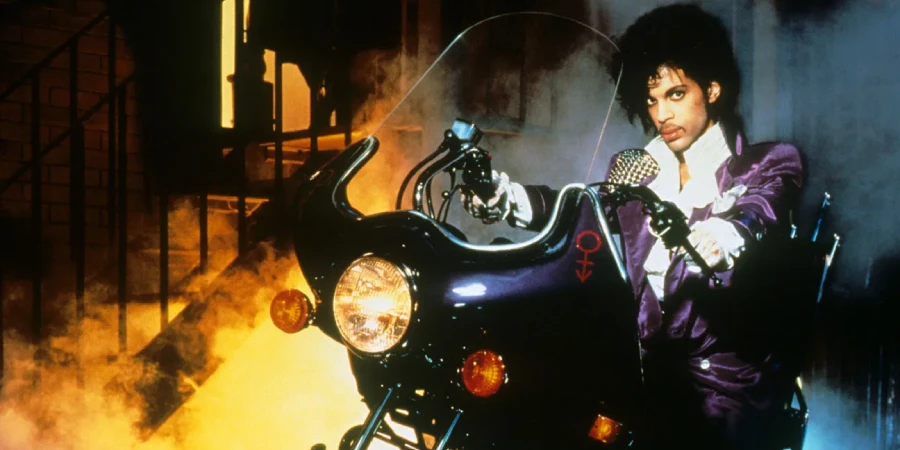
The film ends with The Kid visiting Apollonia, where they reconcile with a kiss. He is then seen riding his motorcycle through the Minnesota countryside, a rare smile on his face. This signifies that he has confronted his demons and found a path toward healing and hope.
Are There Post-Credits Scenes?
There are no post-credits scenes in Purple Rain. Once the credits begin to roll, the film is officially over, leaving audiences with the final, powerful chords of its soundtrack.
Type of Movie
Purple Rain is a rock musical drama. It merges the structure of a classic Hollywood narrative with the energy of a concert film. The tone is deeply dramatic and angsty, filled with emotional conflict and psychological turmoil. In contrast, the musical sequences are explosive, vibrant, and celebratory, creating a unique cinematic experience.
Cast
- Prince – The Kid
- Apollonia Kotero – Apollonia
- Morris Day – Morris
- Olga Karlatos – Mother
- Clarence Williams III – Father (Francis L.)
- Jerome Benton – Jerome
- Wendy Melvoin – Wendy
- Lisa Coleman – Lisa
Film Music and Composer
The music of Purple Rain is not a traditional score but the legendary album of the same name by Prince and The Revolution. Prince composed, arranged, and produced nearly the entire soundtrack himself. This album functions as both the score and the source music, driving the narrative forward with each track.
Iconic songs like “Let’s Go Crazy,” “When Doves Cry,” “The Beautiful Ones,” and the titular “Purple Rain” are central to the plot. Notably, “When Doves Cry” was a last-minute addition that director Albert Magnoli felt was needed to accompany a key montage sequence.

Filming Locations
The film was shot almost exclusively on location in Minneapolis, Minnesota and its surrounding suburbs. This decision was crucial for authenticity, grounding the story in the real-life music scene that Prince helped build. The most famous location is the First Avenue nightclub in downtown Minneapolis, where all the concert sequences were filmed.
Other locations include the Henderson, Minnesota house used for The Kid’s family home. The infamous lake scene, despite the dialogue mentioning Lake Minnetonka, was actually filmed at the Minnesota River near Henderson.
Awards and Nominations
Purple Rain achieved significant critical acclaim for its music. The film won the Academy Award for Best Original Song Score in 1985, a category that no longer exists today. In addition, the soundtrack album won two Grammy Awards and has sold over 25 million copies worldwide, making it one of the best-selling albums of all time.
Behind the Scenes Insights
- Director Albert Magnoli got the directing job after Prince was impressed with his student film. He also helped shape the final story and co-edited the film.
- The powerful live performances of “I Would Die 4 U,” “Baby I’m a Star,” and “Purple Rain” were recorded live on August 3, 1983, at a benefit concert at First Avenue. It was also Wendy Melvoin’s debut performance with The Revolution.
- Apollonia Kotero suffered from hypothermia after jumping into the frigid river for the “purification” scene. Prince reportedly jumped in after her to help warm her up between takes.
- The original script, titled Dreams, was much darker and more sexually explicit. It was heavily rewritten by William Blinn and Magnoli to focus more on the music and secure an R rating.
Inspirations and References
Purple Rain is a semi-autobiographical work heavily inspired by Prince’s own life. The character of The Kid reflects Prince’s public persona and personal struggles. Key elements, such as his mixed-race heritage, a difficult relationship with his musician father, and his meteoric rise in the Minneapolis music scene, are all drawn directly from his experiences.
The film essentially fictionalizes Prince’s journey, exaggerating certain dramatic elements for cinematic effect while remaining true to his artistic and emotional core.
Alternate Endings and Deleted Scenes
Several scenes were cut from the final film to improve pacing and tone down some of the darker content. One significant deleted storyline involved The Kid’s mother leaving his father after a particularly violent argument, adding another layer to his sense of abandonment.
Another cut scene showed Morris Day’s full scheme to create Apollonia 6, including him firing the original lead singer, Brenda. There was no drastically different alternate ending filmed; the story’s conclusion was set from early in the production.
Book Adaptations and Differences
Purple Rain is an original screenplay written by Albert Magnoli and William Blinn. It is not based on a pre-existing book or any other source material outside of the life and music of Prince himself.
Memorable Scenes and Quotes
Key Scenes
- Opening Performance: The film opens with a sermon-like monologue before launching into an explosive performance of “Let’s Go Crazy,” perfectly establishing the film’s quasi-religious and concert-like atmosphere.
- Lake Minnetonka: The Kid tells Apollonia she must “purify” herself in the waters of Lake Minnetonka. Her subsequent jump into the cold water and his cruel laughter crystallize their toxic dynamic.
- “When Doves Cry” Montage: A powerful sequence cutting between The Kid’s passionate performance, his memories of his parents fighting, and his turbulent romance with Apollonia.
- The Final Concert: The Kid’s emotional performance of “Purple Rain” serves as the film’s climax, a moment of pure artistic and personal redemption that remains one of cinema’s greatest musical moments.
Iconic Quotes
- “You have to purify yourself in the waters of Lake Minnetonka.”
- “That ain’t Lake Minnetonka.”
- “Let’s go crazy!”
- “I’m not your father.”
- “I would die 4 you.”
Easter Eggs and Hidden Details
- The untitled symbol that Prince would officially adopt as his name in 1993 appears multiple times in the film, including on his motorcycle gas tank and as an earring.
- Inside the glove box in The Kid’s room are hand puppets. These symbolize the emotional manipulation he endures from his parents and later inflicts upon Apollonia.
- On his dressing room mirror, The Kid has a picture of himself as a child, hinting at the unresolved trauma that drives his adult behavior.
- During one scene, Morris Day looks at himself in a pocket mirror that has “Morris” etched on one side and “The Time” on the other, perfectly summarizing his vanity.
Trivia
- Vanity, the leader of the girl group Vanity 6, was originally cast as the female lead. She left the project shortly before filming began, leading to the creation of the character Apollonia.
- Clarence Williams III, who played Prince’s father, was only 19 years older than Prince.
- “When Doves Cry” famously lacks a bass line. Prince reportedly removed it at the last minute because he felt it was too conventional.
- The film’s budget was a modest $7.2 million, but it went on to gross nearly $70 million at the U.S. box office, proving to be a massive commercial success.
Why Watch?
Watch Purple Rain to witness a cultural icon at the peak of his power. It’s a raw, electrifying, and unabashedly dramatic portrait of artistic genius and personal pain, all powered by one of the greatest soundtracks ever recorded.
Director’s Other Movies
- American Anthem (1986)
- Tango & Cash (1989)
- Street Knight (1993)
Recommended Films for Fans
- Sign o’ the Times (1987)
- 8 Mile (2002)
- A Star Is Born (2018)
- The Harder They Come (1972)