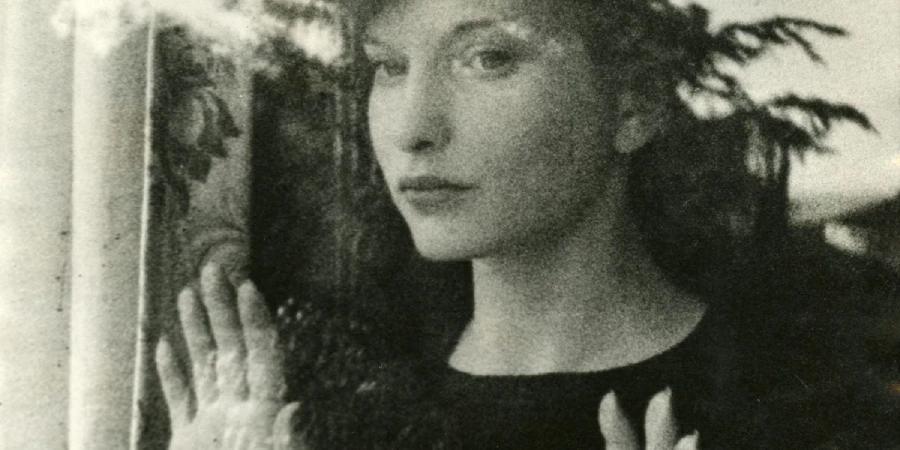

Meshes of the Afternoon is a landmark experimental short film that reshaped how cinema could express psychology, dreams, and identity. Created on a shoestring budget yet endlessly analyzed to this day, the film is less about plot and more about feeling, symbols, and repetition. If you’ve ever wondered how cinema learned to speak the language of dreams, this is where the conversation starts.
Detailed Summary
A Woman, a Key, and the Beginning of the Loop
The film opens with a woman (played by Maya Deren herself) walking down a quiet suburban street. She notices a cloaked figure with a mirror for a face, drops a flower, and enters her home. Already, the rules of reality feel unstable. Objects take on symbolic weight: a key, a knife, a record player, and a telephone become recurring motifs rather than simple props.
Dreams Within Dreams
Once inside the house, the woman falls asleep and the narrative fractures. We begin to see multiple versions of the same woman, interacting with each other as if different aspects of her psyche have split apart. Time loops back on itself. Actions repeat with small variations. The cloaked mirror-faced figure appears again and again, always unreachable, always watching.
The film suggests not a linear dream, but a recursive nightmare, where each attempt to understand or escape only deepens the confusion.
Identity and Self-Confrontation
As the dream intensifies, the woman chases the mirror-faced figure through the house. Each failed attempt leads to another repetition of events. The knife, once a threat, becomes a tool. The key, once promising access or understanding, leads nowhere. These cycles suggest inner conflict, repression, and the impossibility of a single, stable identity.
The presence of a man (Alexander Hammid) complicates things further. He appears alternately as comforting, threatening, distant, and intimate—never fixed, never reliable.


Movie Ending
The ending of Meshes of the Afternoon is one of the most discussed in experimental cinema, and for good reason.
In the final sequence, the woman awakens once more and encounters the man sitting calmly in the house. This time, the tension feels heavier, more resolved. She picks up the knife and approaches him. What follows is ambiguous but deeply unsettling: she attacks the man, and the scene cuts to shattered glass where his face should be. The mirror imagery suggests not murder in a literal sense, but the destruction of an identity or projection.
The film then cuts to a final image: the woman’s body lying on a rocky shoreline, waves washing over her. This shot implies death, but whether it is literal suicide, psychological collapse, or symbolic rebirth is left deliberately unclear.
The key questions the ending raises are:
- Did the dream cause the death, or did the death cause the dream?
- Is the man real, or merely a fragment of the woman’s mind?
- Is the final image an escape from the loop, or its ultimate conclusion?
The film offers no definitive answers, forcing the viewer to sit with uncertainty. That discomfort is very much the point.
Are There Post-Credits Scenes?
No. Meshes of the Afternoon ends abruptly and definitively with its final image. There are no post-credits or hidden scenes, in keeping with its minimalist and uncompromising artistic approach.
Type of Movie
Meshes of the Afternoon is an experimental, avant-garde psychological film that blends surrealism, dream logic, and symbolic imagery. Rather than telling a story, it explores states of mind and inner experience.
Cast
- Maya Deren as The Woman
- Alexander Hammid as The Man
Film Music and Composer
The original 1943 version was silent. In 1959, a musical score was added by Teiji Ito, Maya Deren’s later husband. The music uses dissonant strings and rhythmic patterns that heighten the dreamlike, ritualistic atmosphere of the film.


Filming Locations
The film was shot almost entirely in Maya Deren and Alexander Hammid’s home in Los Angeles and nearby outdoor locations.
The importance of these locations lies in their ordinariness. By transforming a normal domestic space into a psychological maze, the film suggests that inner terror and confusion can exist anywhere—even in familiar surroundings.
Awards and Nominations
At the time of its release, the film did not receive traditional awards, as experimental cinema was rarely recognized. However, it later won the Grand Prix International for Experimental Film at the Cannes Film Festival (1947), cementing its legacy.
Behind the Scenes Insights
- The film was made with an extremely low budget, using borrowed equipment.
- Maya Deren performed many physically demanding shots herself.
- The multiple “selves” were created through careful editing rather than special effects.
- Deren strongly opposed commercial filmmaking and rejected Hollywood norms.
- The film was shot over several months, allowing ideas to evolve organically.
Inspirations and References
- Surrealist art and cinema, particularly Luis Buñuel
- Sigmund Freud’s theories on dreams and the unconscious
- Ritual and mythology, which became central to Deren’s later work
- Experimental dance and movement, influencing the film’s physicality
Alternate Endings and Deleted Scenes
There are no known alternate endings or deleted scenes. The film exists very much as Deren intended it. Any ambiguity comes from interpretation, not missing material.
Book Adaptations and Differences
The film is not based on a book. However, Maya Deren later wrote extensively about the film in essays, particularly in An Anagram of Ideas on Art, Form and Film, where she clarified that the film should be read emotionally rather than literally.


Memorable Scenes and Quotes
Key Scenes
- The first appearance of the mirror-faced figure
- The multiplication of the woman into three versions of herself
- The knife transforming from object to symbol
- The final shoreline image
Iconic Quotes
The film contains no dialogue, which is itself iconic. Its silence forces viewers to engage visually and psychologically rather than verbally.
Easter Eggs and Hidden Details
- The flower transforms into a knife, linking beauty and violence.
- The mirror face reflects the viewer, implicating them in the dream.
- Repeated stair shots subtly change angles, signaling shifts in mental state.
- The record player looping mirrors the narrative loop.
Trivia
- The film is frequently taught in film schools worldwide.
- David Lynch has cited it as a major influence.
- Maya Deren funded much of the film herself.
- The runtime is only 14 minutes, yet it has generated decades of academic analysis.
Why Watch?
If you’re interested in how cinema can express inner reality, Meshes of the Afternoon is essential viewing. It’s short, intense, and endlessly interpretable. You don’t watch it once—you revisit it, each time noticing something new.
Director’s Other Works
- At Land (1944)
- A Study in Choreography for Camera (1945)
- Ritual in Transfigured Time (1946)
- Meditation on Violence (1948)
Recommended Films for Fans
- Un Chien Andalou (1929)
- Eraserhead (1977)
- Persona (1966)
- Last Year at Marienbad (1961)
- The Lighthouse (2019)