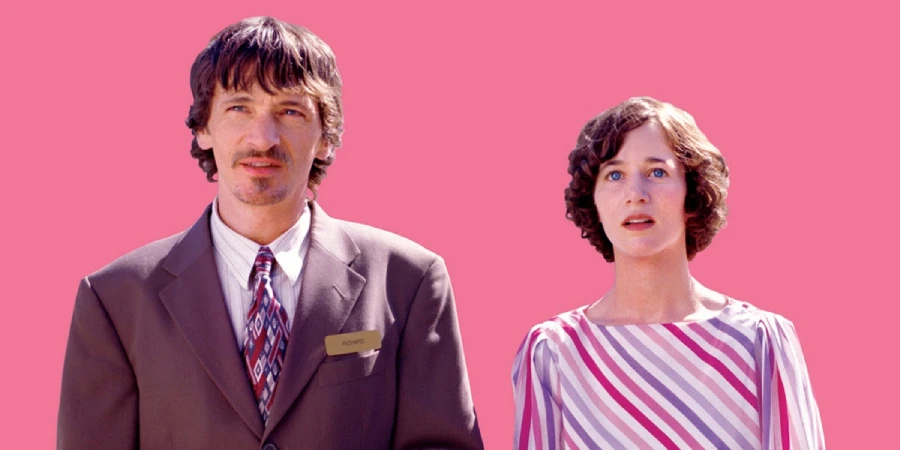

Me and You and Everyone We Know (2005), written and directed by Miranda July, is a quietly eccentric indie drama-comedy about loneliness, connection, art, childhood, and the fragile ways people try to reach each other. It’s tender, bizarre, funny, and emotionally raw—exactly the kind of film that stays with you because it feels too real and too strange at the same time.
Detailed Summary
The Intersecting Lives
Me and You and Everyone We Know follows a group of lonely, odd, hopeful characters whose lives interconnect in unexpected ways. At the center are Christine Jesperson (Miranda July), a performance artist driving elderly people for a living, and Richard Swersey (John Hawkes), a recently divorced shoe salesman trying to navigate single fatherhood. Their awkward yet sincere early interactions set the tone of the film: strange, tender, and deeply human.
Christine & Richard’s Delicate Beginning
Christine becomes fascinated with Richard after a brief encounter at his store. Richard, still reeling from his breakup, struggles to accept her quirky openness. Their early conversations, loaded with subtext and hesitation, become some of the film’s most emotionally layered moments, showing two people trying desperately to express connection in a world that feels increasingly disconnected.
The Swersey Boys’ Online Adventure
Richard’s sons, Peter and Robby, enter a bizarre online chat with an adult who doesn’t know she’s talking to two minors. These scenes, though darkly comedic, explore the film’s recurring theme: people searching for intimacy in misguided ways. Robby’s innocent invention of the now-iconic typed symbol “><(((*>” becomes a surprisingly poetic moment of misunderstanding and vulnerability.
The Neighborhood Girls and Their Dangerous Experiment
Two teenage girls test boundaries by leaving sexually suggestive messages for neighborhood men. Their storyline captures the unsettling mix of curiosity, risk, and emotional naivety—a recurring element in the film’s exploration of how people stumble toward connection.
Christine’s Art & Identity
Throughout the film, Christine struggles to be taken seriously as an artist. Her attempts to pitch her video work and her eventual acceptance into a museum program reveal the fragile yet triumphant side of her character. She is constantly performing versions of herself—emotionally, creatively, and literally.
Movie Ending
The film’s ending brings its scattered characters into quiet emotional resolution. After a series of awkward and tender interactions, Christine and Richard finally allow themselves to connect honestly. Their last walk together—simple, understated, and hopeful—acts as the culmination of the entire film’s emotional arc: two lonely people deciding to step toward each other despite discomfort and fear.
At the same time, the subplot involving Richard’s sons concludes with surprising gentleness. The woman behind the explicit online chat realizes she has been talking to a child and, instead of reacting with horror or aggression, offers a moment of empathetic acknowledgment. It’s an unsettling yet strangely warm conclusion, one that reflects the film’s belief that humans reach out in imperfect ways, often without malice.
The movie ends on a note of quiet optimism. No one is fully “fixed,” but everyone is seen, and for a film centered on longing, that is its true emotional resolution.
Are There Post-Credits Scenes?
No. There is no post-credits scene in Me and You and Everyone We Know. The narrative ends before the credits begin.
Type of Movie
The film is best described as a quirky indie dramedy with strong elements of romance, absurdist humor, and deep emotional realism. Its tone is uniquely delicate—funny, strange, and quietly devastating.
Cast
- Miranda July as Christine Jesperson
- John Hawkes as Richard Swersey
- Miles Thompson as Peter
- Brandon Ratcliff as Robby
- Carlie Westerman as Sylvie
- Jordan Potter, Natasha Slayton, and others in supporting roles
Film Music and Composer
The soundtrack features a mix of experimental indie music, digital textures, and minimalist electronic sounds. The score was composed by Michael Andrews, known for his atmospheric and emotionally resonant compositions (including Donnie Darko).
Filming Locations
The film was primarily shot in Los Angeles County, especially in suburban areas such as Altadena and Pasadena.
These locations contribute to the film’s aesthetic: ordinary, sunlit, slightly lonely spaces that perfectly mirror the emotional isolation and understated yearning of the characters.
Awards and Nominations
The film received significant acclaim, including:
- Caméra d’Or Winner at the Cannes Film Festival
- Special Jury Prize at Sundance
- Several Independent Spirit Award nominations
Behind the Scenes Insights
- Miranda July not only directed and wrote the film, she also starred in it—balancing all three roles in her debut feature.
- July encouraged improvisation, allowing actors—especially the children—to develop scenes organically.
- John Hawkes initially thought he wasn’t “quirky enough” for the tone of the film, but July said his grounded presence was essential.
- Many of the online chat sequences were filmed with the actors typing live, adding authenticity.
Inspirations and References
- Inspired partly by Miranda July’s own performance art and short stories.
- Influenced by the 1990s American indie cinema wave, especially films exploring loneliness and community.
- Thematically echoes Raymond Carver’s short stories and Hal Hartley’s early films.
Alternate Endings and Deleted Scenes
The released film largely matches the director’s original vision. July has noted that some extended character moments were trimmed for pacing, particularly scenes involving Sylvie’s “hope chest” and Christine’s early art performances, but no alternate endings were produced.
Book Adaptations and Differences
The film is not based on a book. However, July later published short stories with similar themes of alienation and connection, creating an unofficial thematic universe that resonates with the film.
Memorable Scenes and Quotes
Key Scenes
- Christine and Richard’s painfully awkward car ride.
- The boys’ online chat scene with the adult stranger—darkly comedic but iconic.
- Christine presenting her video art to museum curators.
- The final walk between Richard and Christine, quiet but emotionally loaded.
Iconic Quotes
- “The future isn’t written yet, but I’m getting good at guessing.”
- “Sometimes you have to be brave enough to show someone how fragile you are.”
- “You think you deserve that pain, but you don’t.”
Easter Eggs and Hidden Details
- Christine’s video-art themes parallel the emotional journeys of the characters.
- The recurring motif of windows symbolizes emotional distance—characters observe others more than they interact.
- The typed symbol “><(((*>” has been interpreted by fans as a metaphor for misguided attempts at intimacy.
Trivia
- Miranda July personally cast several non-actors to maintain a naturalistic tone.
- The film’s title is taken from one of July’s early performance pieces.
- The “poop chat” sequence became a viral meme many years after the film released.
Why Watch?
Because it’s a gentle, odd, and moving film about real human connection. If you appreciate stories where awkwardness, longing, and humor blend into something genuinely heartfelt, this is a rare experience. The film manages to feel intimate without being sentimental, and its emotional honesty is unforgettable.
Director’s Other Works (Movies)
- The Future (2011)
- Kajillionaire (2020)