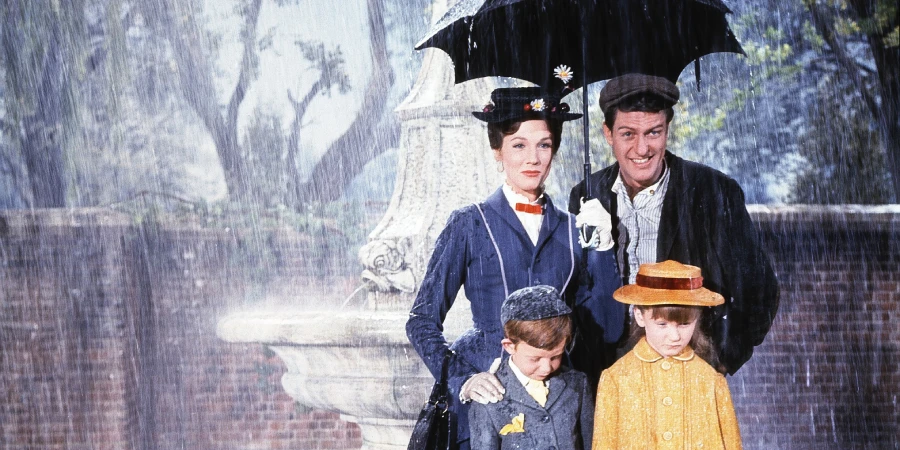

Mary Poppins (1964) is one of Disney’s most iconic and beloved films, blending live action with animation, unforgettable music, and a gentle but powerful emotional core. Though often remembered as a cheerful children’s film, it also offers sharp commentary on family, work, and imagination.
Detailed Summary
A Perfectly Unusual Arrival
The story begins in Edwardian London, where the Banks family struggles with disorder and emotional distance. George Banks is rigid, career-focused, and obsessed with order, while his children, Jane and Michael, constantly chase adventure. When their previous nannies quit, the children write their own advertisement asking for a nanny who is kind and fun. George tears it up and throws it into the fireplace, but the pieces magically reassemble and float away.
Soon after, Mary Poppins descends from the sky using her umbrella and arrives at 17 Cherry Tree Lane. From the start, she presents herself as “practically perfect in every way” and quickly establishes control, though always with a mysterious smile that suggests magic is at work.
Magic Hidden in Plain Sight
Mary introduces the children to a world where ordinary objects behave in extraordinary ways. Her bottomless carpet bag, the famous finger snap that tidies the nursery, and her talking mirror reveal that she operates under her own magical rules. Importantly, she insists that nothing unusual is happening, reinforcing the film’s theme that magic exists for those willing to believe.
Bert and the World Beyond Reality
Mary’s friend Bert, a jack-of-all-trades artist, chimney sweep, and musician, becomes the children’s guide into fantasy worlds. One of the film’s most memorable sequences takes place when Mary, Bert, and the children jump into one of Bert’s sidewalk chalk drawings, entering an animated countryside filled with dancing penguins, carousel horses, and musical numbers.
This sequence showcases Disney’s technical innovation and emphasizes the film’s belief that imagination can literally change one’s surroundings.
Lessons Disguised as Songs
Mary’s teachings are subtle. Through songs like “A Spoonful of Sugar” and “Supercalifragilisticexpialidocious,” she reframes responsibility as something joyful rather than restrictive. Meanwhile, “Feed the Birds” introduces a quiet, emotional counterpoint, urging compassion and generosity in a world increasingly driven by money and routine.
Confronting the Adult World
The story shifts tone when the children visit Mr. Banks’ workplace, a cold and impersonal bank. The children’s innocent desire to feed the birds instead of investing their money leads to chaos, triggering a bank run and threatening George Banks’ career. This moment forces the adults to confront how disconnected their values are from genuine happiness.
Movie Ending
The final act of Mary Poppins brings emotional resolution rather than grand spectacle. After the bank incident, George Banks is fired, and for the first time, he confronts the emptiness of a life built solely on rules and financial success. Instead of anger, he experiences clarity.
George returns home transformed. He repairs his children’s kite, laughs freely, and sings as he walks through London. This moment marks a complete emotional shift: he finally understands that being a good father matters more than being a perfect employee.
The family goes to the park together, flying the kite as a united and joyful group. This simple act represents the restoration of balance between responsibility and imagination.
As harmony is restored, Mary Poppins quietly prepares to leave. She explains that when families no longer need her, it is time for her to move on. She departs just as she arrived, floating into the sky, leaving behind a changed household. Bert watches her go, confirming that although Mary claims she’ll never return, she always knows exactly where she’s needed.
The ending fully resolves the emotional arcs while preserving Mary’s mystery, reinforcing that her magic lies not in spells, but in transformation.
Are There Post-Credits Scenes?
No. Mary Poppins (1964) does not feature a post-credits or mid-credits scene. The film ends traditionally, consistent with the cinematic style of its era.
Type of Movie
Mary Poppins is a musical fantasy film that blends family drama, comedy, and magical realism. While aimed at children, its emotional depth and social commentary resonate strongly with adult audiences.
Cast
- Julie Andrews as Mary Poppins
- Dick Van Dyke as Bert / Mr. Dawes Sr.
- David Tomlinson as George Banks
- Glynis Johns as Winifred Banks
- Karen Dotrice as Jane Banks
- Matthew Garber as Michael Banks
Film Music and Composer
The music was composed by Richard M. Sherman and Robert B. Sherman, whose work became legendary. Songs like “Chim Chim Cher-ee,” “A Spoonful of Sugar,” and “Feed the Birds” are deeply woven into the narrative, advancing character development rather than serving as simple interludes. “Chim Chim Cher-ee” won the Academy Award for Best Original Song.
Filming Locations
Most of the film was shot on sound stages at Walt Disney Studios in Burbank, California. This controlled environment allowed Disney to seamlessly blend live action with animation. London itself is a stylized recreation rather than a realistic one, emphasizing the film’s fairy-tale tone rather than historical accuracy.
Awards and Nominations
- Won 5 Academy Awards, including:
- Best Actress (Julie Andrews)
- Best Original Song
- Best Original Score
- Best Film Editing
- Best Visual Effects
- Nominated for 13 Academy Awards, including Best Picture
Behind the Scenes Insights
- Julie Andrews’ performance made her an instant global star.
- Walt Disney spent over 20 years persuading author P.L. Travers to allow the adaptation.
- Dick Van Dyke later admitted his British accent is considered one of the worst in cinema history.
- P.L. Travers reportedly disliked many creative choices, especially the animated sequences.
Inspirations and References
The film is based on the Mary Poppins book series by P.L. Travers, drawing inspiration from British folklore, nanny archetypes, and moral fables centered on childhood development and family values.
Alternate Endings and Deleted Scenes
Several darker and more emotionally stern scenes faithful to Travers’ books were written but never filmed. Disney deliberately softened Mary’s personality and removed moments where she was more distant and severe, opting for warmth and charm instead.
Book Adaptations and Differences
The movie significantly alters Mary Poppins’ character. In the books, she is far stricter, less affectionate, and more mysterious. The film also emphasizes redemption for Mr. Banks, while the books are more episodic and less focused on long-term character arcs.
Memorable Scenes and Quotes
Key Scenes
- Mary Poppins’ arrival during the windstorm
- The animated chalk-painting sequence
- The chimney sweep rooftop dance
- George Banks fixing the kite
Iconic Quotes
- “Practically perfect in every way.”
- “In every job that must be done, there is an element of fun.”
- “Feed the birds, tuppence a bag.”
Easter Eggs and Hidden Details
- Mary never directly admits to using magic, maintaining plausible deniability.
- Bert breaks the fourth wall during the animated sequence.
- The bank’s rigid architecture visually contrasts with the open, playful park scenes.
Trivia
- Julie Andrews won her Oscar the same year she was passed over for My Fair Lady.
- The film pioneered complex live-action and animation integration.
- Walt Disney considered this film his crowning achievement.
Why Watch?
Mary Poppins remains timeless because it speaks to both children and adults, reminding viewers that imagination, kindness, and emotional presence matter just as much as success and discipline.
Director’s Other Works (Movies)
- Bedknobs and Broomsticks (1971) – Robert Stevenson
- Old Yeller (1957)
- The Love Bug (1968)
Recommended Films for Fans
- The Sound of Music (1965)
- Chitty Chitty Bang Bang (1968)
- Bedknobs and Broomsticks (1971)
- Mary Poppins Returns (2018)