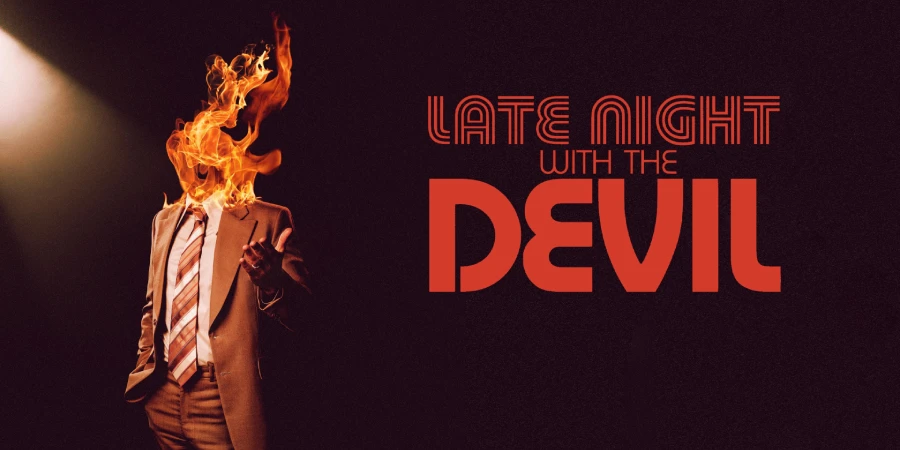

Late Night with the Devil is one of those rare horror films that feels fresh, retro, and deeply unsettling all at once. Disguised as a lost television broadcast from the 1970s, the movie slowly transforms from an odd late-night talk show curiosity into a full-blown descent into supernatural chaos.
Detailed Summary
The Rise of Jack Delroy
The film is presented as a recovered master tape of a 1977 Halloween episode of Night Owls, a late-night talk show hosted by Jack Delroy (David Dastmalchian). Jack is a charismatic but desperate TV host whose ratings have stalled. His motivation to push boundaries is fueled by personal tragedy and professional insecurity.
Intercut documentary-style black-and-white segments reveal Jack’s career history, his ambition, and the devastating illness and death of his wife. These segments subtly suggest that Jack’s success may have come at a moral or supernatural cost.
The Halloween Special Setup
To boost ratings, Jack plans a controversial Halloween broadcast focused on the occult. His guests include:
- A psychic medium who claims to channel spirits
- A skeptic magician whose job is to debunk paranormal claims
- A parapsychologist promoting her new book
- A young girl named Lily, the sole survivor of a satanic cult mass suicide
From the beginning, the atmosphere feels off. Technical glitches, strange noises, and audience reactions hint that something is already wrong.
Live Television Meets the Occult
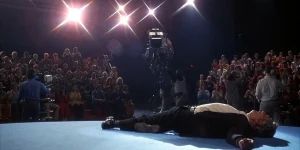
As the show progresses, the psychic appears to genuinely channel something horrifying and dies live on air. The skeptic grows increasingly shaken, and Lily begins displaying disturbing behavioral changes. The parapsychologist insists Lily is possessed by a demon named Abraxas.
Jack, obsessed with ratings and maintaining control, continues the show despite mounting danger. His refusal to stop becomes one of the film’s most disturbing elements.
The Demon Reveals Itself
The final act escalates rapidly. Lily becomes fully possessed, lights fail, the audience panics, and reality itself seems to fracture. Jack is forced to confront visions from his past, including his wife’s death and suggestions that he may have made a Faustian bargain to advance his career.
The film abandons subtlety here, plunging fully into surreal horror.
Movie Ending
The ending reveals that Jack Delroy has been complicit all along.
During the demonic climax, Jack is shown disturbing hallucinations that strongly imply he participated in a secret occult group earlier in his career. This group may have granted him fame in exchange for a future sacrifice. That sacrifice appears to be his wife, whose illness and death are no longer presented as random tragedy.
As Abraxas takes full control of Lily, the demon confronts Jack directly, exposing his selfishness, ambition, and guilt. Jack is given a choice: accept responsibility or continue lying to himself.
In a horrifying final moment, Jack is handed a ceremonial dagger and, in front of the live audience and cameras, kills Lily while under demonic influence. The broadcast abruptly cuts to black.
The implication is devastating:
- Jack’s ambition has led to the death of an innocent child
- The demon has successfully completed its ritual
- The audience and viewers at home were unwilling participants
The final shot suggests that evil has been broadcast into millions of homes, turning entertainment into a mass occult ritual. Jack survives physically, but spiritually and morally, he is utterly destroyed.
Are There Post-Credits Scenes?
No. Late Night with the Devil does not include any post-credits or mid-credits scenes. The abrupt ending is intentional, leaving viewers to sit with the horror rather than offering relief or explanation.
Type of Movie
Late Night with the Devil is a supernatural horror film that blends found-footage aesthetics with psychological horror and satirical commentary on media, fame, and exploitation. It uses minimal gore but delivers sustained dread through implication and atmosphere.
Cast
- David Dastmalchian as Jack Delroy
- Laura Gordon as Dr. June Ross-Mitchell
- Ian Bliss as Carmichael the skeptic
- Ingrid Torelli as Lily
- Fayssal Bazzi as Christou
Film Music and Composer
The score was composed by Roscoe James Irwin, using analog synths and period-accurate instrumentation to recreate the sound of 1970s television. The music is subtle, often blending into background noise, which makes its sudden swells more disturbing.
Filming Locations
The film was shot primarily in Melbourne, Australia, on soundstages designed to replicate a 1970s TV studio.
These locations are crucial because:
- The confined studio space increases claustrophobia
- The artificiality of the set contrasts with the very real horror unfolding
- The lack of exterior locations reinforces the feeling of being trapped in a broadcast
Awards and Nominations
- Nominated for Best Feature Film at Sitges Film Festival
- Winner of Best Actor (David Dastmalchian) at several genre festivals
- Multiple nominations for Best Horror Film in 2023 indie awards circuits
Behind the Scenes Insights
- David Dastmalchian improvised several monologues to maintain realism
- The live audience reactions were partially unscripted
- The directors insisted on practical effects whenever possible
- The film was shot in chronological order to help actors track the descent into chaos
Inspirations and References
- Network (1976) – media obsession and live broadcast danger
- The Exorcist (1973) – possession themes
- 1970s talk shows like The Tonight Show Starring Johnny Carson
- Real-world satanic panic television programs
Alternate Endings and Deleted Scenes
- An alternate ending showed Jack arrested after the broadcast, which was removed for being too explanatory
- A longer cult backstory sequence was cut to preserve ambiguity
- Deleted scenes explored Lily’s life before the cult, but were deemed too sympathetic and distracting
Book Adaptations and Differences
The film is not based on a book, but its faux-documentary structure mimics true-crime and investigative nonfiction, intentionally blurring fiction and reality.
Memorable Scenes and Quotes
Key Scenes
- The psychic collapsing live on air
- Lily calmly explaining the demon’s rules
- Jack’s hallucination of his wife backstage
- The final ritual performed during commercial break
Iconic Quotes
- “Television doesn’t lie. People do.”
- “You invited me.”
- “This is live. We can’t stop.”
Easter Eggs and Hidden Details
- The demon’s symbol appears subtly on Jack’s cue cards
- Background static occasionally forms occult shapes
- The opening documentary includes dates matching real occult scandals
- Camera malfunctions coincide with ritual phases
Trivia
- The entire movie is under 95 minutes
- The talk show set was built from scratch
- No CGI was used for the possession effects
- The film was shot in less than one month
Why Watch?
Watch Late Night with the Devil if you enjoy slow-burn horror, media satire, and films that trust the audience to connect disturbing dots. It’s proof that horror doesn’t need massive budgets—just smart ideas and commitment to atmosphere.
Director’s Other Works
- Scare Campaign (2016)
- 100 Bloody Acres (2012)
Recommended Films for Fans
- Network (1976)
- The Exorcist (1973)
- Broadcast Signal Intrusion (2021)
- Ghostwatch (1992)
- The Wicker Man (1973)
- Creep (2014)