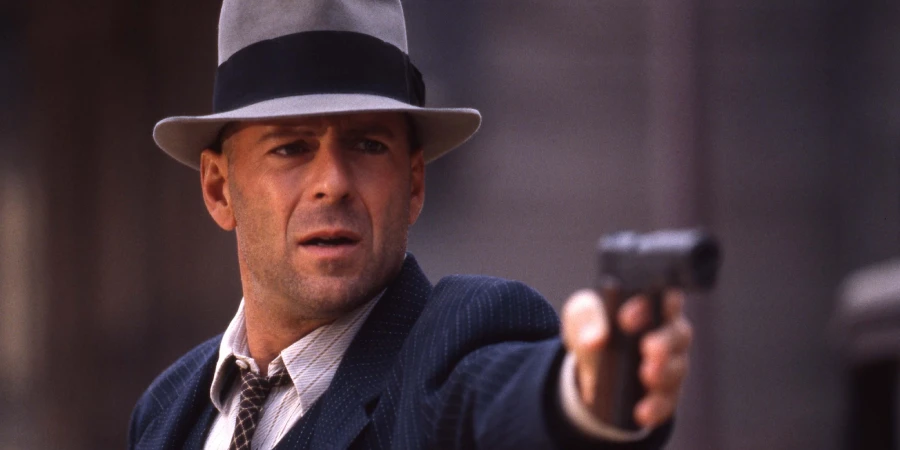
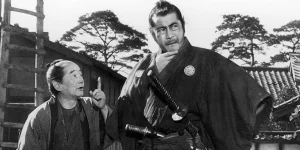
Directed by the stylish action filmmaker Walter Hill, Last Man Standing (1996) is a gritty crime western disguised as a 1930s gangster movie. Starring Bruce Willis, the film blends the lone-gunslinger archetype with Prohibition-era mob warfare. If the story feels familiar, that’s because it’s a modern reinterpretation of Yojimbo (1961) by Akira Kurosawa.
Detailed Summary
A Stranger Arrives in Jericho
The film opens in the dusty Texas border town of Jericho during the Prohibition era. The town is practically dead—economically and morally. Two rival gangs run everything: the Irish mob led by Doyle and the Italian mob run by Strozzi.
Into this bleak setting drives John Smith (Bruce Willis), a quiet drifter with a mysterious past and an even more mysterious moral compass. Smith quickly realizes the town is divided between these two violent factions, and he sees an opportunity: play both sides against each other and profit from the chaos.
Playing Both Sides
Smith begins working for one gang while secretly feeding information to the other. His cold efficiency with guns quickly makes him valuable to both factions.
The Doyle gang hires him first, impressed by his brutal efficiency. But Smith secretly starts dealing with the Italian mob as well, selling information and manipulating events to escalate the war between the two sides.
As the violence escalates, Jericho becomes a battlefield. Shootouts erupt in the streets, and the fragile balance between the gangs begins to collapse.
The Captive Woman and a Flicker of Conscience
Amid the carnage, Smith meets Felina, a woman kept hostage by the Doyle gang. She is essentially being used as leverage against her lover, one of the Strozzi gang members.
Smith’s relationship with Felina reveals that beneath his ruthless exterior, he still has some sense of morality. He secretly helps her escape Jericho, risking the delicate manipulation he’s orchestrating.
This act hints that Smith is not just motivated by money—he also wants to settle some personal demons.
The Gangs Discover the Truth
Eventually the Italian mob realizes Smith has been playing them. They capture him and torture him brutally for information.
Smith refuses to talk, enduring a savage beating that nearly kills him. The gang assumes he’s dead and dumps him outside town.
But Jericho’s local undertaker and doctor secretly nurse him back to health. Once he recovers, Smith prepares to finish what he started.
Movie Ending
The final act becomes a violent showdown in the ghost-like streets of Jericho.
Smith returns to town heavily armed and begins systematically eliminating members of both gangs. His plan has finally reached its endgame: destroy both criminal empires completely.
He first targets the Strozzi gang. In a series of brutal gunfights, Smith wipes them out, using his quick draw and strategic positioning to outgun multiple attackers.
After eliminating the Italians, Smith turns his attention to Doyle and the remaining Irish gang members. One of the most intense shootouts in the film takes place in the town’s main street, where Smith faces Doyle’s men head-on.
The battle culminates in a confrontation between Smith and Doyle himself. Smith kills Doyle after a tense standoff, ending the reign of the Irish mob.
With both gangs destroyed, Jericho is finally free from the violent grip of organized crime.
But Smith doesn’t stay.
He quietly gets back in his car and drives away from Jericho, leaving behind a town littered with the consequences of his actions. The sheriff and the undertaker watch him leave, realizing the mysterious drifter has brought brutal justice—but also unimaginable destruction.
The ending reinforces the film’s central theme: John Smith is not a hero, but a force that restores balance through violence. Once the job is done, he moves on, just like the classic western gunslingers who inspired the character.
Are There Post-Credits Scenes?
No. Last Man Standing does not include any mid-credits or post-credits scenes. Once the credits begin, the story is finished.
Type of Movie
Last Man Standing is essentially a neo-western action crime film set during the Prohibition era. It blends gangster drama with classic samurai and western storytelling structures.
Cast
- Bruce Willis – John Smith
- Christopher Walken – Hickey
- Bruce Dern – Sheriff Ed Galt
- David Patrick Kelly – Doyle
- Ned Eisenberg – Matteo Strozzi
- Karina Lombard – Felina
Film Music and Composer
The score was composed by Ry Cooder. His soundtrack uses blues-influenced guitar and minimalist instrumentation, giving the movie a dusty, lonely atmosphere that perfectly fits Jericho’s desolate environment.
Filming Locations
The movie was primarily filmed in:
- Texas (set inspiration and desert landscapes)
- California studio backlots
A large portion of Jericho was built as a custom western-style town set. The emptiness of the location was intentional—it emphasizes the film’s theme of a dying town consumed by crime and decay.
Awards and Nominations
The film did not win major awards and received mixed reviews at release. However, critics frequently praised:
- Bruce Willis’ minimalist performance
- The stylized gunfights
- Walter Hill’s visual direction
Over time, it has gained a modest cult following among neo-western fans.
Behind the Scenes Insights
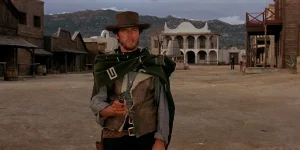
- The movie is an unofficial remake of Yojimbo and its western remake A Fistful of Dollars (1964).
- Director Walter Hill intentionally minimized dialogue to create a classic gunslinger feel.
- Bruce Willis’ narration was recorded late in production to clarify the story.
- The gunfights were choreographed to resemble western quick-draw duels rather than modern shootouts.
- Christopher Walken’s character Hickey was expanded during filming because the director liked his performance.
Inspirations and References
The film draws inspiration from several sources:
- Yojimbo (1961)
- A Fistful of Dollars (1964)
- classic American westerns
- samurai lone-warrior storytelling
The central idea—a lone warrior manipulating rival gangs—comes directly from Kurosawa’s original story.
Alternate Endings and Deleted Scenes
Several scenes were removed from the final cut:
- A longer torture sequence showing Smith’s captivity
- Additional scenes exploring Felina’s backstory
- Extra dialogue between Doyle and Hickey about their criminal empire
There was no confirmed alternate ending, but early drafts included a more explicit explanation of Smith’s past.
Book Adaptations and Differences
The movie is not based on a novel but on the Japanese film Yojimbo.
Major differences include:
- Setting moved from feudal Japan to Prohibition-era Texas
- Samurai replaced with gangsters and bootleggers
- The protagonist uses guns rather than swords
Memorable Scenes and Quotes
Key Scenes
- Smith’s first shootout in Jericho, establishing his deadly accuracy
- The tense meeting with both gangs where Smith manipulates them simultaneously
- Smith’s brutal torture scene after his deception is discovered
- The final street shootout against Doyle’s gang
Iconic Quotes
- “I don’t make trouble. Trouble finds me.” — John Smith
- “This town deserves better than you.” — Sheriff Ed Galt
- “You should’ve stayed dead.” — Hickey
Easter Eggs and Hidden Details
- The film mirrors many scenes from Yojimbo, including the final duel structure.
- Smith’s trench coat visually resembles classic western gunslinger dusters.
- Jericho’s layout is intentionally designed like a western frontier town, despite the 1930s setting.
- The name “Jericho” symbolizes a city destined to fall.
Trivia
- Bruce Willis speaks relatively little dialogue throughout the film.
- The film contains over 30 on-screen gun deaths.
- Walter Hill originally wanted the movie to be even darker and more violent.
- The narration style was inspired by classic film noir detective stories.
Why Watch?
Last Man Standing is worth watching if you enjoy stylized violence, anti-hero protagonists, and western storytelling structures. The film’s appeal lies in its simplicity: one man, two gangs, and a town doomed by greed. Bruce Willis delivers a cool, understated performance that feels like a gunslinger wandering through a gangster world.
Director’s Other Movies
Films directed by Walter Hill:
- The Warriors (1979)
- 48 Hrs. (1982)
- Streets of Fire (1984)
- Red Heat (1988)
- Geronimo: An American Legend (1993)
Recommended Films for Fans
If you enjoyed Last Man Standing, these films share similar themes or style: