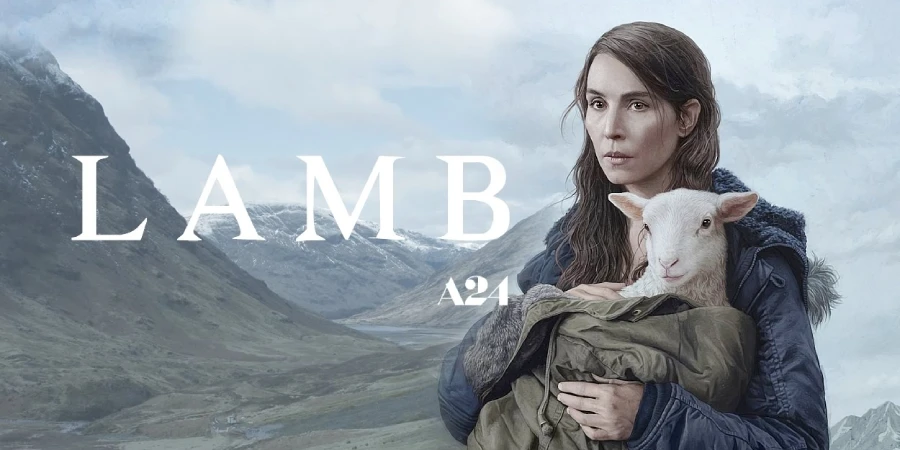

Grief makes people do strange things. In the haunting Icelandic folk tale Lamb, however, it drives a grieving couple to steal a child from nature itself. Consequently, they learn that nature always collects its debts. This slow-burn horror film explores the boundaries of parenthood and the terrifying cost of defying the natural order.
Detailed Summary
The entire, unsettling story of Lamb unfolds in a remote Icelandic valley, where every quiet moment is filled with dread. The plot follows a small cast of characters as they navigate an impossible situation, ultimately leading to a tragic conclusion.
The Mysterious Birth
The film opens on Christmas Eve. An unseen, heavy-breathing entity moves through a blizzard towards a sheep farm. Inside the barn, it frightens the animals. Months later, a childless couple, María and Ingvar, are tending to their flock during lambing season. One ewe gives birth to something shocking: a hybrid creature with the body of a human baby girl and the head of a lamb. Interestingly, instead of being horrified, the couple sees an opportunity. They take the newborn, name her Ada, and decide to raise her as their own daughter. In doing so, they sever the lamb-child from her biological sheep mother, who waits plaintively outside their window every day.
Raising Ada
María and Ingvar create a bizarre yet loving family unit. They dress Ada in human clothes, teach her to walk, and treat her with immense affection. This newfound happiness, however, is a fragile bubble. The couple is clearly filling a void left by a previous tragedy, which is later revealed to be the death of their first daughter, also named Ada. Meanwhile, the persistent bleating of Ada’s sheep mother outside the farmhouse serves as a constant, unnerving reminder of their transgression. Eventually, María grows tired of the animal’s grief and, in a cold and calculated moment, shoots her dead. She then buries the sheep in an unmarked grave, seemingly erasing the last link to Ada’s origins.
Pétur’s Arrival
The couple’s isolated world is soon disrupted by the arrival of Ingvar’s troubled brother, Pétur. He is immediately appalled by the situation, calling Ada an “animal.” Pétur represents the outside world’s judgment. As a result, his presence introduces a new layer of tension into the household. He sees the arrangement as unnatural and perverse, constantly challenging Ingvar and María’s delusion. Nonetheless, they ignore his protests, determined to protect their strange family dynamic at any cost.
Confrontation and Acceptance
One night, Pétur finds Ada sleepwalking and takes her out into the wilderness with a rifle, presumably to kill her. At the last moment, however, he cannot go through with it. He returns her safely to the house. Following this event, Pétur’s attitude shifts towards a reluctant acceptance, and he begins to integrate himself into their routine. The family of three, occasionally four, finds a strange rhythm. Yet, this fragile peace is merely the calm before the storm, setting the stage for the film’s devastating climax.


Movie Ending
The ending of Lamb is abrupt, brutal, and unforgettable. One morning, Ingvar heads out into the fields with Ada to fix a tractor. While Ada wanders off, a massive, horned creature suddenly appears. This being is a Ram-Man hybrid, presumably Ada’s biological father and the entity from the film’s opening scene. Without a word, the Ram-Man picks up Pétur’s discarded rifle, shoots Ingvar in the neck, and kills him. He then gently takes Ada by the hand. Ada, looking back at her dying human father, goes with her biological father without resistance. The two walk off into the Icelandic wilderness together, disappearing from sight.
María eventually wakes up and finds Ingvar bleeding out in the field. As he dies in her arms, she is left completely alone, stripped of both her husband and her surrogate child. María is forced to confront the consequence of her actions: she stole a child from nature, and in return, nature violently reclaimed its own and took her human family as well. The bleak final shot shows María standing alone in the vast, empty landscape, a portrait of absolute loss. The Ram-Man, therefore, acts as a force of natural justice, a mythological being restoring a broken balance.
Are There Post-Credits Scenes?
No, Lamb does not have any mid-credits or post-credits scenes. Once the credits begin to roll, the film is officially over.
Type of Movie
Lamb is best classified as a folk horror film. In addition, it blends elements of supernatural drama and dark fairy tale. The film rejects jump scares in favor of a slow-building, atmospheric dread. Its tone is melancholic, unsettling, and deeply surreal. Ultimately, the horror stems not from gore, but from the psychological weight of grief, denial, and the terrifying implications of the characters’ choices.
Cast
- Noomi Rapace – María
- Hilmir Snær Guðnason – Ingvar
- Björn Hlynur Haraldsson – Pétur
- Ingvar Eggert Sigurðsson – Man on TV (voice)
Film Music and Composer
The score for Lamb was composed by Þórarinn Guðnason, who is the brother of the acclaimed composer Hildur Guðnadóttir (Joker, Chernobyl). The music is minimalist and highly atmospheric. It often uses spare, ambient sounds and haunting string arrangements to amplify the sense of isolation and creeping dread. Rather than driving the narrative, the score works subtly in the background, therefore enhancing the film’s eerie and melancholic tone.

Filming Locations
Lamb was filmed entirely in a remote, picturesque part of northern Iceland. Director Valdimar Jóhannsson chose a specific valley that was difficult to access, which consequently heightened the actors’ sense of isolation. This setting is crucial to the story. The vast, beautiful, yet unforgiving landscape becomes a character in itself, symbolizing the immense and indifferent power of nature that María and Ingvar foolishly believe they can control.
Awards and Nominations
Lamb received significant critical acclaim, especially on the festival circuit. Its most notable award was the Prize of Originality in the Un Certain Regard section at the 2021 Cannes Film Festival. In addition, the film was Iceland’s official submission for Best International Feature Film at the 94th Academy Awards.
Behind the Scenes Insights
- To create Ada, the production team used a combination of puppets, CGI, and ten different child actors, often compositing their performances together.
- Actress Noomi Rapace spent time on a real Icelandic farm to prepare for the role. She learned to drive a tractor and even helped deliver newborn lambs.
- Director Valdimar Jóhannsson grew up on a sheep farm, so the setting and lifestyle depicted in the film were deeply personal and authentic to his own experiences.
- The film’s sparse dialogue was intentional. The filmmakers wanted the story to be told primarily through visuals and the actors’ physical performances.
Inspirations and References
The film is deeply rooted in Icelandic folklore, which is rich with tales of mythological creatures, changelings (umskaeptingur), and the often harsh relationship between humans and nature. While not a direct adaptation of any single myth, the story’s themes echo ancient cautionary tales about respecting the natural world. Furthermore, the striking design of the Ram-Man bears a visual resemblance to pagan figures and creatures like Krampus from Central European folklore, blending pastoral and demonic imagery.
Alternate Endings and Deleted Scenes
There are no known alternate endings or significant deleted scenes for Lamb. Director Valdimar Jóhannsson and co-writer Sjón had a very precise vision for their story. The final, devastating conclusion was always the intended ending, designed to leave the audience with a powerful and lingering sense of sorrow and inevitability.
Book Adaptations and Differences
Lamb is not based on a book. It is an original story conceived by director Valdimar Jóhannsson. He later developed the screenplay with acclaimed Icelandic poet and novelist Sjón, who helped flesh out the mythological and psychological themes of the narrative.
Memorable Scenes and Quotes
Key Scenes
- The Birth of Ada: The initial reveal of the hybrid creature is a masterclass in quiet shock, as the camera focuses on María and Ingvar’s bewildered yet hopeful reactions rather than the creature itself.
- María Kills the Mother Sheep: In a chillingly pragmatic moment, María executes Ada’s persistent biological mother, symbolizing her complete and brutal commitment to her delusion.
- The Final Confrontation: The appearance of the majestic and terrifying Ram-Man is the film’s climax. His silent, swift act of retribution is both horrifying and strangely righteous, providing a definitive answer to who holds the real power.
Iconic Quotes
- Ingvar: “Happiness is…” (He trails off, unable to define a concept he can only momentarily grasp.)
- Pétur: “What the hell is this?” (His blunt, horrified reaction upon first seeing Ada.)
- María: “Ada.” (Her simple declaration, claiming the creature as her own and erasing its true origin.)
Easter Eggs and Hidden Details
- Biblical Undertones: The film’s title, Lamb, and its Christmas setting evoke Christian symbolism (the Lamb of God), but the story twists these ideas into a pagan, nature-centric mythology.
- The Family Photo: A brief glimpse of a family photo shows María, Ingvar, and a young girl—the original Ada whose death haunts them and motivates their desperate actions.
- The Old Tractor: Ingvar is killed while trying to repair an old, abandoned tractor. This can be seen as a metaphor for his futile attempt to fix his broken past and control his environment.
Trivia
- The film’s original Icelandic title is Dýrið, which translates more directly to “The Animal” or “The Beast,” shifting the focus from the innocent lamb to the powerful, primal forces at play.
- The film was produced by A24, a studio renowned for its distinctive and often unconventional horror films like Hereditary and The Witch.
- Despite the heavy use of animal actors, no animals were harmed during the making of the film.
Why Watch?
Watch Lamb for its breathtaking visuals and unsettling atmosphere. It’s a bold, original piece of folk horror that trades cheap scares for profound questions about grief, motherhood, and nature’s unforgiving power. This strange, sad fairy tale will haunt you long after it ends.
Director’s Other Movies
- Lamb (2021) is Valdimar Jóhannsson’s feature directorial debut.