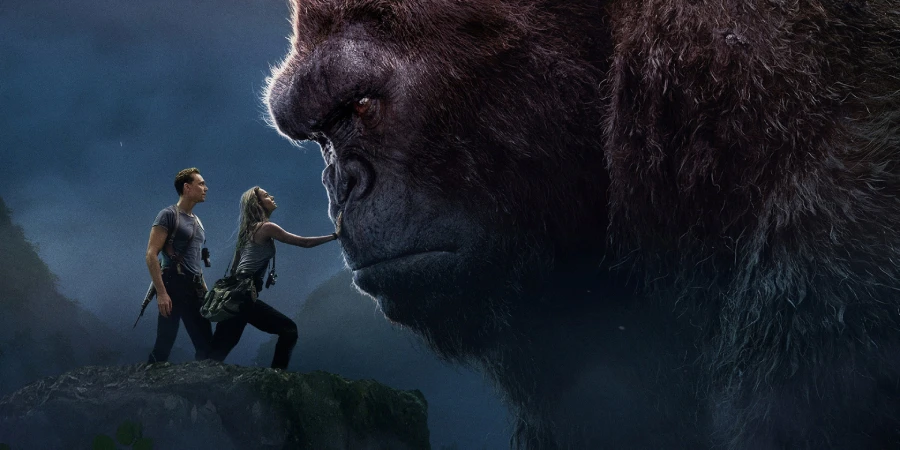

Directed by Jordan Vogt-Roberts, Kong: Skull Island reimagines the legendary giant ape within the modern MonsterVerse. Set in 1973 at the tail end of the Vietnam War, the film blends war drama aesthetics with classic creature-feature spectacle. It’s loud, explosive, occasionally philosophical—and unapologetically fun.
Detailed Summary
The Prologue: Myth Meets War
The film opens during World War II as two pilots—one American, one Japanese—crash-land on a mysterious island. Just as they prepare to kill each other, something enormous moves through the trees. The message is clear: on this island, humans are not at the top of the food chain.
Cut to 1973. As the Vietnam War winds down, government official Bill Randa (John Goodman) convinces U.S. authorities to fund a geological expedition to an uncharted island in the South Pacific. The operation is escorted by a military unit led by Lieutenant Colonel Preston Packard (Samuel L. Jackson).
Also joining the mission are former British SAS tracker James Conrad (Tom Hiddleston) and anti-war photographer Mason Weaver (Brie Larson). Their destination? Skull Island.
The Arrival: Kong’s Thunderous Introduction
The team drops seismic charges to map the island’s terrain. Instead, they wake up its king.
Kong makes his first appearance in one of the film’s most iconic sequences—emerging from a wall of fire and smoke as helicopters approach. What follows is pure chaos. Kong swats helicopters out of the sky with terrifying efficiency, killing many soldiers instantly.
This is the moment the film establishes something important: Kong is not the villain. He is defending his territory.
Divided Survivors and Rising Tensions
After the crash, the survivors split into two groups.
Packard becomes obsessed with killing Kong, blaming him for the deaths of his men. His descent into vengeance mirrors the psychological toll of war—he cannot accept defeat and needs a target.
Meanwhile, Conrad and Weaver encounter the Iwi tribe and a World War II survivor named Hank Marlow (John C. Reilly). Marlow explains the truth: Kong protects the island from underground predators known as Skullcrawlers—reptilian monsters that wiped out Kong’s ancestors.
Suddenly, the narrative shifts. Kong isn’t just a monster. He’s the last guardian of a fragile ecosystem.
The Skullcrawler Threat
The group faces multiple dangers—giant spiders, bamboo-legged creatures, and eventually the terrifying “Big One,” the largest Skullcrawler.
As Packard prepares to lure Kong into a trap using explosives, the others realize this will destabilize the island’s natural balance. The real threat isn’t Kong—it’s what happens if he dies.
Movie Ending
The final act centers on a massive showdown between Kong and the giant Skullcrawler.
Packard refuses to abandon his revenge plan and attempts to detonate explosives to kill Kong. In a tense confrontation, Conrad holds him at gunpoint and forces him to stand down. Packard’s obsession ultimately leads to his death when the Skullcrawler devours him mid-detonation.
The “Big One” emerges in full force and attacks Kong. The battle is brutal and prolonged. Kong is chained underwater at one point and nearly drowns. In a pivotal moment, Weaver revives him using a flare, symbolically reigniting hope.
Kong ultimately defeats the Skullcrawler by tearing it apart in a raw, animalistic finish that confirms his dominance. It’s not clean or heroic—it’s primal.
The surviving humans are rescued. As they leave, Kong stands alone, towering against the sunset. The final image reinforces the film’s central idea: Kong is king—not of destruction, but of balance.
Importantly, the world now knows he exists.
Are There Post-Credits Scenes?
Yes. There is a major mid-credits scene.
Conrad and Weaver are detained in a holding facility, where they’re approached by representatives of Monarch—the secret organization studying giant creatures.
They are shown cave paintings and classified footage revealing other ancient monsters. Most notably, we see references to:
- Godzilla
- King Ghidorah
- Rodan
- Mothra
The scene ends with Godzilla’s iconic roar, officially tying the film into the MonsterVerse timeline and setting up Godzilla: King of the Monsters (2019).
Type of Movie
Kong: Skull Island is a monster action-adventure film with strong war-movie influences. It blends creature-feature spectacle with themes of obsession, environmental balance, and the psychological aftermath of war.
Cast
- Tom Hiddleston as James Conrad
- Brie Larson as Mason Weaver
- Samuel L. Jackson as Lt. Col. Preston Packard
- John Goodman as Bill Randa
- John C. Reilly as Hank Marlow
- Corey Hawkins as Houston Brooks
- Toby Kebbell as Chapman
Film Music and Composer
The score was composed by Henry Jackman. It mixes orchestral tension with heavy percussion. The soundtrack also heavily features 1970s rock classics (Creedence Clearwater Revival, Black Sabbath), reinforcing the Vietnam War atmosphere.

Filming Locations
The movie was shot across several visually striking real-world locations:
- Vietnam – Many of the island landscapes were filmed here, marking one of the first major Hollywood productions to shoot in the country. The dramatic limestone cliffs and jungles add authenticity.
- Hawaii – Provided additional tropical terrain.
- Queensland – Used for jungle and water sequences.
These locations give Skull Island a grounded realism despite its fantastical creatures.
Awards and Nominations
The film was nominated for:
- Best Visual Effects at the Saturn Awards
- Various technical guild awards for sound editing and visual effects
While it wasn’t a major awards contender, it was widely praised for its cinematography and creature design.
Behind the Scenes Insights
- Director Jordan Vogt-Roberts cited Apocalypse Now as a visual inspiration.
- Samuel L. Jackson improvised several intense lines during filming.
- Kong’s size in this film (over 100 feet tall) was intentionally increased to prepare for future battles in the MonsterVerse.
- Much of the cast filmed on location in extreme heat and humidity.
- The cinematography aimed to frame Kong like a mythic war god rather than a traditional movie monster.
Inspirations and References
- The original King Kong
- Apocalypse Now
- Vietnam War photography
- Classic monster cinema of the 1950s
The film consciously avoids New York skyscraper imagery, instead redefining Kong in his natural habitat.
Alternate Endings and Deleted Scenes
There are no confirmed alternate endings, but several deleted scenes expand on:
- Hank Marlow’s emotional reunion with his family
- Additional creature encounters
- Extended military dialogue scenes
These were removed for pacing.
Memorable Scenes and Quotes
Key Scenes
- Kong’s first helicopter attack through a wall of fire
- The slow-motion shot of soldiers silhouetted against napalm explosions
- Kong drinking from the lake in quiet reflection
- The final underwater struggle with the Skullcrawler
Iconic Quotes
- “All monsters exist for a reason.” – Bill Randa
- “This is a good group of boys.” – Packard
- “That’s Kong.” – Marlow


Easter Eggs and Hidden Details
- The Monarch logo directly connects to Godzilla (2014).
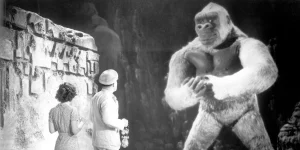
- Kong’s design subtly resembles his 1933 version in facial structure.
- The post-credits cave art foreshadows future MonsterVerse films.
- The Vietnam-era soundtrack choices mirror war-film classics deliberately.
Trivia
- Kong is significantly larger here than in Peter Jackson’s 2005 version.
- Brie Larson won her Academy Award shortly before filming began.
- This was the first major Hollywood film shot in Vietnam.
- The film grossed over $560 million worldwide.
Why Watch?
If you enjoy large-scale spectacle with surprisingly thoughtful undertones, this film delivers. It’s not just about a giant ape smashing helicopters—it’s about ego, nature, and humanity’s need to conquer what it doesn’t understand. The cinematography alone makes it worth the ride.
Director’s Other Works
- The Kings of Summer (2013)
- The Death of Stalin (2017) – actor only, but Vogt-Roberts is often confused here—his directorial focus remains limited but stylistically distinct