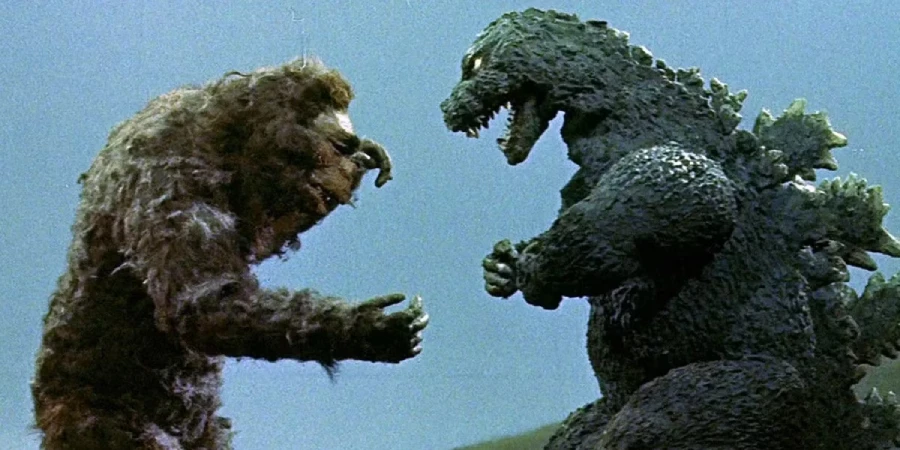

Let’s travel back to 1962, when two of cinema’s biggest monsters finally collided on screen. King Kong vs. Godzilla is one of the most iconic kaiju crossovers ever made and a landmark moment for both franchises. Produced by Toho Co., Ltd., the film brought together Japan’s radioactive titan and Hollywood’s giant ape in a spectacle that’s still debated by fans today.
Directed by Ishirō Honda, this was the third film in the Godzilla series and the first time the King of the Monsters faced another legendary creature.
Detailed Summary
Corporate Greed Sparks a Monster Problem
The film opens not with destruction, but satire. A struggling pharmaceutical company, Pacific Pharmaceuticals, is desperate for ratings and publicity. Their solution? Capture a giant monster from a remote island to use as a promotional mascot.
Meanwhile, Godzilla reawakens from an iceberg after a submarine accident in the Arctic. From the very beginning, the film positions Godzilla as an unstoppable natural force, while King Kong is introduced through human exploitation and media frenzy.
This corporate satire adds a surprisingly sharp edge to what could have been just a monster brawl.
The Discovery of King Kong
On Faro Island, explorers encounter King Kong, who is worshipped by natives and subdued with red berry juice that acts as a sedative. Kong is transported to Japan for publicity purposes, which is, obviously, a terrible idea.
During transport, Kong escapes and heads toward Tokyo. At the same time, Godzilla is already making landfall. The inevitable collision course is set.
First Clash – Power vs. Instinct
Their first battle is chaotic and relatively brief. Godzilla’s atomic breath overwhelms Kong, who appears outmatched and is rendered unconscious by the radioactive blast.
This early fight establishes an important dynamic: Godzilla has raw destructive power, while Kong relies more on physical strength and adaptability.
Japan’s Failed Countermeasures
The Japanese Self-Defense Forces attempt to stop Godzilla with electrical barriers, artillery, and traps. Nothing works. The government becomes increasingly desperate.
At one point, Kong absorbs electricity from power lines and seems empowered by it, a major departure from earlier portrayals of the character. This ability becomes crucial later.
The stage is set for the ultimate showdown.
Movie Ending
The final battle takes place at Mount Fuji. Both monsters are lured into confrontation, and what follows is a prolonged, brutal fight.
Godzilla initially dominates with atomic breath and relentless force. However, during a thunderstorm, lightning strikes King Kong repeatedly. Instead of harming him, it revitalizes and empowers him. Kong rises with renewed strength.
The two exchange heavy blows. Kong uses wrestling-style attacks, throws boulders, and grapples Godzilla directly. The choreography is more physical and grounded compared to later Godzilla films.
Eventually, the fight pushes both monsters off a cliff into the ocean below. They vanish beneath the water’s surface.
After a tense pause, only King Kong resurfaces. He swims away toward Faro Island. Godzilla does not reappear.
The film ends with reporters announcing Kong as the apparent victor, while Godzilla’s fate remains ambiguous. Importantly, Godzilla is not shown dead. Given his near-immortal status in the franchise, the implication is that he survived but retreated.
This ambiguous ending has fueled debates for decades: Did Kong truly win, or did Godzilla simply withdraw? Officially, within the narrative of this film, King Kong is the winner.
Are There Post-Credits Scenes?
No. As typical for films of the early 1960s, there are no post-credits scenes. The story concludes definitively once Kong swims away and the credits roll.
Type of Movie
King Kong vs. Godzilla is a classic kaiju film blending science fiction, monster action, and satirical comedy. It mixes large-scale destruction with surprisingly sharp commentary on media sensationalism and corporate opportunism.
Cast
- Tadao Takashima as Osamu Sakurai
- Kenji Sahara as Kazuo Fujita
- Yū Fujiki as Kinsaburo Furue
- Ichirō Arishima as Mr. Tako
- Mie Hama as Fumiko Sakurai
- Akihiko Hirata as Dr. Shigezawa
The human characters lean heavily into comedic tones, especially Mr. Tako, who embodies the film’s corporate satire.
Film Music and Composer
The score was composed by Akira Ifukube, the legendary composer behind many Godzilla themes. While the film incorporates Godzilla’s iconic motifs, Kong is given distinct musical cues to emphasize his different cinematic origin and personality.
Ifukube’s dramatic brass arrangements elevate the monster clashes, giving them operatic intensity.

Filming Locations
The movie was primarily shot in Japan at Toho Studios, with miniature city sets constructed to depict Tokyo and Mount Fuji. The Mount Fuji battle setting is especially significant because it symbolizes Japan itself — placing the climactic fight at the nation’s most iconic landmark amplifies the sense of national crisis.
The film relies heavily on suitmation (actors in monster suits) combined with elaborate miniatures, a hallmark of Toho’s kaiju productions.
Awards and Nominations
The film was a massive commercial success in Japan and became one of the highest-grossing Godzilla films of its era. While it did not dominate international award circuits, it won the Japanese Blue Ribbon Award for Special Effects, recognizing the technical craftsmanship behind the monster battles.
Behind the Scenes Insights
- The King Kong suit was widely criticized for its exaggerated, almost comical face design.
- This film marked a tonal shift toward lighter, more comedic Godzilla entries.
- The American version significantly re-edited the film, adding new scenes with U.S. actors for Western audiences.
- The production leaned into professional wrestling popularity in Japan, influencing the choreography of the final fight.
- It became the most attended Godzilla film in Japan at the time of its release.
Inspirations and References
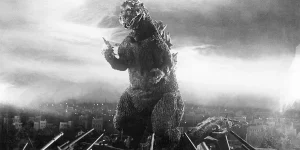
Godzilla originated in Godzilla, while King Kong first appeared in King Kong. The crossover was inspired by the popularity of monster cinema and an unrealized Hollywood concept that would have featured Kong battling Frankenstein’s monster.
The film also reflects Cold War anxieties and post-war industrial growth in Japan.
Alternate Endings and Deleted Scenes
There has long been a rumor that Japanese and American versions had different winners. This is not true. Both versions show Kong surfacing at the end.
However, the American cut includes additional newsroom scenes and altered dialogue to reshape the tone. No fully alternate ending exists, but edits changed pacing and emphasis.
Book Adaptations and Differences
The film is not directly adapted from a novel but is based on characters owned by Toho and RKO. Novelizations followed the release, though they largely mirror the film’s plot rather than expanding the lore significantly.
Memorable Scenes and Quotes
Key Scenes
- Kong being transported by balloon over Japan
- The first electrified barrier confrontation
- The Mount Fuji thunderstorm revival moment
- The cliffside plunge into the ocean
Iconic Quotes
- “This is a publicity stunt that will shake the world!”
- “Godzilla cannot be stopped by conventional weapons!”
While not particularly dialogue-driven, the film’s spectacle defines its legacy more than its lines.
Easter Eggs and Hidden Details
- Subtle reuse of miniature sets from previous Godzilla films
- Godzilla’s design slightly modified from earlier entries
- Commentary on television ratings culture embedded in Mr. Tako’s character
- Wrestling-inspired moves reflecting Japan’s sports entertainment boom
Trivia
- It was the first color Godzilla film.
- It significantly boosted Godzilla’s popularity among children.
- The suit actors performed in extremely heavy costumes under hot studio lights.
- The film played a major role in transforming Godzilla from villain to anti-hero in later entries.
Why Watch?
If you enjoy classic practical effects, cultural film history, and giant monsters throwing each other off mountains, this is essential viewing. Beyond the spectacle, the film offers a fascinating look at early 1960s media satire wrapped inside a kaiju showdown.
Director’s Other Works
Directed by Ishirō Honda:
- Godzilla (1954)
- Mothra vs. Godzilla (1964)
- Ghidorah, the Three-Headed Monster (1964)
- Destroy All Monsters (1968)
Honda was instrumental in shaping the tone and identity of early kaiju cinema.
Recommended Films for Fans
- Godzilla (1954)
- Mothra (1961)
- Ghidorah, the Three-Headed Monster (1964)
- King Kong Escapes (1967)
- Godzilla vs. Kong (2021)