
King Kong Lives is the direct sequel to the 1976 remake of King Kong. Directed by John Guillermin, the film asks a bold question: What if Kong didn’t die after falling from the World Trade Center? The answer is… surprisingly melodramatic, occasionally bizarre, and very 1980s.
Starring Linda Hamilton and Brian Kerwin, this sequel leans heavily into sci-fi romance and military thriller territory, while trying to turn the world’s most famous giant ape into an unlikely tragic hero.
Detailed Summary
Kong Survives the Fall
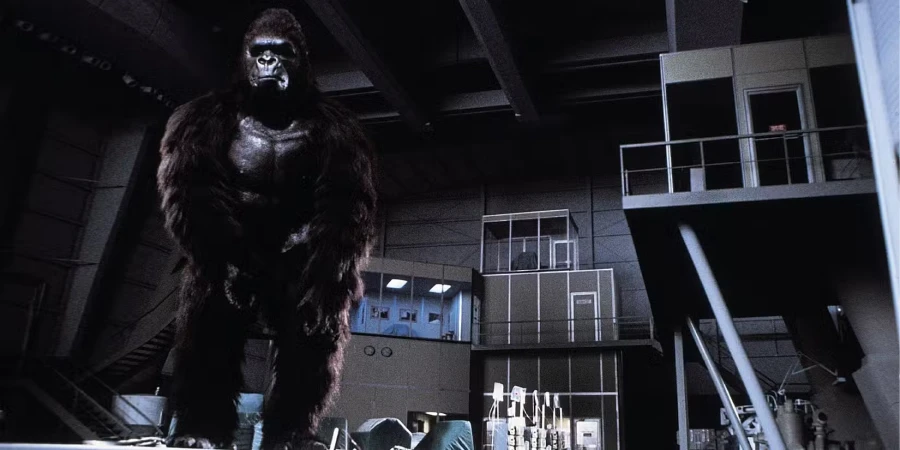
The film opens with a retcon. Despite the dramatic fall at the end of the 1976 film, Kong is revealed to be alive but in a deep coma. For ten years, he has been kept alive by life support machines at the fictional Atlantic Institute. His heart is severely damaged, and he requires an artificial transplant to survive.
The problem? No compatible donor heart exists. Until…
Discovery of Lady Kong
An expedition to Borneo uncovers a female giant ape, soon dubbed “Lady Kong.” This discovery changes everything. She becomes the only viable donor candidate for Kong’s artificial heart procedure. Instead of harvesting her heart, scientists decide to perform a full heart transplant and blood transfusion between the two.
The surgery scene is one of the film’s major sci-fi spectacles. After an intense operation, Kong survives. But things don’t stay under control for long.
Kong Escapes with Lady Kong
Once revived, Kong senses Lady Kong’s presence. The two connect immediately, and Kong breaks free from containment to reunite with her. This leads to multiple action sequences involving military intervention, gunfire, helicopters, and jungle pursuits.
The U.S. Army, led by Colonel Archie Nevitt (Brian Kerwin), treats Kong as a national security threat. Dr. Amy Franklin (Linda Hamilton), however, sees Kong as an intelligent being deserving compassion. This moral tension runs throughout the film.
As Kong and Lady Kong escape into the wilderness, their bond grows. The film leans heavily into a Beauty and the Beast-style dynamic, but this time between two giant apes.
Military Pursuit and Escalation
The military relentlessly hunts the pair, viewing them as dangerous biological anomalies. Kong becomes increasingly aggressive in defending Lady Kong, especially once she becomes pregnant.
Yes, the movie escalates into full monster melodrama: Kong is now not just a revived giant ape but a soon-to-be father.
The film builds toward a final confrontation in the mountains of the American Southeast.

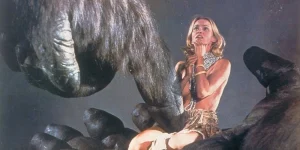
Movie Ending
The climax unfolds as the military corners Kong and Lady Kong in a mountainous forest area. Lady Kong is heavily pregnant, and Kong is doing everything possible to protect her from artillery and air attacks.
In the final battle, the military unleashes overwhelming firepower. Kong sustains severe gunshot wounds while trying to shield Lady Kong. Despite his immense strength, he cannot withstand the assault indefinitely.
Lady Kong goes into labor during the chaos.
In a tragic and emotionally charged sequence, Kong uses the last of his strength to fend off soldiers and helicopters. He collapses from his injuries shortly after ensuring Lady Kong and their newborn baby are safe.
Kong dies from his wounds.
The final moments focus on Lady Kong cradling her infant while standing over Kong’s lifeless body. The military, witnessing the emotional scene, finally stands down. The image of the baby Kong signals hope and the possibility of a future.
The film closes on this bittersweet note: Kong is gone, but his legacy lives on through his child.
The ending attempts to transform Kong from a destructive monster into a sacrificial, almost mythic father figure.
Are There Post-Credits Scenes?
No, King Kong Lives does not include a post-credits scene. Once the final image fades and the credits roll, the story is complete.
Type of Movie
King Kong Lives is a sci-fi adventure monster film with strong elements of melodrama and romantic tragedy. It blends military action, creature feature spectacle, and emotional storytelling in a distinctly 1980s style.
Cast
- Linda Hamilton as Dr. Amy Franklin
- Brian Kerwin as Colonel Archie Nevitt
- John Ashton as Alan Prescott
- Peter Elliott as Kong
- George Yiasoumi as Lady Kong
Film Music and Composer
The score was composed by John Scott, whose orchestral work aims to give the film emotional weight and grandeur. The music tries to elevate Kong’s journey into tragic epic territory, especially in the final act.



Filming Locations and Their Importance
The film was primarily shot in:
- North Carolina, USA
- Army bases and rural forested areas in the American Southeast
The dense forests and mountainous terrain serve as the stand-in for Kong’s temporary wilderness refuge. These natural landscapes emphasize the contrast between the military’s industrial firepower and Kong’s primal connection to nature.
Studio work was also used extensively for close-up creature effects and surgery scenes.
Awards and Nominations
King Kong Lives did not receive major award recognition and was largely considered a critical and commercial disappointment upon release. However, it has since gained a certain cult status among fans of 1980s creature features.
Behind the Scenes Insights
- The film is a direct sequel to the 1976 King Kong rather than the 1933 original.
- Linda Hamilton filmed this shortly after The Terminator (1984), but before Aliens (1986) made her a major action icon.
- The Kong suit performance required significant physical endurance, with Peter Elliott spending long hours inside animatronic-enhanced costume rigs.
- The mechanical heart surgery sequence required complex practical effects, reflecting 1980s pre-CGI craftsmanship.
- The production struggled with tonal balance, unsure whether to lean into camp or tragedy.
Inspirations and References
The film continues the legacy of the original King Kong (1933) and directly follows the narrative of King Kong (1976). It also echoes themes from classic tragic monster stories like Frankenstein, where the “monster” becomes a misunderstood victim of human aggression.
Alternate Endings and Deleted Scenes
There are no widely documented alternate endings. However, reports suggest certain military action scenes were trimmed for pacing. Some extended character moments between Dr. Franklin and Colonel Nevitt were also shortened to keep the focus on Kong’s arc.
Book Adaptations and Differences
Unlike some Kong entries, King Kong Lives was not directly adapted from a specific novel but continues the cinematic storyline established in the 1976 film. It takes significant liberties with plausibility, especially regarding Kong’s survival and medical procedures, prioritizing emotional spectacle over realism.



Memorable Scenes and Quotes
Key Scenes
- The artificial heart transplant surgery on Kong
- Kong and Lady Kong’s first reunion
- The mountain showdown between Kong and the military
- Kong’s final stand protecting Lady Kong and his newborn
Iconic Quotes
- “He’s not just an animal.”
- “We created this situation.”
- “He’s fighting for her.”
Easter Eggs and Hidden Details
- References to the 1976 film’s events are woven into dialogue exposition.
- Military briefings subtly reference public panic from Kong’s previous New York rampage.
- Kong’s design slightly modifies the 1976 suit to appear more expressive and sympathetic.
Trivia
- The film was released the same year as Aliens (1986), making 1986 a strong year for creature features.
- It was one of the more expensive monster films of the mid-1980s.
- The baby Kong at the end was portrayed using scaled-down animatronics and suit work.
- The film underperformed at the box office, significantly affecting plans for further sequels at the time.
Why Watch?
If you enjoy so-bad-it’s-fascinating 1980s creature films, this is essential viewing. The movie’s attempt to turn Kong into a tragic romantic father figure is bold, strange, and oddly sincere. It may not be subtle, but it is undeniably ambitious.
Director’s Other Works (John Guillermin)
- King Kong (1976)
- The Towering Inferno (1974)
- Death on the Nile (1978)
- Shaft in Africa (1973)
Recommended Films for Fans
- King Kong (1976)
- King Kong (1933)
- King Kong Escapes (1967)
- Godzilla vs. Biollante (1989)
- The Beast from 20,000 Fathoms (1953)
- Mighty Joe Young (1998)