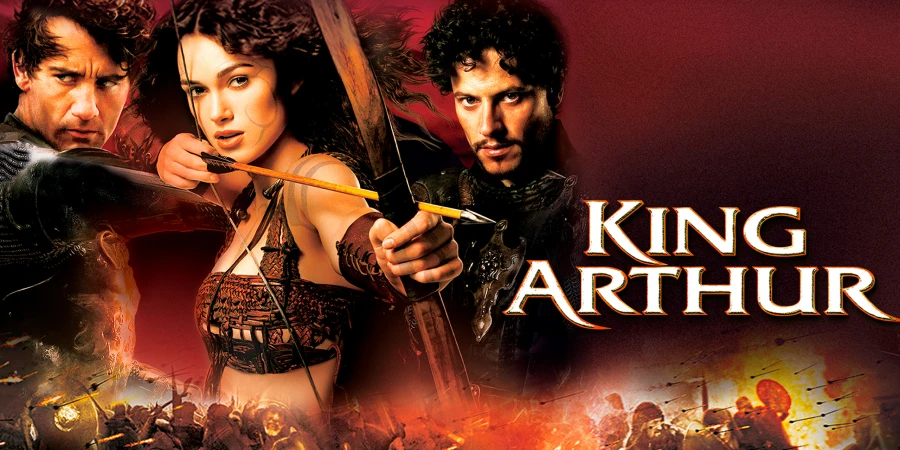

King Arthur (2004), directed by Antoine Fuqua, is a darker, more grounded reinterpretation of the legendary Arthurian myth. Instead of magic-heavy fantasy, the film leans into historical realism, presenting Arthur as a Roman commander and the Knights of the Round Table as elite cavalry officers stationed on the edge of a collapsing empire.
Detailed Summary
The Roman Frontier and Arthur’s Mission
The story is set in 5th-century Britain, during the final days of Roman rule. Arthur (Clive Owen) is a Roman officer, not a king yet, leading a group of loyal knights: Lancelot, Galahad, Tristan, Bors, Dagonet, and Gawain. These men are Sarmatian warriors, bound to Rome by a forced service contract that promises freedom after years of battle.
Arthur, torn between loyalty to Rome and his growing belief in justice and freedom, is given one final mission before their release: escort a Roman family out of dangerous territory north of Hadrian’s Wall.
Encounter with the Woads
During the mission, Arthur meets Guinevere (Keira Knightley), a fierce Woad warrior woman captured by the Romans. Unlike traditional portrayals, Guinevere is not a noble lady but a freedom fighter, opposing Roman occupation.
The knights discover that the Roman family they are escorting includes a corrupt bishop who has brutally oppressed the local population. Arthur’s moral conflict deepens as he realizes Rome is no longer the force of civilization he once believed in.
The Saxon Threat
Parallel to this journey, a massive Saxon invasion led by Cerdic and his son Cynric is sweeping toward Britain. The Saxons are portrayed as ruthless conquerors, threatening to wipe out both Romans and native Britons.
Arthur ultimately defies Roman orders, choosing to defend the local population alongside the Woads. This marks a turning point: Arthur stops being Rome’s knight and starts becoming Britain’s leader.
The Battle for Britain
The film builds toward a massive final confrontation at Hadrian’s Wall, where Arthur and his knights make a desperate stand against the Saxon army. This battle is brutal, grounded, and emotionally heavy, emphasizing sacrifice and loyalty rather than spectacle alone.
Several knights fall in battle, reinforcing the cost of freedom and leadership.
Movie Ending
In the final act, Arthur leads the remaining knights and Woad warriors into a last stand against Cerdic’s forces. Lancelot is gravely wounded, and several knights die defending the wall, including Dagonet, whose death symbolizes the end of their old Roman-bound lives.
Arthur personally confronts Cerdic, killing him in combat. However, victory is not without loss. Britain is saved from Saxon domination, but at a terrible cost.
With the Roman Empire officially withdrawing from Britain, Arthur is finally freed from Roman service, not by decree but by necessity—Rome no longer has power here.
The film concludes with:
- Arthur marrying Guinevere in a simple Woad ceremony
- Arthur being crowned King of Britain
- The surviving knights swearing loyalty not to Rome, but to Arthur and the people
The ending emphasizes that Arthur’s true legacy is not conquest, but unity, justice, and chosen leadership. Britain enters a new era, fragile but free, with Arthur as its protector.
Are There Post-Credits Scenes?
No. King Arthur (2004) does not include any post-credits or mid-credits scenes. The story ends definitively with Arthur’s coronation and marriage.
Type of Movie
King Arthur is a historical action-drama with strong war film elements. While based on legend, it intentionally minimizes fantasy in favor of realism, focusing on politics, warfare, and moral responsibility.
Cast
- Clive Owen as Arthur
- Keira Knightley as Guinevere
- Ioan Gruffudd as Lancelot
- Mads Mikkelsen as Tristan
- Ray Winstone as Bors
- Hugh Dancy as Galahad
- Ray Stevenson as Dagonet
- Stellan Skarsgård as Cerdic
Film Music and Composer
The score was composed by Hans Zimmer, delivering a powerful, percussion-heavy soundtrack. The music blends Celtic influences with epic orchestration, enhancing both the emotional weight and the scale of the battles.
Filming Locations
- Ireland – Used extensively for Britain’s wild landscapes, reinforcing the raw, untamed feel of the setting
- Wales – Provided mountainous terrain for battle scenes
- England – Historical locations helped ground the story in realism
These locations emphasize the idea of Britain as a harsh, contested land rather than a mythical fairy-tale kingdom.
Awards and Nominations
While not a major awards contender, the film received:
- Nominations for Best Sound Editing
- Recognition for costume design and battle choreography at genre-focused award ceremonies
Behind the Scenes Insights
- The film originally aimed to launch a trilogy but box office performance halted those plans
- Keira Knightley’s warrior costume sparked controversy due to its impractical design
- Antoine Fuqua pushed for minimal CGI, favoring real stunts and locations
- Hans Zimmer composed the score in collaboration with ethnic musicians to enhance authenticity
Inspirations and References
- Theories suggesting King Arthur was a Roman military leader
- Historia Brittonum and early medieval chronicles
- Roman withdrawal from Britain around 410 AD
- Celtic resistance to imperial occupation
Alternate Endings and Deleted Scenes
- Early drafts included Arthur dying in battle, becoming a martyr figure
- Deleted scenes expanded Lancelot’s backstory and his loyalty conflict
- A longer epilogue showing Britain’s future under Arthur was cut
Book Adaptations and Differences
This film is not a direct adaptation of any single Arthurian text. Instead, it selectively reinterprets legends:
- Merlin is omitted entirely
- Magic and prophecy are removed
- Guinevere is reimagined as a warrior
- Arthur’s sword is symbolic, not mystical
Memorable Scenes and Quotes
Key Scenes
- The frozen lake battle against the Saxons
- Dagonet holding the bridge alone
- Arthur choosing to defy Rome
- The final coronation ceremony
Iconic Quotes
- “I don’t believe that destiny controls our lives. I believe that we control destiny.” – Arthur
- “Freedom is not given. It is taken.” – Guinevere
Easter Eggs and Hidden Details
- The knights’ armor subtly blends Roman and Celtic designs
- Arthur’s banner uses early British symbols instead of royal crests
- Saxon helmets are historically inspired rather than fantasy-based
Trivia
- Mads Mikkelsen trained with real falconers for his role
- The film used over 1,000 extras for battle scenes
- Clive Owen performed many of his own stunts
- Early marketing incorrectly promoted the film as historically accurate
Why Watch?
If you enjoy gritty historical epics, morally conflicted heroes, and grounded reimaginings of famous legends, King Arthur (2004) offers a refreshing alternative to traditional fantasy. It’s imperfect, but ambitious and emotionally sincere.
Director’s Other Works (Movies)
- Training Day (2001)
- Tears of the Sun (2003)
- Shooter (2007)
- The Equalizer (2014)
- The Magnificent Seven (2016)