
Stop-motion skeletons fighting live-action heroes should be cheesy. It should look dated. Instead, Ray Harryhausen’s masterful work in Jason and the Argonauts remains a spectacle of cinematic magic that defines the fantasy adventure genre. More than a monster movie, this film is a powerful, if truncated, retelling of a timeless Greek myth. Consequently, its influence is still felt today.
Detailed Summary
The Prophecy and the Quest
The film opens with the brutal usurpation of the throne of Thessaly. The ruthless Pelias (Douglas Wilmer) murders King Aristo, fulfilling a prophecy that one of Aristo’s children will avenge him. However, another prophecy warns Pelias that a man wearing a single sandal will be his undoing.
Twenty years later, the gods Zeus (Niall MacGinnis) and Hera (Honor Blackman) watch as the grown Jason (Todd Armstrong), Aristo’s son, unknowingly saves Pelias from drowning. In the process, Jason loses a sandal, marking himself as the man from the prophecy. Recognizing the threat, Pelias cleverly sends Jason on an impossible quest: sail to the land of Colchis and retrieve the legendary Golden Fleece. Pelias believes the journey will certainly kill him.
Assembling the Heroes
Before his departure, Jason holds a tournament to gather the greatest heroes of Greece. Men like Hercules (Nigel Green) and Acastus (Gary Raymond), Pelias’s own son sent to sabotage the mission, join his crew. These heroes become the Argonauts.
Protected by Hera, who grants him aid five times, Jason sets sail on the magnificent ship, the Argo. Hermes takes him to Mount Olympus, where Zeus warns him that his destiny is his own to make, despite Hera’s patronage. This divine intervention sets the stage for a journey fraught with both mortal and supernatural dangers.
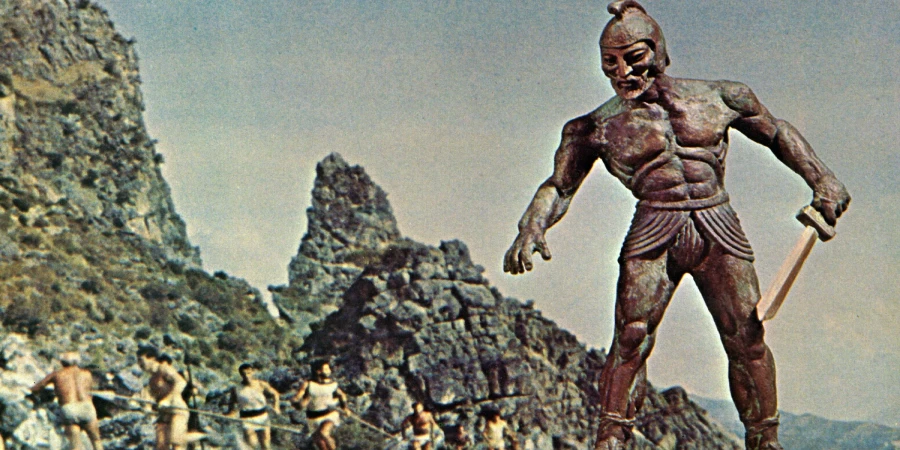
The Bronze Giant Talos
The Argonauts first stop at the Isle of Bronze for supplies. Despite warnings, the foolish Hylas (John Cairney) and Hercules enter a chamber filled with giant bronze statues of the gods. Hylas steals a massive brooch pin from a treasure pile, awakening the colossal statue of Talos.
Talos, a bronze giant, relentlessly attacks the Argonauts, destroying their ship and trapping them. Following Hera’s advice, Jason spots a plug on the giant’s heel. He successfully removes it, causing the vital ichor to drain from Talos’s body. The giant then crumbles and collapses, but sadly crushes Hylas in the process. A grief-stricken Hercules decides to stay behind.
Phineus and the Harpies
Next, the Argo reaches the desolate home of Phineus (Patrick Troughton), a blind king punished by Zeus for misusing his gift of prophecy. Every day, winged harpies torment him by stealing his food. In exchange for information about their journey, Jason and the Argonauts agree to help him.
They cleverly trap the harpies in a net and cage them, freeing Phineus from his curse. As a reward, Phineus gives Jason a crucial amulet and tells him how to navigate the deadly Clashing Rocks, a strait where massive rock walls smash any ship that tries to pass.
The Clashing Rocks and Medea
Following Phineus’s advice, Jason releases a dove to fly through the Clashing Rocks. As the rocks crash together to catch the bird, they begin to recede. The Argo rows furiously through the opening. However, the god Triton emerges from the sea to hold the rocks apart just long enough for the ship to pass safely.
Upon arriving in Colchis, King Aeëtes (Jack Gwillim) imprisons the Argonauts. Meanwhile, the high priestess Medea (Nancy Kovack) has a vision of Jason and feels a powerful attraction. She helps Jason and his men escape their prison, falling in love with him in the process.
The Golden Fleece and the Skeleton Army
Medea leads Jason to the Golden Fleece. It is guarded by the seven-headed Hydra. Jason fights and slays the beast in a dramatic battle. He then seizes the fleece, which has healing powers.
King Aeëtes arrives and, in a fit of rage, takes the Hydra’s teeth and sows them into the ground. From these teeth spring a terrifying army of skeletal warriors. The film’s most famous sequence unfolds as Jason and his men fight a desperate, prolonged battle against these undead soldiers. Jason ultimately tricks them into jumping off a cliff into the sea, allowing him, Medea, and the surviving Argonauts to escape.

Movie Ending
The ending of Jason and the Argonauts is famously abrupt. After Jason, Medea, and the surviving Argonauts escape the skeleton army, they board the Argo and sail away from Colchis with the Golden Fleece. The final shot of the film shows the Argo sailing off into the sunset.
Audiences are often curious about what happens next. The film deliberately leaves Jason’s return journey and his confrontation with Pelias unresolved. In the original myth, Jason does return to Thessaly. Medea uses her magic to trick Pelias’s daughters into killing him. Jason then claims his rightful throne. The movie, however, concludes on a triumphant note, focusing solely on the successful retrieval of the Fleece and the beginning of a new chapter for Jason and Medea.
Are There Post-Credits Scenes?
No, there are no post-credits or mid-credits scenes in Jason and the Argonauts. This practice was not common in films made during the 1960s. Once the credits begin to roll, the movie is officially over.
Type of Movie
Jason and the Argonauts is a classic fantasy adventure film with strong elements of Greek mythology. It pioneered the “sword-and-sandal” subgenre. Its tone is one of high adventure, epic stakes, and wondrous spectacle, punctuated by moments of genuine suspense and horror, particularly during the creature encounters.
Cast
- Todd Armstrong – Jason
- Nancy Kovack – Medea
- Gary Raymond – Acastus
- Laurence Naismith – Argos
- Niall MacGinnis – Zeus
- Honor Blackman – Hera
- Michael Gwynn – Hermes
- Nigel Green – Hercules
- Jack Gwillim – King Aeëtes
- Patrick Troughton – Phineus
Film Music and Composer
The thunderous and majestic score for Jason and the Argonauts was composed by the legendary Bernard Herrmann. Herrmann was a frequent collaborator with Alfred Hitchcock and is known for his work on films like Psycho and Vertigo. His score for this film is one of his most powerful and recognizable works.
The music perfectly captures the epic scale of the adventure. Notably, the brass-heavy and percussive cues for the appearance of Talos and the skeletal, xylophone-driven theme for the skeleton fight are iconic. They effectively elevate the tension and complement Ray Harryhausen’s visual effects perfectly.

Filming Locations
While set in ancient Greece, the movie was primarily filmed on location in Italy. The dramatic coastal scenery and ancient ruins provided a perfect, sun-drenched backdrop for the mythological tale. Principal photography took place in and around Palinuro, a coastal town in Southern Italy.
The famous temple ruins where Jason first meets Medea are the Greek temples at Paestum, Italy. These well-preserved Doric temples added a layer of authenticity and grandeur to the production that simply could not be replicated on a soundstage.
Awards and Nominations
Surprisingly, Jason and the Argonauts received no major awards or nominations from institutions like the Academy Awards upon its release. Its groundbreaking visual effects were completely overlooked. However, its legacy has earned it significant recognition over the years. Ray Harryhausen received a special Gordon E. Sawyer Award from the Academy in 1992 for his lifetime of technical contributions to cinema, with this film being a cornerstone of his career.
Behind the Scenes Insights
- The iconic skeleton fight sequence took Ray Harryhausen over four months to animate. He produced roughly 13 frames a day, which amounts to about half a second of screen time.
- Lead actor Todd Armstrong’s voice was considered unsuitable by the producers. As a result, his entire performance was dubbed by British actor Robert Rietty.
- Honor Blackman, who played the goddess Hera, would achieve international fame just one year later as Pussy Galore in the James Bond film Goldfinger (1964).
- Columbia Pictures significantly cut the budget for the film, forcing Harryhausen and the producers to scale back several planned sequences, including a more elaborate encounter with the Clashing Rocks.
Inspirations and References
The film is directly inspired by the ancient Greek epic poem Argonautica, written by Apollonius of Rhodes in the 3rd century BC. This poem is the most comprehensive ancient source for the myth of Jason and his quest for the Golden Fleece.
While the film streamlines the narrative for a cinematic audience, it retains many key events from the poem. For instance, the encounters with Talos, Phineus and the Harpies, and the Clashing Rocks are all drawn directly from the text.
Alternate Endings and Deleted Scenes
There are no known alternate endings or officially released deleted scenes for Jason and the Argonauts. The film’s abrupt ending was the intended conclusion, meant to cap the adventure on a high note without getting into the darker, more complex events that follow in the myth.
Screenwriter Beverley Cross had originally planned a sequel that would have followed Jason’s return journey. Unfortunately, the film’s modest box office performance meant these plans were never realized.
Book Adaptations and Differences
The film is an adaptation of the epic poem Argonautica, not a traditional novel. In adapting the text, the filmmakers made several key changes. The poem is much longer and features dozens of other Argonauts and side-quests that are omitted from the film for pacing.
A major difference lies in the portrayal of the gods. In the film, they are direct and active participants. In the poem, their influence is more subtle. Furthermore, the film’s most famous set piece, the battle with the skeleton army, is a creative invention. In the myth, Jason sows the teeth, but he tricks the “earthborn” warriors who spring from them into fighting and killing each other rather than fighting them himself.

Memorable Scenes and Quotes
Key Scenes
- Talos Awakens: The chilling moment when the giant bronze statue turns its head to look at Hylas is pure nightmare fuel. Its subsequent rampage is a masterclass in stop-motion effects and scale.
- Phineus and the Harpies: The disgusting, winged creatures tormenting the blind king is a fantastic blend of horror and fantasy. The Argonauts’ clever plan to capture them is a highlight.
- The Skeleton Fight: The seven-minute battle between Jason, two crewmen, and seven skeletal warriors is arguably the most famous stop-motion sequence in film history. Its choreography and execution are simply breathtaking.
Iconic Quotes
- Zeus: “For the deeds of men, the gods have laid a path. And you, Jason, are to walk it.”
- Hera: “Jason, I can only help you five times. The gods are not allowed to do more.”
- Pelias: “Let them have their hero. I’ll have his throne.”
Easter Eggs and Hidden Details
- One of the skeletons in the finale has a shield featuring an image of the Hydra that Jason had just defeated.
- The figurehead on the Argo is a representation of the goddess Hera, Jason’s divine protector, watching over the crew.
- The constellation map that Argos shows Jason includes a centaur, a possible nod to Chiron, the centaur who raised Jason in some versions of the myth.
Trivia
- The titular hero Jason is only seen wearing his iconic single sandal for one scene at the beginning of the movie.
- The original Talos of Greek mythology was a guardian of Crete, not the “Isle of Bronze,” and was created by the god Hephaestus.
- Patrick Troughton, who played Phineus, would later become famous as the Second Doctor in the classic British sci-fi series Doctor Who.
- Ray Harryhausen cited the 1933 classic King Kong as his primary inspiration for becoming a stop-motion animator. The influence is clear in the scale and personality he gives his creatures.
Why Watch?
This film is a cornerstone of fantasy cinema. Its groundbreaking stop-motion effects by Ray Harryhausen remain utterly captivating. It offers pure, unadulterated adventure that will charm anyone with a love for mythology and classic filmmaking spectacle.
Director’s Other Movies
- The 7th Voyage of Sinbad (1958)
- The 3 Worlds of Gulliver (1960)
- Mysterious Island (1961)
- First Men in the Moon (1964)
Recommended Films for Fans
- Clash of the Titans (1981)
- The 7th Voyage of Sinbad (1958)
- Mysterious Island (1961)
- The Golden Voyage of Sinbad (1973)