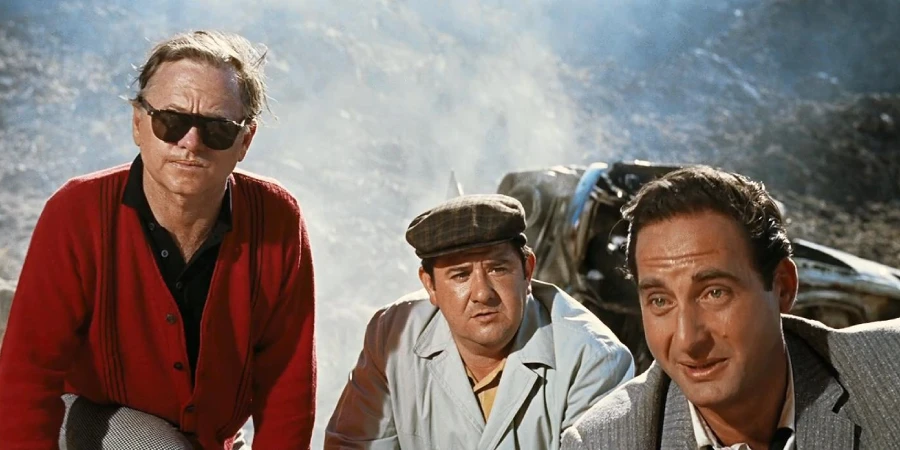

It’s a Mad Mad Mad Mad World is one of the most ambitious and influential comedies ever made. Released in 1963 and directed by Stanley Kramer, the film is a sprawling, star-studded epic that blends slapstick chaos with satirical commentary on human greed. Even today, it remains a benchmark for ensemble comedies and large-scale cinematic mayhem.
Detailed Summary
The Inciting Incident: A Crash, a Confession, and a Curse
The film begins on a California highway, where several motorists stop to witness a spectacular car crash involving a reckless driver named Smiler Grogan. As Grogan lies dying, he reveals a secret that instantly changes everyone’s fate: he once stole $350,000 and buried it beneath a “big W” in Santa Rosita State Park. His final words trigger not sympathy, but raw, unfiltered greed.
What follows is not cooperation, but immediate suspicion. Every witness smiles politely while secretly plotting to get the money first.
The Great Race Begins
Once the truth sinks in, alliances form and dissolve within minutes. Families, couples, and lone opportunists launch a frantic race across California, each convinced they are smarter than the others. Cars speed, planes are hijacked, friendships are destroyed, and moral compasses are thrown out the window.
Stanley Kramer structures the film as a series of escalating disasters, each one more absurd than the last. The comedy comes not just from physical slapstick, but from watching otherwise “respectable” people slowly abandon all dignity.
Authority Enters the Chaos
Unbeknownst to the treasure hunters, the entire race is being secretly monitored by Captain T.G. Culpeper, a weary police officer on the verge of retirement. Rather than stopping the madness, Culpeper watches with growing fascination, subtly nudging events while pretending to maintain order.
This subplot adds a satirical layer: the law itself is tempted by the same greed it is supposed to suppress.
Total Breakdown: When Everyone Loses Control
As the characters grow closer to Santa Rosita, the film descends into full-scale chaos. Airplanes crash, buildings collapse, and bodies pile up in comedic fashion. Former partners turn on each other without hesitation. What began as a treasure hunt becomes a moral collapse on wheels.
The closer they get to the money, the worse they become.

Movie Ending
The finale takes place in Santa Rosita State Park, where all surviving competitors converge at the famous “big W” made of palm trees. After frantic digging, the money is finally uncovered, confirming Grogan’s story was true all along.
But greed reaches its peak here. Instead of celebrating, the group immediately fights over how to divide the cash. Physical comedy escalates into a massive brawl involving ladders, tree branches, and eventually a fire escape high above the ground.
Captain Culpeper reveals his true intentions: after decades of honest service, he wants the money for himself as a “retirement bonus.” In a moment of dark irony, he steals the suitcase of cash and attempts to escape.
Fate intervenes cruelly. While fleeing, Culpeper slips on a banana peel and the suitcase bursts open, sending every dollar bill flying into the air, scattered by the wind. The fortune is completely lost.
In the end, everyone is arrested or hospitalized. No one gets rich. The film closes with the characters injured, humiliated, and punished, while Culpeper, broken and disgraced, laughs hysterically in a straightjacket. The message is clear: greed makes fools of everyone, without exception.
Are There Post-Credits Scenes?
No. It’s a Mad Mad Mad Mad World predates the modern concept of post-credits scenes. Once the film ends, the story is completely finished with no hidden epilogues or extra moments after the credits.
Type of Movie
This is a large-scale ensemble comedy that combines slapstick, satire, and road-movie elements. It uses exaggerated humor to explore very real human flaws, especially greed, selfishness, and moral compromise.
Cast
- Spencer Tracy – Captain T.G. Culpeper
- Milton Berle – J. Russell Finch
- Sid Caesar – Melville Crump
- Ethel Merman – Mrs. Marcus
- Mickey Rooney – Ding Bell
- Buddy Hackett – Benjy Benjamin
- Jonathan Winters – Lennie Pike
The film is also famous for featuring over 40 cameo appearances by classic Hollywood comedians.
Film Music and Composer
The score was composed by Ernest Gold, who crafted energetic, playful music that perfectly matches the film’s frantic pacing. His work amplifies both the excitement and the absurdity of the chase.

Filming Locations
The movie was shot primarily in California, including:
- Desert highways and rural roads to emphasize the vastness of the chase
- Santa Rosita State Park, which becomes the symbolic endpoint of greed
- Urban Los Angeles locations for the final chaotic sequences
These locations are essential because the film’s humor depends on scale. The vast landscapes contrast sharply with the small-minded selfishness of the characters.
Awards and Nominations
- Won Academy Award for Best Sound Editing
- Nominated for Best Cinematography
- Nominated for Best Film Editing
While not a major awards darling, the film gained immense cultural prestige over time.
Behind the Scenes Insights
- Stanley Kramer, known for serious dramas, deliberately made this film as a reaction against heavy social issue movies.
- Jonathan Winters improvised many of his scenes, terrifying both the cast and the crew with his unpredictable energy.
- The film had one of the longest runtimes for a comedy at the time, originally over 3 hours.
- Many comedians accepted cameo roles for free just to be part of the project.
Inspirations and References
The film draws inspiration from:
- Silent-era slapstick comedies by Buster Keaton and Charlie Chaplin
- Greed-driven morality tales
- Vaudeville and radio comedy traditions
It also influenced countless ensemble comedies that followed.
Alternate Endings and Deleted Scenes
Several scenes were cut from the original roadshow version, including extended character interactions and longer slapstick sequences. No alternate ending was filmed, but restored editions include additional footage that deepens character rivalries and comedic buildup.
Book Adaptations and Differences
The film was not based on a novel. Instead, it was written directly for the screen by William Rose. Later novelizations closely follow the movie and introduce no major changes.

Memorable Scenes and Quotes
Key Scenes
- Smiler Grogan’s dying confession and infamous laugh
- The airplane sabotage sequence
- Jonathan Winters destroying an entire gas station
- The final ladder and fire escape disaster
Iconic Quotes
- “Everybody’s gotta get something. I mean, nobody gets nothing.”
- “You don’t trust anybody, do you?”
- “I’ve been honest all my life… and what has it gotten me?”
Easter Eggs and Hidden Details
- Many cameo actors appear without dialogue, rewarding sharp-eyed viewers
- Some character names are inside jokes referencing real-life comedians
- Stanley Kramer appears briefly in the crowd scenes
- The repeated emphasis on smiling faces subtly mocks forced politeness
Trivia
- It held the record for the largest comedy cast for years
- The title contains four “mad” words because Kramer felt three were not enough
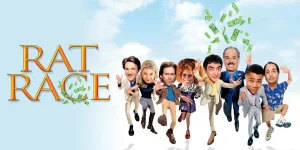
- The film influenced Rat Race (2001) almost directly
- Jonathan Winters reportedly destroyed props faster than the studio could replace them
Why Watch?
Because it’s not just funny, it’s foundational. This film invented the modern ensemble comedy, proved that chaos could be cinematic, and delivered a timeless message about human greed. Even today, its scale and ambition are impressive.
Director’s Other Works (Movies)
- Judgment at Nuremberg (1961)
- The Defiant Ones (1958)
- Guess Who’s Coming to Dinner (1967)
- Inherit the Wind (1960)
Recommended Films for Fans
- Rat Race (2001)
- The Great Race (1965)
- Duck Soup (1933)
- Monty Python and the Holy Grail (1975)
- Ocean’s Eleven (2001)