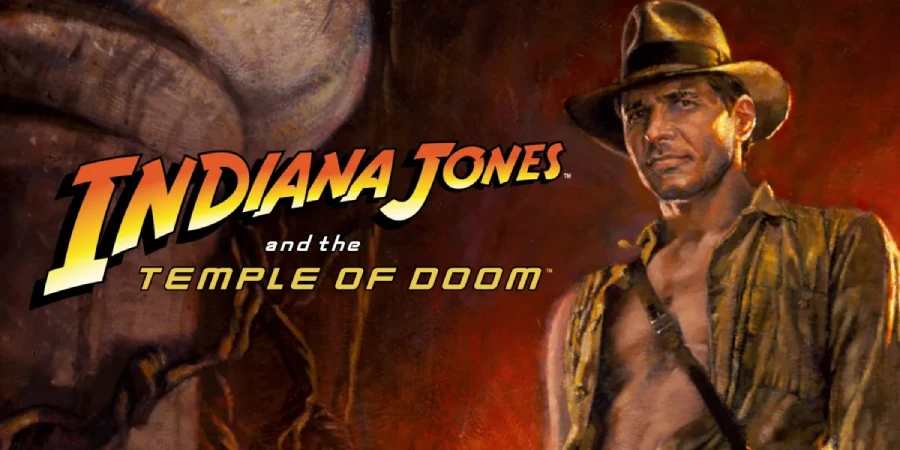

Steven Spielberg’s Indiana Jones and the Temple of Doom is the second film in the Indiana Jones series, but chronologically it takes place before Raiders of the Lost Ark. Darker, louder, and more intense than its predecessor, this film leans heavily into pulp adventure, supernatural horror, and relentless action. It is also the movie that directly led to the creation of the PG-13 rating due to its disturbing imagery.
Detailed Summary
Shanghai Nightclub Escape
The film opens not in a jungle, but in a glamorous Shanghai nightclub in 1935. Indiana Jones is attempting to trade the remains of a Chinese emperor for a precious diamond. The deal goes wrong, poison is involved, and within minutes Indy, nightclub singer Willie Scott, and Indy’s young sidekick Short Round are fleeing a gunfight, escaping in a car, then in a plane that turns out to be sabotaged.
Their escape ends with one of the most famous sequences in the series: jumping out of the plane in an inflatable raft and sliding down a snowy mountain into a raging river.
Arrival in the Indian Village
The trio lands in a remote Indian village suffering from famine and fear. The villagers explain that their sacred Sankara Stone has been stolen and their children kidnapped by an evil cult from the nearby Pankot Palace. They believe Indy is sent by Shiva to help them.
This sets up the central quest: recover the stone and rescue the children.
The Mystery of Pankot Palace
At Pankot Palace, Indy, Willie, and Short Round are welcomed by seemingly polite royalty. The tone quickly shifts during the infamous banquet scene featuring bizarre and grotesque dishes. Indy begins to suspect something sinister beneath the palace’s hospitality.
That night, Indy discovers secret tunnels beneath the palace leading to an underground temple.
The Thuggee Cult and Human Sacrifice
Indy witnesses a horrifying ritual conducted by the Thuggee cult, led by the priest Mola Ram. A man’s heart is ripped from his chest and he is lowered into lava while still alive. Indy learns the cult is using black magic and enslaving children to mine for the remaining Sankara Stones.
Short Round and Indy are captured. Indy is forced to drink a mind-controlling potion called the Blood of Kali, turning him into a servant of Mola Ram.
Short Round Saves Indy
In a crucial turning point, Short Round burns Indy with a torch, snapping him out of the trance. Indy regains control of himself, rescues Willie, and begins freeing the enslaved children.
The Mine Cart Chase
What follows is one of the most famous action sequences in cinema: the underground mine cart chase. Indy, Willie, and Short Round flee through twisting tunnels at impossible speeds while being pursued by Thuggee guards.

Movie Ending
The climax takes place on a rope bridge suspended over a crocodile-infested river. Indy confronts Mola Ram while holding the Sankara Stones. Knowing he cannot defeat the cult physically, Indy cuts the bridge in half. Everyone falls, but Indy hangs onto the broken section while Mola Ram tries to grab the stones.
Indy invokes the power of Shiva, causing the stones to heat up and burn Mola Ram’s hands. Unable to hold on, Mola Ram falls into the river below and is devoured by crocodiles. The remaining Thuggee guards are defeated by arriving British forces, who were alerted by the freed children.
Indy returns the sacred Sankara Stone to the village. The children reunite with their families in an emotional closing scene. Willie, who wanted wealth and comfort throughout the film, witnesses genuine gratitude and relief from the villagers. The film ends with Indy and Willie sharing a kiss as rain pours down, completing Indy’s arc from reluctant helper to true hero guided by conscience rather than treasure.
Are There Post-Credits Scenes?
There are no post-credits scenes in Indiana Jones and the Temple of Doom. Once the credits roll, the story is fully concluded.
Type of Movie
This film is a high-intensity adventure movie that blends pulp action, supernatural horror, and exotic mystery into a fast-paced treasure-hunt narrative.
Cast
- Harrison Ford as Indiana Jones
- Kate Capshaw as Willie Scott
- Ke Huy Quan as Short Round
- Amrish Puri as Mola Ram
- Roshan Seth as Chattar Lal
Film Music and Composer
The score was composed by John Williams, whose work here is darker and more ominous than in Raiders. The music for the Thuggee rituals, the mine chase, and the rope bridge climax are among the most memorable pieces in the franchise.

Filming Locations and Their Importance
- Sri Lanka – Jungle and river scenes; provided authentic tropical landscapes for the village and rope bridge sequence
- Elstree Studios, England – Interior sets including the temple, palace, and mine tunnels
- Kandy, Sri Lanka – Used for village exteriors and lush environments that emphasize isolation and mysticism
These locations gave the movie a sense of real exotic danger rather than purely studio fantasy.
Awards and Nominations
- Academy Award Winner: Best Visual Effects
- Nominated for Best Original Score (John Williams)
- BAFTA nomination for Best Special Effects
Behind the Scenes Insights
- This was Steven Spielberg’s darkest Indiana Jones film, influenced by his own difficult divorce period
- The heart-ripping scene was so disturbing it contributed to the creation of the PG-13 rating
- Kate Capshaw later married Spielberg after meeting on this film
- The mine cart chase required complex miniature and stunt coordination rarely seen at the time
- Harrison Ford suffered a severe back injury during filming and had to rest for weeks
Inspirations and References
The film draws heavily from 1930s adventure serials, pulp comics, and real historical myths about the Thuggee cult in India, though highly fictionalized. It also channels horror influences reminiscent of Gunga Din (1939).
Alternate Endings and Deleted Scenes
Several darker ritual scenes were cut to avoid an even harsher rating. An extended version of the child labor scenes in the mines was also trimmed. No official alternate ending exists, but early drafts had Indy staying longer in the village.
Book Adaptations and Differences
Unlike Raiders, this story was original but inspired by the tone and structure of pulp novels. Novelizations added more backstory to Mola Ram and the cult that the film does not explore in detail.
Memorable Scenes and Quotes
Key Scenes
- The plane escape with the inflatable raft
- The banquet dinner at Pankot Palace
- The human sacrifice ritual
- The mine cart chase
- The rope bridge confrontation
Iconic Quotes
- “Fortune and glory, kid. Fortune and glory.”
- “Kali Ma… Kali Ma…”
- “Hold on to your potatoes!”
Easter Eggs and Hidden Details
- The opening musical number references classic Hollywood musicals
- The nightclub name “Club Obi Wan” is a nod to Star Wars
- Indy’s white tuxedo is a tribute to James Bond
Trivia
- Ke Huy Quan was discovered through an open audition and became one of the most beloved child characters in cinema
- The rope bridge was a real structure built over a river in Sri Lanka
- This is the only Indiana Jones film set before Raiders of the Lost Ark chronologically
Why Watch?
Because it shows Indiana Jones at his most vulnerable, most intense, and most human. The film’s darker tone, relentless action, and unforgettable set pieces make it one of the most memorable adventure films ever made.
Director’s Other Works (Steven Spielberg)
- Jaws (1975)
- Close Encounters of the Third Kind (1977)
- E.T. the Extra-Terrestrial (1982)
- Schindler’s List (1993)
- Saving Private Ryan (1998)