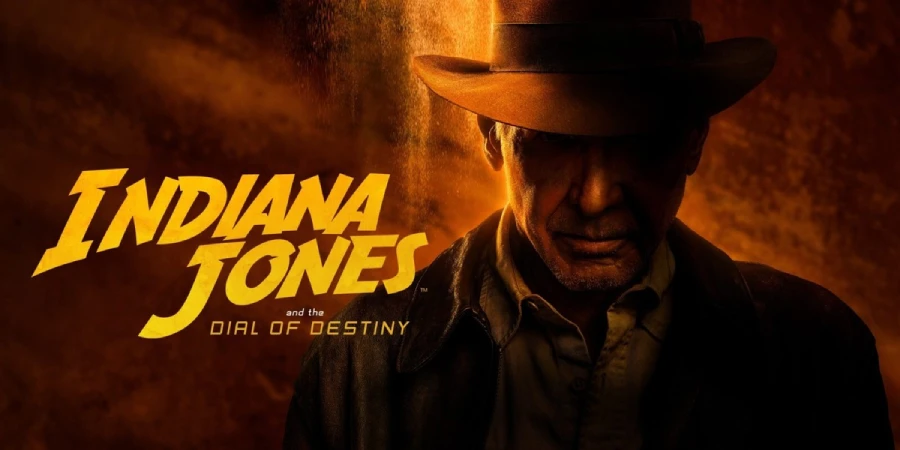

Lucasing back into fedora-and-whip territory one last time, Indiana Jones and the Dial of Destiny brings Harrison Ford’s legendary archaeologist to a reflective, surprisingly emotional finale. Directed by James Mangold, the film blends classic Indy adventure with themes of aging, regret, time, and legacy, while sending the character into one of the wildest historical detours the franchise has ever attempted.
Detailed Summary
Opening: 1944, Nazis, and a Familiar Chase
The film opens during World War II with a de-aged Indiana Jones and Basil Shaw (Toby Jones) attempting to recover a mysterious artifact from the Nazis. They discover that what the Nazis believe to be the Lance of Longinus is fake, but Indy notices something far more interesting: half of a device created by Archimedes called the Antikythera, later referred to as the Dial of Destiny.
This sequence is classic Indiana Jones: trains, punches, narrow escapes, and Nazis being outsmarted. However, it also establishes the central mystery of the film and introduces the idea that this device may have the power to locate time fissures.
1969: An Older, Bitter Indiana Jones
We jump to 1969. Indy is no longer the adventurous professor we remember. He’s tired, divorced from Marion, and on the verge of retirement. The world has changed. The space race is underway, and people care more about astronauts than archaeologists.
Enter Helena Shaw (Phoebe Waller-Bridge), Basil’s daughter and Indy’s goddaughter. She wants the Dial. Indy initially thinks she’s following in her father’s academic footsteps, but Helena is motivated by money, not history.
The Return of a Nazi Scientist
Jürgen Voller (Mads Mikkelsen), a former Nazi scientist now working for NASA under a new identity, re-enters the picture. He is obsessed with correcting Hitler’s mistakes. Voller believes the Dial doesn’t just locate fissures in time, but can allow someone to travel through them and change history.
From here, the film becomes a globe-trotting race: New York, Tangier, Greece, Sicily. Indy and Helena chase clues while Voller and his team pursue them with ruthless efficiency.
Discovering Archimedes’ Truth
As the pieces of the Dial come together, Indy realizes Archimedes did not build the device to predict eclipses or map stars. He built it to calculate where time rifts occur.
This is where the movie leans into bold sci-fi territory. The Dial doesn’t control time. It points to a moment where time has torn open.
Voller plans to travel back to 1939 to assassinate Hitler and reshape the future under his own vision of Nazi victory.
Movie Ending
Aboard Voller’s plane, the completed Dial guides them into a violent electrical storm over Sicily. Voller believes it will open a fissure to 1939 Germany.
He is wrong.
Archimedes designed the Dial to lead to one fixed point in time: 212 BC, during the Roman siege of Syracuse. The plane passes through the fissure and emerges in the middle of an ancient naval battle. Mistaken for a dragon, it is struck by flaming projectiles and crashes. In the chaos, Voller is killed by falling debris—an ironic end for a man trying to rewrite history.
Wounded and overwhelmed, Indy meets Archimedes and realizes he is witnessing the past every archaeologist dreams of. Feeling old, lost, and out of place in 1969, he asks Helena to leave him behind.
She refuses. Knocking him unconscious, she drags him back onto the plane and forces their return before the fissure closes.
Indy wakes up in his New York apartment, unsure if it was real. Helena soon appears, followed by Marion. Indy and Marion share a quiet, heartfelt reunion, echoing a moment from Raiders of the Lost Ark, now filled with age, pain, and reconciliation.
The film ends not with adventure, but with Indy accepting his time, his life, and the people he loves.
Are There Post-Credits Scenes?
There are no post-credits scenes in the film.
Type of Movie
Indiana Jones and the Dial of Destiny is an action-adventure film with strong historical mystery and unexpected science-fiction elements, wrapped in a character-driven story about aging, regret, and legacy.
Cast
- Harrison Ford as Indiana Jones
- Phoebe Waller-Bridge as Helena Shaw
- Mads Mikkelsen as Jürgen Voller
- Boyd Holbrook as Klaber
- Toby Jones as Basil Shaw
- Antonio Banderas as Renaldo
- Karen Allen as Marion Ravenwood
- John Rhys-Davies as Sallah
Film Music and Composer
The score was composed by John Williams, returning once again to the franchise. This is one of Williams’ final major film scores, and it blends classic Indy themes with more melancholic tones that reflect the film’s emotional weight.



Filming Locations and Their Importance
- United Kingdom (Pinewood Studios) for large-scale set pieces and controlled environments
- Sicily, Italy for the ancient Syracuse sequences and Mediterranean atmosphere
- Morocco for Tangier chase scenes, echoing the franchise’s love for exotic markets and narrow streets
- Glasgow, Scotland doubled as 1969 New York during the parade sequence
These locations were crucial in maintaining the globe-trotting authenticity that defines Indiana Jones.
Awards and Nominations
The film received nominations in technical categories, especially for Visual Effects, Sound, and Production Design, and was shortlisted in several critics’ awards for Harrison Ford’s performance as an aging action hero.
Behind the Scenes Insights
- Harrison Ford insisted on performing many practical stunts despite his age
- James Mangold aimed to give Indy a “character ending,” not just an action ending
- The de-aging technology used in the opening sequence was developed from deep archival footage of Ford from the 1980s
- Phoebe Waller-Bridge improvised several lines that stayed in the final cut
- John Williams wrote a specific theme for Helena to contrast Indy’s classic motif
Inspirations and References
The story draws inspiration from the real Antikythera mechanism, an ancient Greek astronomical device often called the world’s first computer. The film also references classic time-travel paradox ideas seen in science fiction literature and cinema.
Alternate Endings and Deleted Scenes
Early drafts reportedly had Indy choosing to remain in the past willingly. This was changed to emphasize his return to the present and emotional reconciliation. Several extended chase and dialogue scenes were trimmed for pacing.
Book Adaptations and Differences
The film is not based on a book but uses real historical artifacts and legends as its foundation, as previous Indiana Jones films have done.


Memorable Scenes and Quotes
Key Scenes
- The de-aged train escape in 1944
- The Tangier tuk-tuk chase through narrow streets
- The plane entering the time fissure during the storm
- Indy meeting Archimedes face to face
Iconic Quotes
- “I don’t believe in magic. But a few times in my life, I’ve seen things.”
- “You’re an archaeologist, Indiana. This is what you do.”
Easter Eggs and Hidden Details
- References to past Indy artifacts in his apartment
- Sallah’s return as a nostalgic bridge to earlier films
- The parade sequence mirrors the chaos energy of Raiders market scenes
- Archimedes’ design sketches resemble the real Antikythera diagrams
Trivia
- Harrison Ford was 80 during filming
- This is the first Indiana Jones film not directed by Steven Spielberg
- The budget exceeded $300 million, making it one of the most expensive films ever made
- Karen Allen’s return was kept secret during production
Why Watch?
Because this is not just another Indiana Jones adventure. It is a thoughtful, emotional farewell to one of cinema’s most iconic characters, blending spectacle with a surprisingly intimate story.