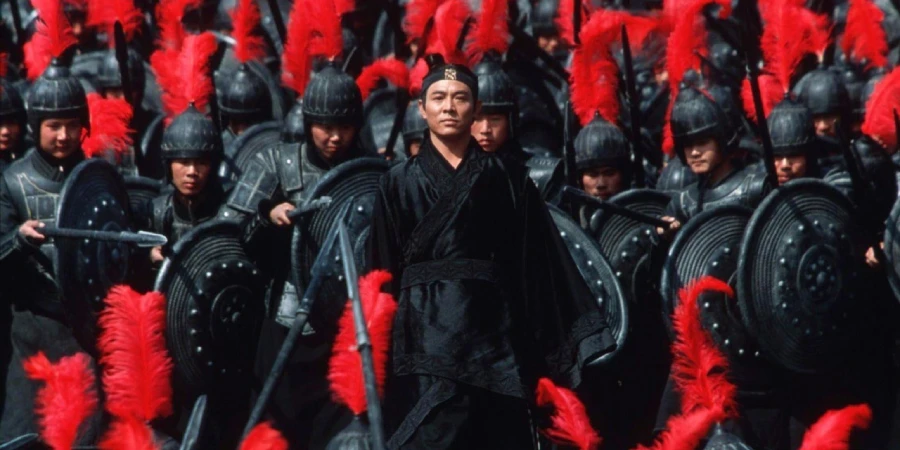

Hero (2002), directed by Zhang Yimou, is not just a martial arts film; it is a philosophical, visual, and political epic that redefined the wuxia genre for international audiences. Combining breathtaking choreography, color-coded storytelling, and deep moral questions, Hero asks a simple but heavy question: What is the true meaning of heroism?
Detailed Summary
The Assassin Who Killed Three Legends
The story begins with Nameless, a low-ranking prefect who is summoned to the palace of the King of Qin, a ruler constantly threatened by assassins. Nameless claims he has killed the king’s three greatest enemies: Sky, Broken Sword, and Flying Snow. As proof, he presents their weapons.
Because of this extraordinary achievement, Nameless is allowed to sit unusually close to the king, a visual cue that something important is unfolding.
The Red Story – Passion and Betrayal
Nameless narrates his version of events, shown in red, symbolizing emotion, jealousy, and rage. In this story, Flying Snow and Broken Sword are lovers torn apart by suspicion. Nameless manipulates their emotional conflict, leading Flying Snow to kill Broken Sword, after which Nameless defeats her as well.
This version paints Nameless as a brilliant tactician who uses human weakness as a weapon.
The Blue Story – Doubt and Deeper Truth
The King begins to question the story’s logic. He retells the events in blue, representing calm, reason, and skepticism. In this version, Flying Snow and Broken Sword are united, and Nameless never truly defeats them. Instead, they intentionally allow events to unfold.
This shift reveals that truth in Hero is subjective, shaped by perspective and intention.
The White Story – The Ultimate Revelation
Finally, the story moves to white, symbolizing truth and clarity. Here, the audience learns that Broken Sword understood something profound: that killing the King would only prolong endless war. He believed that only unification could bring peace.
Nameless was never seeking personal glory. His entire journey was designed to get close enough to kill the King—but also to understand whether doing so would truly benefit the world.
Movie Ending
In the final act, Nameless stands within striking distance of the King of Qin. He is close enough to kill him, closer than any assassin has ever been. Yet he chooses not to.
Nameless has come to understand Broken Sword’s philosophy: that the King, despite his cruelty, is the only one capable of unifying the warring states of China and ending centuries of bloodshed. Killing him would plunge the land into more chaos.
The King realizes this and orders Nameless’ execution anyway. From the King’s perspective, allowing Nameless to live would encourage future assassins. Nameless accepts this fate willingly, embracing death as the final act of his heroism.
He is executed by a barrage of arrows, one of the most visually and emotionally striking scenes in the film. Later, Broken Sword and Flying Snow also meet tragic ends, victims of the same impossible conflict between personal love and national destiny.
The film closes with China’s unification underway, leaving the audience to reflect on a haunting question:
Was Nameless a hero for sparing the King—or a martyr who sacrificed his morality for peace?
Are There Post-Credits Scenes?
No. Hero does not include any post-credits or mid-credits scenes. The film ends definitively, allowing its philosophical weight to linger without additional commentary.
Type of Movie
Hero is a wuxia martial arts epic blended with historical drama and philosophical allegory. It balances stylized combat with deep political and moral themes, elevating it beyond a traditional action film.
Cast
- Jet Li as Nameless
- Tony Leung Chiu-wai as Broken Sword
- Maggie Cheung as Flying Snow
- Zhang Ziyi as Moon
- Chen Daoming as the King of Qin
- Donnie Yen as Sky
Each performance is deliberately restrained, reinforcing the film’s meditative tone.
Film Music and Composer
The score was composed by Tan Dun, blending traditional Chinese instruments with sweeping orchestral arrangements. The music is minimalist yet emotionally powerful, reinforcing the film’s themes of restraint, sacrifice, and destiny.
Filming Locations and Their Importance
- Zhangye National Geopark (China) – Used for the vibrant autumn forest duel, symbolizing emotional chaos.
- Jiuzhaigou Valley – Provides serene natural backdrops reflecting inner peace and clarity.
- Deserts of Inner Mongolia – Represent isolation, inevitability, and the weight of destiny.
The natural landscapes are not just scenery; they act as emotional extensions of the characters.
Awards and Nominations
- Academy Awards (2003) – Nominated for Best Foreign Language Film
- BAFTA Awards – Nominated for Best Film Not in the English Language
- Hong Kong Film Awards – Multiple wins including Best Cinematography
The film was widely praised for its visual innovation.
Behind the Scenes Insights
- Zhang Yimou structured the film around color symbolism, each palette representing a different emotional truth.
- Jet Li reportedly took the role not for money, but because of the film’s philosophical depth.
- Many fight scenes were choreographed to resemble calligraphy in motion.
- The lake duel required weeks of rehearsal to synchronize movement with water ripples.
Inspirations and References
- Inspired by Chinese Warring States history
- Influenced by classical wuxia literature
- Visual storytelling draws from traditional Chinese ink paintings
- Philosophically echoes Confucian ideas of order over individual desire
Alternate Endings and Deleted Scenes
Early drafts reportedly explored an ending where the King questions his own actions more openly, but Zhang Yimou removed this to preserve narrative ambiguity. No officially released alternate ending exists.
Book Adaptations and Differences
Hero is not directly adapted from a single book, but it draws heavily from Chinese legends and wuxia traditions. Unlike traditional wuxia stories that glorify rebellion, Hero controversially emphasizes unity and submission to authority.
Memorable Scenes and Quotes
Key Scenes
- The chess-house duel between Nameless and Sky
- The calligraphy school massacre
- The lake duel between Flying Snow and Moon
- Nameless walking alone toward execution
Iconic Quotes
- “Our land is suffering. Only one sword can stop the chaos.”
- “A hero thinks of the world before himself.”
Easter Eggs and Hidden Details
- Each color segment subtly alters character behavior and dialogue.
- Broken Sword’s calligraphy characters literally spell the film’s central philosophy.
- The King’s throne room grows emptier as the story approaches truth.
Trivia
- Quentin Tarantino helped promote the film’s U.S. release.
- At the time, it was China’s most expensive film ever made.
- The film influenced Hollywood’s visual approach to martial arts cinema.
Why Watch?
Watch Hero if you want more than action. This is a film about sacrifice, power, morality, and peace, wrapped in some of the most beautiful visuals ever put on screen. It challenges you to rethink what it means to be heroic.
Director’s Other Works
- Raise the Red Lantern (1991)
- To Live (1994)
- House of Flying Daggers (2004)
- Curse of the Golden Flower (2006)
- Shadow (2018)
Recommended Films for Fans
- Crouching Tiger, Hidden Dragon (2000)
- House of Flying Daggers (2004)
- Shadow (2018)
- The Assassin (2015)
- Ran (1985)