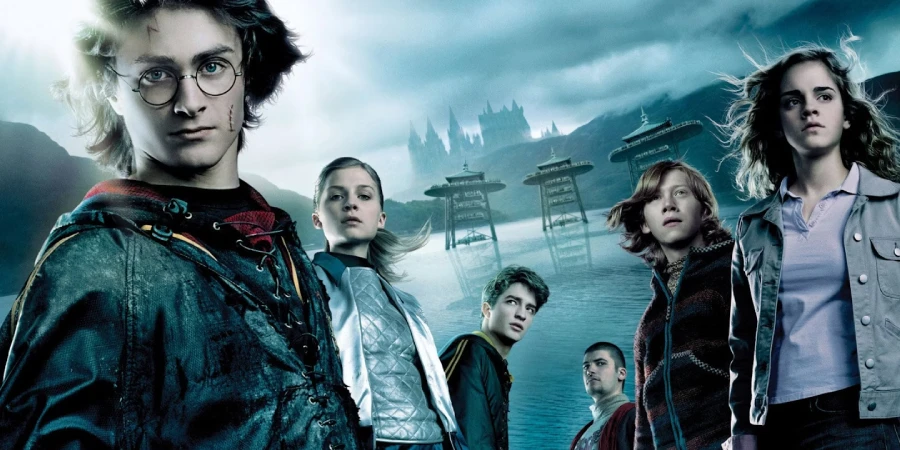

Harry Potter and the Goblet of Fire marks a major tonal shift in the Wizarding World. It is the point where the series leaves childhood behind and steps firmly into darker, more dangerous territory. Mystery, political fear, death, and betrayal enter the story—and they stay for the rest of the saga.
Detailed Summary
The Quidditch World Cup and Rising Tensions
The film opens with Harry attending the Quidditch World Cup with the Weasley family and Hermione. What should be a celebration of wizarding sport turns ominous when Death Eaters attack the campsite, casting the Dark Mark into the sky. This moment is crucial: Voldemort’s followers are no longer hiding. The wizarding world tries to downplay the event, but fear is clearly returning.
The Triwizard Tournament Is Announced
At Hogwarts, Dumbledore announces the return of the Triwizard Tournament, a legendary and extremely dangerous magical competition between three schools:
- Hogwarts
- Beauxbatons
- Durmstrang
Only students over 17 may enter. The Goblet of Fire selects:
- Cedric Diggory (Hogwarts)
- Fleur Delacour (Beauxbatons)
- Viktor Krum (Durmstrang)
Then everything goes wrong. The Goblet unexpectedly selects Harry Potter, despite him being underage and insisting he did not enter. This mystery becomes the backbone of the film.
Harry as the Reluctant Champion
Harry is forced to compete. Many students, including Ron, believe Harry cheated his way into fame. This strains their friendship and isolates Harry emotionally. Meanwhile, Professor Moody (later revealed to be far more than he seems) subtly guides Harry through the tournament.
The three tasks escalate in danger:
- First Task: Facing a dragon to retrieve a golden egg
- Second Task: Rescuing loved ones from the Black Lake
- Third Task: Navigating a deadly enchanted maze
Each task pushes Harry further, proving not just his magical skill, but his moral courage.
The Yule Ball and Emotional Undercurrents
The Yule Ball offers a brief emotional pause. Beneath the formal robes and dancing, relationships fracture and deepen. Hermione attends with Viktor Krum, surprising many, while Ron’s jealousy reveals growing emotional complexity. This chapter highlights that the characters are no longer children—they are confused, emotional teenagers under pressure.
The Third Task and the Trap
The final task leads Harry and Cedric together to the Triwizard Cup. Choosing cooperation over rivalry, they touch the cup simultaneously—only to discover it is a Portkey. They are transported to a graveyard, far from Hogwarts.
This is where the film fully transforms.

Movie Ending
In the graveyard, Peter Pettigrew murders Cedric Diggory instantly on Voldemort’s orders. Cedric’s death is sudden, senseless, and devastating—it marks the first on-screen death of a student in the series and signals that no one is safe anymore.
Harry is restrained while Voldemort is reborn using dark magic, involving:
- Bone of the father
- Flesh of the servant
- Blood of the enemy (Harry)
Voldemort returns to physical form and summons his Death Eaters. He taunts Harry and challenges him to a duel. During the duel, their wands connect due to Priori Incantatem, causing echoes of Voldemort’s past victims to emerge—including Harry’s parents. These spirits help Harry escape with Cedric’s body.
Back at Hogwarts, chaos erupts. Harry reveals Voldemort’s return, but the Ministry refuses to believe him. Dumbledore accepts the truth immediately, beginning preparations for war. In a final, chilling revelation, Professor Moody is exposed as Barty Crouch Jr., a Death Eater who manipulated events all year to deliver Harry to Voldemort.
The film ends with Hogwarts mourning Cedric, and Harry realizing that the world has fundamentally changed. Innocence is gone. The war has begun.
Are There Post-Credits Scenes?
No. Harry Potter and the Goblet of Fire does not include any post-credits or mid-credits scenes. The story ends definitively with emotional closure rather than teasing future events.
Type of Movie
The film is a fantasy adventure with strong mystery and dark fantasy elements, gradually transitioning into a political and psychological drama as the series matures.
Cast
- Daniel Radcliffe as Harry Potter
- Emma Watson as Hermione Granger
- Rupert Grint as Ron Weasley
- Robert Pattinson as Cedric Diggory
- Ralph Fiennes as Lord Voldemort
- Brendan Gleeson as Mad-Eye Moody
- Michael Gambon as Albus Dumbledore
- Maggie Smith as Minerva McGonagall
Film Music and Composer
The score was composed by Patrick Doyle, introducing a more dramatic and orchestral tone than previous films. The music emphasizes danger, destiny, and emotional loss, especially during Voldemort’s return and Cedric’s death.
Filming Locations
- Alnwick Castle (England): Exterior Hogwarts scenes
- Leavesden Studios: Interior Hogwarts sets
- Black Park (UK): Forbidden Forest scenes
These locations contribute to the darker, more grounded atmosphere, moving away from the fairy-tale aesthetic of earlier films.
Awards and Nominations
- Nominated for Academy Award – Best Art Direction
- BAFTA nominations for visual effects and production design
- Widely praised for technical achievement, though noted for its darker tone dividing younger audiences
Behind the Scenes Insights
- This is the first Harry Potter film directed by Mike Newell
- Ralph Fiennes intentionally avoided reading the books to create his own version of Voldemort
- The graveyard scene was physically exhausting for Daniel Radcliffe due to long night shoots
- The cast underwent visible aging, prompting costume and lighting changes to reflect maturity
Inspirations and References
- Based on Harry Potter and the Goblet of Fire (2000) by J.K. Rowling
- Influenced by classic tournament myths and Gothic horror imagery
- The graveyard duel draws visual inspiration from classic dark fantasy cinema
Alternate Endings and Deleted Scenes
- Extended Quidditch World Cup footage was filmed but cut
- A longer scene showing Hogwarts reacting to Cedric’s death was shortened for pacing
- No known alternate ending exists; the bleak conclusion was always intended
Book Adaptations and Differences
- The film removes S.P.E.W. (Hermione’s elf rights campaign)
- Barty Crouch Sr.’s storyline is heavily simplified
- The maze in the book includes creatures and riddles, while the film focuses on psychological threat
Memorable Scenes and Quotes
Key Scenes
- The Dark Mark appearing at the World Cup
- Harry facing the dragon
- Voldemort’s resurrection
- Cedric’s body being returned to Hogwarts
Iconic Quotes
- “That’s my son!” – Amos Diggory
- “I want you to look at me when I kill you.” – Voldemort
- “Cedric Diggory was murdered by Lord Voldemort.” – Dumbledore
Easter Eggs and Hidden Details
- The Triwizard Cup maze layout subtly resembles a skull from above
- Voldemort’s костume incorporates snake symbolism throughout
- The Yule Ball music foreshadows later romantic pairings
Trivia
- Robert Pattinson was nearly cut early from the film
- This is the first film where Voldemort appears fully
- The runtime is the longest in the series
Why Watch?
This is the film where Harry Potter grows up. It delivers emotional weight, genuine loss, and narrative consequences that reshape the entire franchise. If you want to see the moment fantasy turns into tragedy, this is it.
Director’s Other Works
- Four Weddings and a Funeral (1994)
- Donnie Brasco (1997)
- Mona Lisa Smile (2003)
- Prince of Persia: The Sands of Time (2010)
Recommended Films for Fans
- Harry Potter and the Order of the Phoenix (2007)
- The Chronicles of Narnia: The Lion, the Witch and the Wardrobe (2005)
- Pan’s Labyrinth (2006)
- Fantastic Beasts: The Crimes of Grindelwald (2018)
- Percy Jackson & the Olympians: The Lightning Thief (2010)
- The Hobbit: The Desolation of Smaug (2013)
- The Lord of the Rings: The Fellowship of the Ring (2001)
- The Hunger Games: Catching Fire (2013)