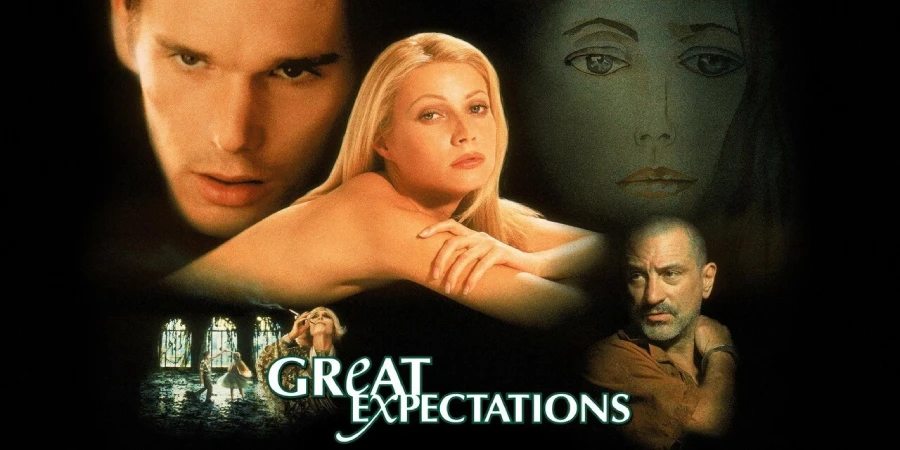

Alfonso Cuarón’s 1998 adaptation of Great Expectations trades Victorian England for the humid decay of the Florida coast and the cold ambition of New York City. Consequently, this film is less a faithful retelling and more a fever dream of obsession and art. It ultimately paints a haunting portrait of unrequited love, where every frame drips with a lush, melancholic beauty.
Detailed Summary
Finn’s Childhood Encounter
The story begins with a young boy named Finn Bell living a simple life with his sister Maggie and her partner Joe on Florida’s Gulf Coast. Finn spends his days drawing the local marine life. One afternoon, however, his quiet world is shattered when an escaped convict in an orange jumpsuit startles him. The imposing man, Arthur Lustig, demands that Finn bring him bolt cutters to remove his leg irons. A terrified but compassionate Finn complies; moreover, he brings the man food and a blanket. Lustig expresses his gratitude before vanishing back into the water, leaving a profound mark on the boy.
Meeting Estella at Paradiso Perduto
Shortly thereafter, Joe secures a gardening job for Finn at a nearby dilapidated estate called Paradiso Perduto (“Lost Paradise”). This crumbling mansion belongs to Nora Dinsmoor, the wealthiest and most eccentric woman in the Gulf. Ms. Dinsmoor, a fragile recluse perpetually dressed in her yellowing wedding gown, enlists Finn as a playmate for her beautiful and precocious niece, Estella. Ms. Dinsmoor actively encourages Finn to fall for Estella. In contrast, Estella treats Finn with calculated cruelty, calling him common and mocking his simple clothes. Despite her coldness, Finn becomes completely infatuated.
The Mysterious Benefactor
Years pass, and Finn becomes a fisherman, his artistic ambitions seemingly forgotten. One day, a lawyer named Jerry Ragno arrives with an astonishing offer. An anonymous benefactor has offered to fund Finn’s career as an artist in New York City. Believing the wealthy Ms. Dinsmoor is his patron, Finn eagerly accepts the opportunity. Therefore, he moves to New York and immerses himself in the art scene. There, he miraculously reconnects with an adult Estella, who is as beautiful and emotionally distant as ever. Their lives intertwine again, culminating in Finn’s successful debut gallery show.
The Truth Revealed
Following his success, Finn’s world unravels. Estella, despite their intense connection, suddenly announces her engagement to a wealthy architect named Walter Plane. A heartbroken Finn stumbles back to his studio, only to be confronted by an unexpected visitor. Arthur Lustig, the convict from his childhood, stands before him. Lustig reveals the shocking truth: he is Finn’s secret benefactor. Having made a fortune in organized crime, he wanted to repay Finn’s long-ago act of kindness by making him a gentleman. Shortly after this confession, however, Lustig’s old mob associates track him down. In a brutal subway station fight, Lustig is fatally stabbed while protecting Finn, dying in his arms.



Movie Ending
The death of Arthur Lustig completely shatters Finn’s worldview. His success was not the result of Ms. Dinsmoor’s patronage or his own talent but was funded by a criminal’s gratitude. As a result, he becomes completely disillusioned with the New York art scene and his own life. He sells his paintings and returns to Florida, a broken man. Finn visits Paradiso Perduto one last time, where he discovers that Ms. Dinsmoor took her own life after Estella abandoned her.
The film then jumps forward several years. Finn has returned to his quiet life, sketching by the ocean just as he did as a child. One morning, he spots a young girl who strongly resembles Estella. Intriguingly, he follows her through the overgrown gardens of Paradiso Perduto. He finds the adult Estella, now a mother and divorced from her husband. She offers a sincere apology for her cruelty and the pain she caused. The film closes with Finn and Estella holding hands, walking towards the sea, signifying a fragile but hopeful reconciliation.
Are There Post-Credits Scenes?
No, there are no post-credits or mid-credits scenes for Great Expectations. Once the final credits begin to roll, the film has concluded completely.
Type of Movie
Great Expectations is a romantic drama with heavy gothic undertones. Director Alfonso Cuarón masterfully blends a classic tale of obsession and social climbing with a distinctly modern, moody aesthetic. The film’s tone is consistently melancholic and atmospheric, focusing on the powerful emotions of longing, heartbreak, and identity. Furthermore, it functions as a coming-of-age story, charting Finn’s tumultuous journey from innocence to painful experience.
Cast
- Ethan Hawke – Finn Bell
- Gwyneth Paltrow – Estella
- Anne Bancroft – Ms. Nora Dinsmoor
- Robert De Niro – Arthur Lustig
- Chris Cooper – Joe
- Hank Azaria – Walter Plane
- Raquel Beaudene – Young Estella
- Jeremy James Kissner – Young Finn
Film Music and Composer
The score for Great Expectations was composed by the renowned Scottish composer Patrick Doyle. His music effectively enhances the film’s romantic and melancholic atmosphere with sweeping orchestral pieces. However, the film is arguably more famous for its curated soundtrack of popular music. The album became a bestseller, perfectly capturing the 90s alternative and trip-hop zeitgeist.
Notable tracks include the haunting “Life in Mono” by Mono, which plays during a pivotal restaurant scene, and “Siren” by Tori Amos. In addition, songs from artists like Pulp, Scott Weiland, Iggy Pop, and Chris Cornell (“Sunshower”) helped define the film’s unique, contemporary mood and contributed immensely to its cultural impact.
Filming Locations
The film’s distinct visual identity is largely thanks to its carefully chosen locations. The Florida scenes of Finn’s childhood were filmed in and around Sarasota. Specifically, the ridiculously opulent Ca’ d’Zan Mansion, the former home of circus magnate John Ringling, served as the exterior and grounds for Ms. Dinsmoor’s Paradiso Perduto. Its Mediterranean Revival architecture and overgrown banyan trees provided the perfect backdrop for gothic decay in a tropical setting.
In contrast, Finn’s adult life unfolds in New York City. These scenes showcase the cold, ambitious, and sophisticated art world that stands in stark opposition to his humid, naturalistic upbringing. This geographical dichotomy, as a result, effectively represents Finn’s internal conflict between his humble origins and his manufactured high-society life.
Awards and Nominations
While not a major awards contender, Great Expectations received recognition for its stunning visual design. The film’s most significant nomination was at the 71st Academy Awards, where it was nominated for Best Art Direction-Set Decoration (Tony Burrough, Susan Bode). Ultimately, it lost to Shakespeare in Love, which also starred Gwyneth Paltrow. In addition, Patrick Doyle’s score received a nomination for Most Creative Use of Music in a Film from the International Film Music Critics Association.
Behind the Scenes Insights
- All of the artwork created by the character Finn Bell was actually produced by Italian contemporary artist Francesco Clemente. Clemente created over 200 paintings and drawings for the film, from Finn’s childhood sketches of fish to his large-scale, expressive New York portraits.
- Director Alfonso Cuarón insisted on using the color green as a dominant visual motif. It appears throughout the film in clothing, decor, and lighting to symbolize envy, desire, wealth, and the decaying nature of Paradiso Perduto.
- Robert De Niro reportedly spent time in Sing Sing prison to research his role as Arthur Lustig, soaking in the atmosphere and speaking with inmates to understand the character’s mindset.
- The memorable slow-motion scene where Finn and Estella kiss at a water fountain was a last-minute addition by Cuarón. He felt the script needed a more potent visual representation of Finn’s lifelong thirst for Estella.
Inspirations and References
The film is directly inspired by and based on the classic 1861 novel Great Expectations by Charles Dickens. However, the screenplay by Mitch Glazer takes significant liberties by transposing the story to a contemporary American setting. Beyond the source material, the film draws visual inspiration from the aforementioned artwork of Francesco Clemente and the lush, atmospheric cinematography of Emmanuel Lubezki, who would become a frequent collaborator with Cuarón.
Alternate Endings and Deleted Scenes
The theatrical release features a hopeful ending where Finn and Estella reconnect. However, the filmmakers shot a much darker, more ambiguous alternate ending that hewed closer to the tone of Dickens’ original published conclusion. In this version, Finn returns to Paradiso Perduto and sees Estella from a distance, watching her with her daughter. They make eye contact, but he simply turns and walks away without speaking to her. Test audiences reacted negatively to this bleak finale, so the more optimistic reunion was chosen instead.
Book Adaptations and Differences
As a modern adaptation, the film makes substantial changes from the Charles Dickens novel. The differences are not just cosmetic; they fundamentally alter the plot and characters.
- Setting and Time Period: The film is set in late 20th-century America (Florida and New York), whereas the book takes place in 19th-century England (Kent and London).
- Protagonist’s Profession: In the book, Pip is an apprentice blacksmith. In the film, Finn is a talented sketch artist, a change that makes his patronage and rise in the art world more visually dynamic.
- Character Names: Major characters were renamed. Pip becomes Finn Bell, Miss Havisham becomes Nora Dinsmoor, and the convict Abel Magwitch becomes Arthur Lustig. Minor characters like Orlick, Wemmick, and Herbert Pocket are completely omitted from the film.
- Plot Simplification: The film streamlines the novel’s complex plot. It excises the entire subplot involving Compeyson (Magwitch’s nemesis) and the convoluted family history connecting several characters. Estella’s parentage, a major reveal in the book, is never addressed in the movie.
- Ms. Dinsmoor’s Fate: In the film, Ms. Dinsmoor commits suicide. In the novel, Miss Havisham dies from injuries after her dress catches on fire.
Memorable Scenes and Quotes
Key Scenes
- The Water Fountain Kiss: In a beautifully shot slow-motion sequence, young Finn drinks from a public fountain as Estella leans in and kisses him, a pivotal moment that cements his lifelong obsession.
- Finn’s Art Show: The culmination of Finn’s journey to New York, where all the main characters converge. The tension between Finn, Estella, and her fiancé Walter comes to a head amidst Finn’s emotional portraits.
- Lustig’s Death: The violent, chaotic confrontation in the subway where Lustig sacrifices himself for Finn. It is both a tragic and redemptive moment that forces Finn to confront the source of his fortune.
Iconic Quotes
- Ms. Dinsmoor: “She’ll only break your heart, it’s a fact. And even though I warn you, even though I guarantee you that the pain will be unbearable, you’ll still pursue her.”
- Estella: “We are who we are. People don’t change.”
- Finn: “It’s my heart, and it’s broken.”
- Arthur Lustig: “I’m not going to tell you the story of my life. I’m going to tell you the story of yours.”
Easter Eggs and Hidden Details
- The Color Green: As mentioned, green is a pervasive visual motif. Estella almost always wears green, Paradise Perduto is overgrown with green, and Finn’s New York world is saturated with it, symbolizing his desire.
- Paradiso Perduto: The name of Ms. Dinsmoor’s estate is Italian for “Lost Paradise,” a direct reference to John Milton’s epic poem Paradise Lost, which chronicles the fall from a state of grace.
- Water and Fish Imagery: The film is filled with aquatic imagery. Finn grows up on the water, obsessively draws fish, and Lustig first appears from and disappears into the water. This symbolizes Finn’s origins and his feeling of being a “fish out of water” in New York.
Trivia
- Brad Pitt was the studio’s first choice for the role of Finn Bell, but he passed on the project.
- The film’s popular soundtrack album was certified Gold by the RIAA in the United States.
- This was the final major theatrical film role for the legendary actress Anne Bancroft before her death in 2005.
- The character of Finn’s uncle, Joe, is played by acclaimed actor Chris Cooper, but his name is never actually spoken aloud in the entire film.
Why Watch?
Watch this film for its breathtaking visuals and intoxicating mood. Its 90s soundtrack is iconic, and the powerhouse performances from Anne Bancroft and Robert De Niro are unforgettable. It is a gorgeous, melancholic exploration of love, art, and obsession.
Director’s Other Movies
- Y tu mamá también (2001)
- Harry Potter and the Prisoner of Azkaban (2004)
- Children of Men (2006)
- Gravity (2013)
- Roma (2018)