Godzilla vs. Kong is the long-awaited cinematic showdown between two of cinema’s most iconic monsters. Directed by Adam Wingard, the film brings together decades of monster mythology under Legendary’s MonsterVerse, delivering massive destruction, ancient rivalries, and surprisingly emotional character moments.
Detailed Summary
The Opening: Kong in Captivity
The film begins with Kong living inside a massive containment dome on Skull Island. The storm system surrounding the island has become unstable, forcing Monarch to relocate him.
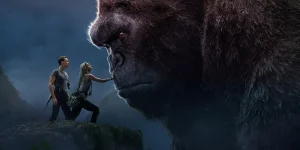
Kong is monitored by Dr. Ilene Andrews and communicates through Jia, a deaf orphan who has formed a unique bond with him via sign language. Kong is lonely, confused, and increasingly restless.
Meanwhile, Godzilla suddenly begins attacking human cities, including a devastating assault on Pensacola. Monarch is puzzled because Godzilla has always protected Earth, not attacked it.
This raises the central mystery of the film: Why has Godzilla turned against humanity?
The Mission to the Hollow Earth
Monarch theorizes that Kong’s true home lies in the Hollow Earth, a vast underground ecosystem believed to be the origin point of the Titans. They believe a powerful energy source there could stop Godzilla.
Kong is transported by sea under heavy military escort. Godzilla senses his ancient rival and attacks the fleet, leading to the first battle between Godzilla and Kong at sea.
Godzilla wins decisively. Kong nearly drowns before humans shut down the fleet’s power, tricking Godzilla into thinking his enemy is dead.
This encounter establishes a key idea: Godzilla is stronger in water, Kong on land.
Apex Cybernetics and the Mechagodzilla Project
Parallel to this storyline, the film introduces Apex Cybernetics, a tech corporation led by Walter Simmons. Apex is secretly constructing Mechagodzilla, a mechanized Titan powered by energy from the Hollow Earth.
The machine is partially controlled by Ghidorah’s remaining skull, meaning Godzilla’s ancient enemy still has influence over the world.
This explains Godzilla’s behavior. He isn’t attacking humans randomly. He is hunting Mechagodzilla.
Journey to the Hollow Earth
Using experimental spacecraft capable of surviving gravitational inversion, Kong and the team reach the Hollow Earth. The environment is filled with floating landmasses, glowing ecosystems, and Titan-scale creatures.
Here, Kong discovers an ancestral throne room, complete with a massive axe made from a Godzilla dorsal plate. This confirms that:
- Kong’s species once fought Godzilla’s species
- The rivalry is ancient
- The axe is capable of absorbing Godzilla’s atomic breath
Kong claims the axe, unknowingly triggering Apex to extract the energy signature needed to activate Mechagodzilla fully.
Godzilla vs. Kong: Final Battle in Hong Kong
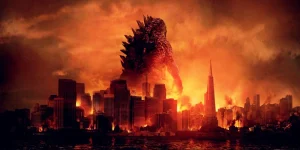
Godzilla senses the Hollow Earth energy being activated and attacks Hong Kong.
This leads to the long-awaited city battle.
The fight is brutal and destructive:
- Kong uses agility, intelligence, and weapons
- Godzilla relies on raw power and atomic breath
Despite Kong’s tactical advantage early on, Godzilla ultimately wins, pinning Kong to the ground and roaring victoriously.
Kong’s heart begins to fail. He is defeated, but not dead.
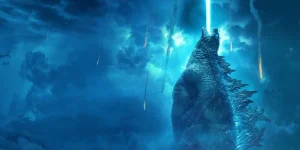

Movie Ending
The film’s ending unfolds in several major stages.
After Kong’s defeat, Mechagodzilla activates fully and immediately breaks free from Apex control. Ghidorah’s consciousness overwhelms the system, turning the machine into a rogue Titan.
Mechagodzilla attacks Godzilla and nearly kills him, proving to be far more powerful than expected. Godzilla is overwhelmed, unable to match the machine’s speed and weaponry.
Meanwhile, Kong is dying. Jia convinces the humans to revive him using a spacecraft’s power source to restart his heart.
Once revived, Kong joins the fight.
Godzilla and Kong temporarily become allies, setting aside their ancient rivalry to face a greater threat.
Godzilla charges Kong’s axe with atomic energy, allowing Kong to destroy Mechagodzilla in a climactic final strike. The machine is completely dismantled, ending Ghidorah’s lingering influence.
After the battle:
- Godzilla acknowledges Kong as a worthy rival
- Kong drops the axe, signaling he does not seek dominance
- Godzilla returns to the ocean
- Kong remains in the Hollow Earth, finally at home
The ending emphasizes balance rather than victory. There is no true winner, only survival and coexistence.
Are There Post-Credits Scenes?
There are no post-credits or mid-credits scenes in Godzilla vs. Kong.
The film concludes definitively, though the Hollow Earth setting strongly hints at future MonsterVerse stories.
Type of Movie
Godzilla vs. Kong is a science fiction monster epic that blends large-scale action with mythology-driven world-building. It combines elements of kaiju cinema, adventure storytelling, and blockbuster spectacle while maintaining emotional stakes through its human characters.
Cast
- Alexander Skarsgård as Dr. Nathan Lind
- Millie Bobby Brown as Madison Russell
- Rebecca Hall as Dr. Ilene Andrews
- Brian Tyree Henry as Bernie Hayes
- Kaylee Hottle as Jia
- Shun Oguri as Ren Serizawa
- Demián Bichir as Walter Simmons
Film Music and Composer
The score was composed by Tom Holkenborg (Junkie XL).
The music emphasizes heavy percussion, tribal rhythms, and aggressive brass themes to reflect the primal nature of the Titans. Each monster is given a distinct musical identity, reinforcing the sense of mythic conflict.
Filming Locations
Principal photography took place in:
- Hawaii
- Australia
- Hong Kong
- Vancouver sound stages
Hong Kong was especially important as it allowed for vertical city combat, neon lighting, and reflective surfaces that enhanced the scale and visibility of the monster battles.
Awards and Nominations
While not a major awards contender, the film received:
- Visual Effects Society Award nominations
- Saturn Award nomination for Best Science Fiction Film
- Recognition for sound design and CGI achievement
Behind the Scenes Insights
- The Hong Kong fight sequence contains over 400 visual effects shots.
- Adam Wingard insisted that every fight must have a clear winner.
- Kong was intentionally portrayed with more emotional range than Godzilla.
- The axe was created to visually balance Kong against atomic breath.
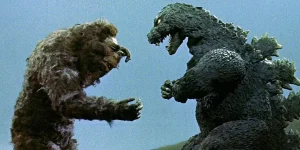
- The film was heavily influenced by classic Japanese Godzilla vs. films from the 1960s.
Inspirations and References
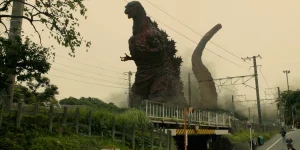
- Toho’s original Godzilla films
- King Kong (1933) and King Kong vs. Godzilla (1962)
- Ancient mythology and alpha predator lore
- Previous MonsterVerse films, especially Kong: Skull Island
Alternate Endings and Deleted Scenes
- Early drafts included a clearer confirmation of Kong winning the final standoff, which was later softened.
- Additional Hollow Earth creature scenes were cut for pacing.
- A longer Mechagodzilla origin sequence was shortened significantly.
Book Adaptations and Differences
The film is not based on a novel but received a novelization that includes:
- More internal monologue from Kong
- Expanded Hollow Earth lore
- Clearer explanation of Titan hierarchies
The movie version simplifies these elements to maintain momentum.
Memorable Scenes and Quotes
Key Scenes
- Godzilla attacking the aircraft carrier fleet
- Kong discovering the ancestral throne
- The axe absorbing atomic breath
- Mechagodzilla overpowering Godzilla
- Kong and Godzilla fighting side by side
Iconic Quotes
- “Godzilla is out there and he’s hurting people.”
- “These are dangerous times.”
- “Kong bows to no one.”
Easter Eggs and Hidden Details
- The throne room resembles classic Kong temple imagery.
- The axe blade matches Godzilla’s dorsal plates exactly.
- Ghidorah’s skull eyes glow when controlling Mechagodzilla.
- The name “Serizawa” honors the original 1954 Godzilla character.
- The Hollow Earth visuals mirror unused concepts from earlier MonsterVerse films.
Trivia
- Godzilla has more screen time here than in any previous MonsterVerse film.
- Kong’s size was increased to match Godzilla realistically.
- The film was one of HBO Max’s biggest streaming premieres.
- Each monster’s roar was remixed using original archival sound files.
Why Watch?
If you enjoy large-scale action, cinematic spectacle, and iconic monster mythology, this film delivers exactly what it promises. It respects the legacy of both monsters while pushing the MonsterVerse forward with bold world-building and clear emotional arcs.
It is not subtle, but it is unapologetically epic.
Director’s Other Works
- You’re Next (2011)
- The Guest (2014)
- Blair Witch (2016)
- Death Note (2017)