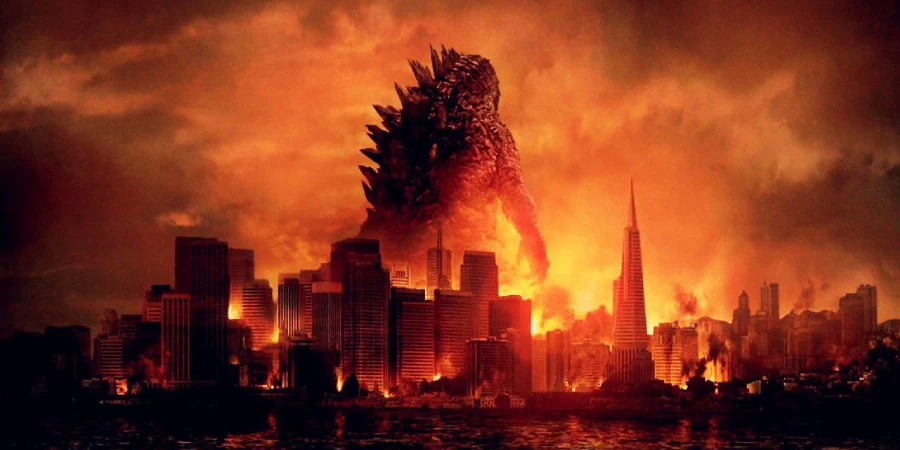

Godzilla (2014) marked the powerful return of the legendary kaiju to Hollywood cinema. Directed by Gareth Edwards, the film aimed to reboot the franchise with a darker, more grounded tone, emphasizing scale, realism, and humanity’s insignificance in the face of nature.
Detailed Summary
The Prologue: Nuclear Secrets
The film opens in 1999 at a nuclear facility in Japan. Scientist Joe Brody and his wife Sandra investigate mysterious seismic tremors beneath the plant. When containment protocols fail, Sandra sacrifices herself to seal the reactor, saving countless lives.
The official explanation becomes a nuclear meltdown, but Joe suspects something far worse.
This emotional opening establishes one of the film’s key themes:
human arrogance versus forces we do not understand.
Years Later: Obsession and Loss
Fifteen years later, Joe Brody remains obsessed with uncovering the truth behind the disaster. His son Ford Brody, now a U.S. Navy bomb disposal officer, reluctantly returns to Japan when his father is arrested for trespassing into the quarantined zone.
Inside the ruins, they discover radiation levels are oddly low and something massive has escaped underground.
This is our first hint that the “meltdown” was never the real danger.
The Awakening of the MUTO
A colossal creature known as a MUTO (Massive Unidentified Terrestrial Organism) emerges from its cocoon beneath the plant. Feeding on radiation, it escapes and heads toward the Pacific Ocean.
Joe Brody dies shortly afterward, reinforcing the film’s bleak realism:
heroes are not guaranteed survival.
Meanwhile, scientists led by Dr. Ishiro Serizawa explain that these creatures predate humanity and once ruled Earth.
And then comes the revelation.
They were not the apex predator.
Godzilla Revealed
Godzilla emerges from the ocean in Hawaii, triggering one of the film’s most iconic sequences. The military engages both monsters, but their weapons are largely ineffective.
Rather than portraying Godzilla as a villain, the film establishes him as a natural balancing force, an ancient alpha predator whose role is to restore equilibrium.
This interpretation aligns closely with classic Japanese lore.
Escalation: The MUTOs Multiply
A second MUTO, female and significantly larger, appears in Nevada. The two creatures seek each other out to reproduce, threatening global extinction if their eggs hatch.
Humanity becomes collateral damage as cities are destroyed and military plans repeatedly fail.
Ford Brody becomes unintentionally involved in nearly every major conflict, serving as the audience’s grounded human perspective amid overwhelming destruction.
The Battle for San Francisco
The final act unfolds in San Francisco, where the MUTOs build their nest. The city is evacuated as nuclear warheads are prepared to destroy the creatures and their offspring.
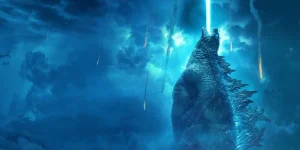
Godzilla arrives for the final confrontation.
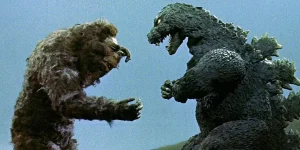
What follows is a brutal, slow, weighty battle emphasizing scale rather than spectacle. Every movement feels catastrophic.
Movie Ending
The ending delivers one of the most memorable kaiju finales in modern cinema.
Godzilla battles both MUTOs simultaneously and is nearly defeated when the female pins him down and the male attacks from above. At the brink of death, Godzilla summons his iconic atomic breath, blasting the male MUTO out of the sky.
In the final moments, the female MUTO attempts to strike again. Godzilla forces her jaws open and unleashes atomic breath directly down her throat, annihilating her from the inside.
With the MUTOs dead, Ford successfully destroys the nest before the nuclear explosion can occur.
Godzilla, heavily wounded, collapses into the ruins of San Francisco. News reports declare him dead.
Then the ground shifts.
Godzilla rises, lets out a final thunderous roar, and returns to the ocean.
The world realizes something unsettling yet hopeful:
Godzilla is not humanity’s enemy. He is nature’s answer to imbalance.
The final headlines read:
“Godzilla: Savior of Our City?”
Are There Post-Credits Scenes?
No. There are no mid-credit or post-credit scenes in Godzilla (2014).
However, the end credits include ancient cave paintings depicting Godzilla fighting multiple monsters, subtly foreshadowing the expanded MonsterVerse.
Type of Movie
Godzilla (2014) is a science fiction monster film with strong elements of disaster cinema and military thriller. It emphasizes realism, atmosphere, and tension over nonstop action.
Cast
- Aaron Taylor-Johnson as Ford Brody
- Bryan Cranston as Joe Brody
- Elizabeth Olsen as Elle Brody
- Ken Watanabe as Dr. Ishiro Serizawa
- Sally Hawkins as Dr. Vivienne Graham
- David Strathairn as Admiral Stenz
Film Music and Composer
The score was composed by Alexandre Desplat.
His music blends traditional orchestral power with ominous percussion, reinforcing the godlike presence of Godzilla. The theme emphasizes awe rather than heroism, perfectly matching the film’s tone.
Filming Locations
The movie was filmed across multiple locations:
- Vancouver, Canada (urban destruction scenes)
- Honolulu, Hawaii (airport and city sequences)
- California (military and coastal shots)
These locations were essential in grounding the film in realism. Real cities were used as visual references, making the destruction feel disturbingly authentic rather than stylized.
Awards and Nominations
- Academy Award nominee for Best Visual Effects (2015)
- Saturn Award winner for Best Science Fiction Film
- Visual Effects Society nominations
While divisive among fans, the film was widely praised for its visual realism.
Behind the Scenes Insights
- Gareth Edwards previously directed Monsters (2010) with only a $500,000 budget.
- Godzilla’s movements were intentionally slow to convey immense weight.
- The HALO jump scene was inspired by real military footage.
- Many monster scenes were shot from human eye level to enhance scale.
- Bryan Cranston was originally intended to have a much larger role.
Inspirations and References
- Original 1954 Godzilla film themes of nuclear fear
- Japanese Shinto mythology regarding natural balance
- Classic Toho monster cinematography
- Post-9/11 disaster imagery for emotional realism
Alternate Endings and Deleted Scenes
- Early drafts featured Godzilla dying permanently.
- Several military subplots were removed for pacing.
- Extended scenes involving Ford’s family were cut.
- Test screenings favored a more hopeful ending, leading to Godzilla’s survival.
Book Adaptations and Differences
The film is not directly adapted from a novel but draws heavily from Toho’s original Godzilla mythology.
Major differences from classic versions include:
- Godzilla as a protector rather than destroyer
- Scientific realism over fantasy explanations
- MUTOs replacing traditional monsters like Anguirus
Memorable Scenes and Quotes
Key Scenes
- The nuclear plant collapse
- Godzilla’s airport reveal in Hawaii
- The silent HALO jump through red smoke
- Atomic breath reveal during the final battle
- Godzilla’s final roar before returning to the sea
Iconic Quotes
- “The arrogance of man is thinking nature is in our control and not the other way around.”
- “Let them fight.”
- “He’s not here to save us. He’s here to restore balance.”
Easter Eggs and Hidden Details
- Godzilla’s roar incorporates the original 1954 sound design.
- Monarch logos reference classic Toho research agencies.
- News tickers mention unexplained ancient creatures worldwide.
- Cave paintings hint at future titans like King Ghidorah.
Trivia
- Godzilla is 355 feet tall in this version.
- The atomic breath appears only once, intentionally saved for impact.
- The film contains fewer than 15 minutes of monster screen time.
- Gareth Edwards insisted on natural lighting for CGI integration.
Why Watch?
You should watch Godzilla (2014) if you want:
- A serious, grounded monster movie
- Realistic scale and atmosphere
- Powerful visual storytelling
- A respectful modern reboot of a cinematic legend
This is not a popcorn monster brawl.
It is a film about fear, insignificance, and survival.
Director’s Other Works
- Monsters (2010)
- Rogue One: A Star Wars Story (2016)
- The Creator (2023)