
George of the Jungle (1997) is the kind of film that proudly knows it’s ridiculous and leans into that ridiculousness with style. Adapted from the 1960s Jay Ward cartoon, it combines slapstick, adventure, romance, and tons of self-aware narrator jokes.
Detailed Summary
The Legend of George
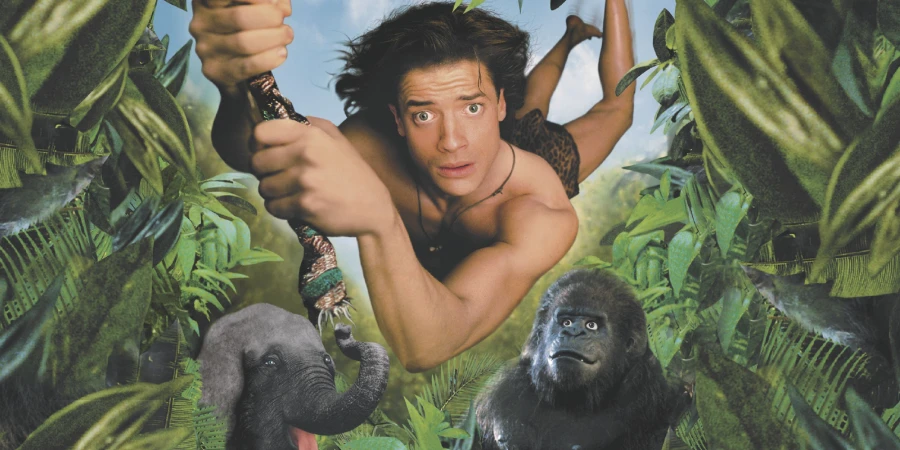
The film opens with the omniscient narrator explaining that a baby survived a plane crash in the jungle and was raised by gorillas, becoming George, “the King of the Jungle.” Raised by the wise talking ape Ape, George grows into a vine-swinging hero with a habit of crashing into trees at high speed.
Ursula Meets George
We meet Ursula Stanhope, a wealthy San Francisco socialite traveling in Africa. Her fiancé, the cartoonishly awful Lyle Van de Groot, accompanies her. During an expedition, Lyle accidentally causes chaos and Ursula is chased by a lion. George rescues her in classic jungle-hero fashion and takes her to his treehouse to recover.
Falling in Love, Jungle-Style
Ursula and George grow close as she discovers he’s innocent, sweet, strong, and deeply attached to the jungle and its animals. Meanwhile Ape educates George in everything from etiquette to British literature. Three poachers, including the returning Thor and Max, arrive hoping to capture Ape, who can talk and therefore is extremely valuable.
Back to San Francisco
After Lyle mistakenly shoots George, he is arrested and Ursula takes George back home to heal. In San Francisco, George becomes a media sensation and Ursula’s family warms to him—everyone except her controlling mother. George tries to adapt to city life but remains very much a jungle man, complete with vine-swinging across the Bay Area.
Chaos in the City
The poachers trail George to San Francisco, kidnap Ape, and plan to exploit him for profit. George senses trouble and returns to the jungle, where he must rescue his mentor. Ursula finally realizes she’s in love with George and follows him back to Africa, determined to be with him despite her family’s objections.

Movie Ending
George races back to the jungle, where the poachers attempt to smuggle Ape out. In a comedic and chaotic showdown, George defeats the poachers using his strength, vine-swinging skills, and the help of the jungle animals. Ape is rescued, and the poachers are humiliated.
Meanwhile, Ursula confronts Lyle, who has returned with delusional plans to marry her using a jungle witch doctor. Lyle ends up accidentally marrying a female gorilla instead, thanks to his own incompetence and misunderstanding of the ceremony.
George and Ursula reunite in the treetops. She confesses her love, and they swing together into a new life. The final sequence shows them married, living in the jungle, and welcoming their baby son, while Ape moves to Las Vegas to headline as a lounge singer (a fittingly bizarre epilogue). The narrator closes the film with one last meta joke, reminding viewers that the “dumb ones always fall in love with the gorilla.”
Are There Post-Credits Scenes?
Yes. During the credits, we see scenes featuring Ape thriving in Las Vegas as a performer. These play more like bonus comedic epilogues rather than story-advancing scenes, but they do occur after the movie’s main ending.
Type of Movie
- Family adventure comedy
- Slapstick parody
- Live-action adaptation of a classic animated series
Cast
- Brendan Fraser as George
- Leslie Mann as Ursula Stanhope
- Thomas Haden Church as Lyle Van de Groot
- Holland Taylor as Mrs. Stanhope
- Richard Roundtree as Kwame
- John Cleese as the voice of Ape
Film Music and Composer
The score was composed by Marc Shaiman, known for his energetic, comedic, and whimsical style. The movie also features memorable licensed songs, including the film’s standout gag: a literal “Bad to the Bone” needle drop when a villain appears.
Filming Locations
- Hawaii (Kauai): Used for the lush African jungle scenes due to its dense tropical forests and waterfalls. The scenery helped create the film’s adventurous, fairy-tale jungle aesthetic.
- San Francisco, California: Urban sequences featuring George trying to navigate modern life were shot on location, including iconic spots like the Golden Gate Bridge and surrounding neighborhoods.
- Los Angeles soundstages: Used for the elaborate indoor jungle sets and treehouse interiors.
The contrast between Hawaii’s natural tropical environment and San Francisco’s metropolitan density visually supports George’s journey between two worlds.
Awards and Nominations
While not an awards juggernaut, the film did receive recognition for its stunt work and Fraser’s physical performance. It earned nominations from the Blockbuster Entertainment Awards and recognition for costume design and makeup in family-film categories.
Behind the Scenes Insights
- Brendan Fraser performed many of his own stunts, including vine-swinging sequences that required intense physical training.
- The talking Ape was a complex creation involving Jim Henson’s Creature Shop, blending animatronics and puppetry.
- John Cleese recorded his lines separately but improvised many jokes that made it into the final cut.
- The production built a massive practical treehouse set, complete with working rope bridges and ladders.
- Fraser reportedly lost significant weight due to the intense physical demands and strict diet required for George’s physique.
Inspirations and References
- Based on the 1967 animated series George of the Jungle, created by Jay Ward, who also created Rocky and Bullwinkle.
- The film intentionally mimics the cartoon’s over-the-top narrator style and slapstick sensibility.
- Includes playful nods to Tarzan, classic pulp adventure novels, and comic jungle heroes.
Alternate Endings and Deleted Scenes
A few comedic scenes were trimmed, including extended slapstick moments in San Francisco and a longer version of Ape’s confrontation with the poachers. There are no confirmed alternate full endings, but early drafts reportedly included a more elaborate jungle wedding sequence.
Book Adaptations and Differences
The movie is not based on a book but on the 1960s cartoon series. The biggest differences include:
- A more detailed romantic arc between George and Ursula.
- New antagonists and expanded roles for side characters.
- A more emotionally grounded portrayal of George compared to the purely chaotic cartoon version.
Memorable Scenes and Quotes
Key Scenes
- George rescuing Ursula from the lion while the narrator mocks Lyle.
- George smashing into a tree mid-swing—the franchise’s signature gag.
- The San Francisco bridge vine swing.
- Ape’s Las Vegas lounge performance.
Iconic Quotes
- “Watch out for that tree!”
- Narrator: “No, no, the other way! Don’t run that way!”
- Lyle: “You’re just jealous because I’ve got a fiancé!”
- Ape: “I’ve taught him everything he knows. Unfortunately, I taught him everything I know.”
Easter Eggs and Hidden Details
- Repeated references to Jay Ward’s original cartoon characters.
- The Narrator often comments on technical production mistakes as if they’re canon.
- Ape’s love for culture and sophistication mirrors John Cleese’s real-life comedic persona.
- The villain poachers use props and costumes reminiscent of old adventure serials.
Trivia
- The film’s theme song is an updated version of the original cartoon theme.
- Brendan Fraser became an instant family-film icon because of this role.
- The movie was a surprise box-office success, leading directly to a 2003 sequel.
- Many animal sound effects were performed by voice actors, not actual animals.
Why Watch?
Because it’s one of the rare films that blends slapstick, romance, adventure, parody, and heart with unapologetic sincerity. It’s charming, funny, and surprisingly sweet, with Brendan Fraser delivering one of his most lovable performances.
Director’s Other Movies
Directed by Sam Weisman, who also worked on:
- The Out-of-Towners (1999)
- D2: The Mighty Ducks (1994)
- Bye Bye Love (1995)
Recommended Films for Fans
- The Mask (1994)
- Encino Man (1992)
- Jumanji (1995)
- The Jungle Book (1994)
- Tarzan (1999)
- Dudley Do-Right (1999)
- The Mummy (1999)