
Detailed Summary
Prelude / Arctic Framing
The film begins in 1857, aboard the Danish navy ship Horisont, stuck in Arctic ice. The crew rescues a gravely wounded Victor Frankenstein. Suddenly, they’re attacked by a hulking, regenerating Creature demanding Victor be handed over. Chaos erupts; the Creature is shot and seemingly sunk under the ice — but Victor claims it will return. What follows is Victor’s own confession of the tragedy that led to this moment.
A Childhood Forged in Grief
We flash back to Victor’s childhood: His mother dies giving birth to his brother William, and his aristocratic father (a respected surgeon) coldly favors William. The trauma of his mother’s death and his father’s neglect harden young Victor, shaping him into a brilliant but emotionally fractured man. Driven by grief and ambition, he becomes obsessed with defeating death.
Expulsion and Isolation
In 1855 he is expelled from the Royal College of Surgeons in Edinburgh after attempting to reanimate a corpse — seen as sacrilegious. Isolated and desperate, Victor accepts funding from an arms dealer, Henrich Harlander (portrayed by Christoph Waltz), and is given a remote tower/laboratory to continue his experiments. He enlists his brother’s help and becomes infatuated with William’s fiancée, Elizabeth Harlander (Mia Goth), who rebuffs him.
The Creation
Under pressure from Harlander, Victor assembles a body from corpses — criminals executed and soldiers killed in the Crimean War — and attempts to harness electricity to animate it. Harlander, terminally ill with syphilis, demands his brain be used. Victor refuses. After Harlander dies in a fall during a confrontation, Victor proceeds. That stormy night, lightning strikes — and the Creature awakens. Victor is horrified and chains him up. The Creature is physically imposing with regenerative abilities, but barely able to speak — at first, only manages the name “Victor.”
A Cycle of Cruelty and Kindness
Despite Victor’s hopes, he treats the Creature cruelly — echoing the abuse Victor endured from his father. The Creature, confused and lonely, lashes out. Eventually Elizabeth takes pity on him; she tries to teach him language and shows him kindness. The Creature, yearning for belonging, briefly rescues a blind old man from wolves — an early glimpse of his capacity for compassion. But rejection remains constant.
The Final Refusal and Tragedy
As the Creature realizes his immortality alone, he demands Victor create a companion / mate so he’s not condemned to eternal solitude. Victor refuses — fearing the consequences of more such beings. That refusal ignites tragedy: on the night of William and Elizabeth’s wedding, the Creature appears. In the ensuing panic, Victor shoots — but accidentally hits Elizabeth. The Creature, enraged and grief-stricken, kills several attackers and carries the wounded Elizabeth away. She dies in a cave. William also dies — in Victor’s arms, calling him the real monster.
Transition: The Creature’s Perspective and Vengeance
From this point, the film shifts tone: it’s no longer just Victor’s tragic ambition, but a tragic story of rejection, rage, and grief — from the Creature’s point of view. He becomes the hunted, and Victor the pursuer. Haunted by guilt and loss, Victor vows vengeance and chases the Creature across frozen landscapes, eventually ending up back where the film began — the Arctic, aboard the ice-trapped ship.
Movie Ending
By the end, Victor is mortally wounded and aboard the stranded ship. The Creature boards as well. Instead of vengeance, the Creature confronts Victor — not with hate, but with pain and sorrow. Victor finally acknowledges his failure and asks forgiveness. The Creature, emotionally raw, forgives him. Victor dies. The Creature, using his immense strength, frees the ship from the ice so the crew can return home. Then — instead of vanishing in despair — he walks into the rising Arctic sun, alone but alive, accepting his existence.
This ending is a big departure from the novel: rather than a tragic mutual doom, it ends on a note of remorse, forgiveness, and ambiguous hope — the Creature lives on. The final moments emphasize themes of compassion, redemption, and the possibility of healing — even for beings made of sorrow.
Are There Post-Credits Scenes?
No — the film does not feature any post-credits scene. The story is self-contained; the final image of the Creature walking into the Arctic sunrise serves as the thematic closure.
Type of Movie
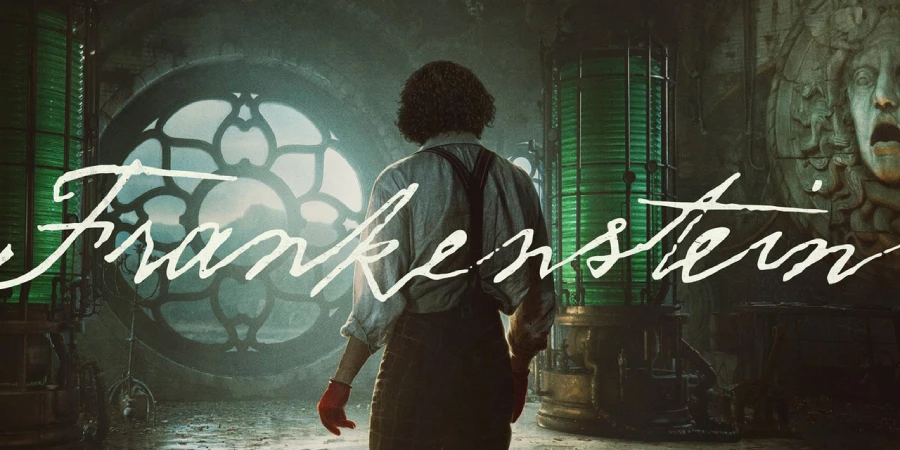
This is a Gothic-style, emotionally driven science fiction / drama. It blends horror elements, period-setting, romantic tragedy and moral complexity in a cinematic vision more interested in empathy and redemption than shocks.
Cast
- Oscar Isaac as Victor Frankenstein
- Jacob Elordi as the Creature (Frankenstein’s creation)
- Mia Goth in dual-role capacities: as Elizabeth Harlander (Victor’s brother’s fiancée) and in flashbacks as Victor’s mother.
- Christoph Waltz as arms-dealer/funder Henrich Harlander.
- Supporting: Felix Kammerer (William), Charles Dance (Victor’s father), Lars Mikkelsen (Captain Anderson), David Bradley (blind man), Ralph Ineson (professor), Burn Gorman (executioner), among others.
Film Music and Composer
The score is by Alexandre Desplat, who reunites with director for this film — previously collaborating on The Shape of Water (2017) and Pinocchio (2022). The music leans toward lyrical, emotional tones rather than traditional horror — matching the film’s tragic, romantic, gothic mood.
Filming Locations
Principal photography began February 2024 in Toronto, then additional filming occurred in Edinburgh (Royal Mile), Arbroath (Hospitalfield House), and in Stamford, Lincolnshire (Burghley House) — utilizing these historical / gothic-looking European settings to evoke the 19th-century aesthetic.
These choices reinforce the film’s atmosphere: cold stone streets, old mansions, decaying grandeur — all supporting the story’s themes of decay, mortality, ambition and ruin. Del Toro’s production design blends romantic gothic visuals with metaphorical weight.
Awards and Nominations
While the full awards season is still ongoing, the film has already earned significant recognition: it premiered at the 82nd Venice International Film Festival with a long ovation and is considered one of the most lauded films of 2025.
Major film institutions such as the National Board of Review and the American Film Institute listed it among the top ten films of the year.
Behind the Scenes Insights
- The project was a long-cherished dream for director Guillermo del Toro — he spent decades trying to bring a faithful yet personal adaptation to screen.
- Scenes involving the Creature and Elizabeth were shot at 36 frames per second (higher than standard 24 fps), to heighten emotional realism — particularly subtle gestures like trembling faces or fluttering clothing.
- The Creature’s design blends practical prosthetics with digital enhancements: its form draws from anatomical art and Renaissance sculpture, giving a fragile, “newborn” vulnerability rather than monstrous exaggeration.
- Oscar Isaac described the movie as “very European story, told through a Latin American / Mexican Catholic point of view,” hinting at the emotional intensity, religious imagery, and personal stakes underlying the gothic horror.
Inspirations and References
- The film is based (largely) on the classic 1818 novel Frankenstein; or, The Modern Prometheus by Mary Shelley.
- Visually and thematically, the film draws from gothic horror tradition — but del Toro frames it with influences from Romantic literature and classical tragedy, even hinting at parallels with works like Paradise Lost.
Alternate Endings and Deleted Scenes
So far no public record of alternate endings or extended deleted scenes have been released. The version streaming on Netflix appears to be the definitive cut. The shift from the novel’s tragic ending to a (somewhat) hopeful one seems intentional and central to del Toro’s vision.
Book Adaptations and Differences
Compared to Mary Shelley’s novel:
- The film modifies character dynamics — Victor is shown as more overtly cruel / abusive, while the Creature is portrayed with more empathy and capacity for kindness. That changes the moral ambiguity: in the film, humans (especially Victor) carry the darkest sins.
- The ending diverges dramatically: in the book, the Creature vows vengeance and misery; in the film, he forgives Victor and walks into the light. That turns the story from pure tragedy into something like a melancholic redemption.
- Also, in the film the Creature’s immortality and regenerative powers are more explicitly emphasized, adding a quasi-supernatural dimension absent in Shelley’s more philosophical/horror original.


Memorable Scenes and Quotes
Key Scenes
- The moment of creation: the lightning strike, the Creature awakening — a newborn in a monstrous shell, trembling with fear and confusion.
- The Creature’s gentle rescue of the blind old man — a small act of compassion that powerfully contrasts with Victor’s cruelty.
- The wedding-night tragedy: chaos, betrayal, accidental shooting, death of Elizabeth and William — emotional climax that sets the final chapters in motion.
- Arctic finale: Victor’s death, the Creature freeing the ship from ice, then walking alone into the sunrise — haunting, somber, but strangely hopeful.
Iconic Quotes
Although the film doesn’t yet have a widely shared quote-list, the closing sentiment — paraphrased by the Creature as “The heart will break and yet brokenly live on” — stands out as emblematic of this adaptation’s tone: tragic but persevering.
Easter Eggs and Hidden Details
- The Creature’s design references anatomical art and Renaissance sculpture — a nod to classical ideas of human form, beauty and tragedy.
- The cinematography and lighting underline Gothic symbolism: deep shadows, saturated reds and blacks, haunting interiors — visual cues to sin, guilt, and inner turmoil.
- The film structure uses a framing device (Arctic ship + flashback) to mirror isolation — beginning and ending in ice, reflecting themes of death, fate, and rebirth.
Trivia
- The film’s runtime is 150 minutes.
- Del Toro had been trying to adapt Frankenstein for many years; this is his long-dreamed version.
- The Creature is played by Jacob Elordi — replacing earlier plans (in previous decades) when the project was under different studios.
- Scenes with the Creature and Elizabeth were shot at a higher frame rate to enhance emotional subtleties — not common in mainstream horror movies.
Why Watch?
If you appreciate gothic atmosphere, tragic romance, and morally complex storytelling, this film offers one of the richest, most visually lavish adaptations of Frankenstein in recent memory.
It reimagines the Creature not as a monster to fear — but as a tragic soul yearning for empathy and acceptance. The visual design, the music, and the performances (especially from Jacob Elordi and Oscar Isaac) make it one of 2025’s most emotionally resonant films.
Director’s Other Movies
- Pan’s Labyrinth (2006)
- The Shape of Water (2017)
- Hellboy (2004)
- Hellboy II: The Golden Army (2008)
- Crimson Peak (2015)