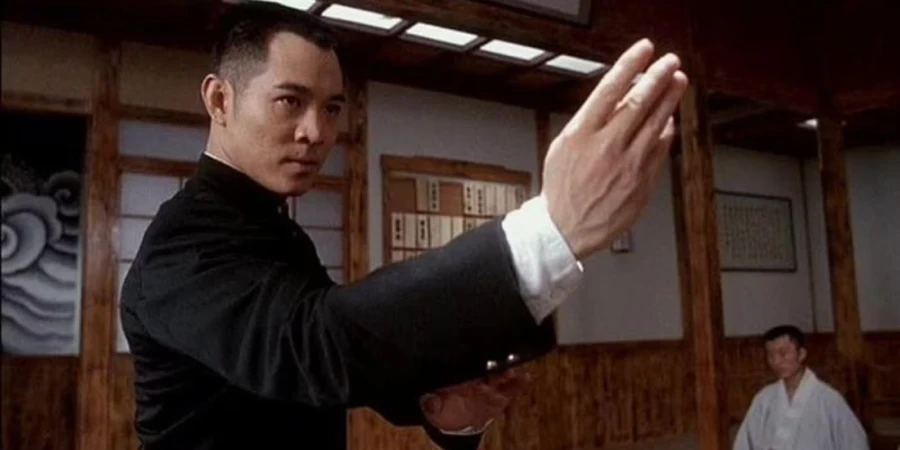
Fist of Legend (1994) is widely regarded as one of the greatest martial arts films ever made. Directed by Gordon Chan and starring Jet Li at the peak of his physical prowess, the film is both a respectful remake of Bruce Lee’s Fist of Fury and a sharper, more politically nuanced reinterpretation. It blends blistering fight choreography with themes of nationalism, racism, honor, and identity.
Detailed Summary
Arrival in Shanghai and the Death of Huo Yuanjia
The film begins in 1937, during the Japanese occupation of Shanghai. Chen Zhen (Jet Li), a Chinese student studying in Japan, returns home after learning that his master, Huo Yuanjia, founder of the Jingwu School, has died under mysterious circumstances.
Chen arrives to find the Jingwu School humiliated by the Japanese-run Hongkou Dojo. From the outset, racial oppression and national tension are front and center. Chen’s quiet grief quickly turns into suspicion when he notices inconsistencies surrounding his master’s death.
The Hongkou Dojo Confrontation
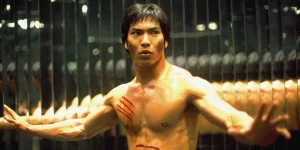
Chen confronts the Hongkou Dojo alone, defeating multiple Japanese martial artists in one of the film’s most iconic sequences. Unlike Bruce Lee’s version, this scene is less about raw fury and more about technical superiority and moral restraint, emphasizing Chen’s discipline rather than rage.
This moment establishes Chen Zhen as a symbol of resistance, but also paints a target on his back.
Poison, Betrayal, and the Truth
Chen secretly exhumes Huo Yuanjia’s body and discovers traces of poison, proving that his master was murdered. The plot thickens when it’s revealed that the poisoning was orchestrated not by Japanese fighters directly, but through political manipulation and Chinese collaborators.
This revelation deepens the film’s moral complexity. The enemy is no longer simply “the other,” but corruption and betrayal from within.
Love Across Enemy Lines
Chen’s relationship with Mitsuko (Shinobu Nakayama), a Japanese woman he met while studying abroad, adds emotional depth. Their bond challenges the simplistic idea of nationalism and highlights the film’s recurring message: hatred is taught, not inherent.
Their love, however, is doomed by the realities of war and prejudice.
Escalation and Open War Between Schools
As tensions escalate, the Jingwu School is attacked, students are beaten, and Chen is framed for murder. Internal divisions weaken the Chinese side, while Japanese forces tighten their grip.
Chen eventually uncovers the full conspiracy involving General Fujita, whose goal is to dismantle Chinese martial pride by destroying Jingwu from the inside.
Movie Ending
The final act delivers both physical and emotional closure.
Chen confronts General Fujita in a brutal, technically precise fight that contrasts sharply with earlier dojo battles. Fujita relies on raw strength and militaristic aggression, while Chen’s style is fluid, adaptive, and intelligent. Chen ultimately kills Fujita, symbolically defeating the ideology behind the occupation rather than just the man himself.
However, victory comes at a cost.
Knowing that his continued existence will bring destruction upon Jingwu, Chen chooses exile over glory. In the final scene, he attempts to cross the border with Mitsuko. Japanese soldiers open fire. The film deliberately leaves Chen’s fate ambiguous, but heavily implies his death.
The Jingwu students watch from afar, understanding that Chen Zhen has become a legend rather than a man. His sacrifice ensures the survival of the school and preserves its honor.
The ending reinforces the film’s central idea: true victory is not survival, but legacy.
Are There Post-Credits Scenes?
No. Fist of Legend does not include any post-credits or mid-credits scenes. The story ends definitively with its final moments.
Type of Movie
Fist of Legend is a martial arts action drama rooted in historical fiction. It combines traditional kung fu cinema with political commentary, elevating it beyond a standard revenge narrative.
Cast
- Jet Li as Chen Zhen
- Shinobu Nakayama as Mitsuko Yamada
- Chin Siu-ho as Huo Ting’en
- Billy Chow as General Fujita
- Yasuaki Kurata as Funakoshi
Film Music and Composer
The score was composed by Joseph Koo, whose music subtly reinforces the emotional weight of the story rather than overpowering it. Traditional Chinese melodies are blended with somber orchestration to reflect loss, resistance, and dignity.
Filming Locations
The film was shot primarily in Shanghai and Hong Kong, with sets recreating 1930s occupied Shanghai.
These locations are essential to the film’s atmosphere. The narrow streets, dojo interiors, and colonial architecture visually reinforce the sense of cultural suffocation and foreign dominance that defines Chen Zhen’s struggle.
Awards and Nominations
While not heavily awarded internationally, Fist of Legend is consistently ranked among the greatest kung fu films ever made by critics and filmmakers. It is particularly praised for its choreography and thematic maturity.
Behind the Scenes Insights
- Jet Li deliberately restrained facial expressions to differentiate his Chen Zhen from Bruce Lee’s explosive portrayal.
- Fight choreographer Yuen Woo-ping emphasized realistic timing and counter-techniques, influencing modern martial arts cinema.
- Gordon Chan aimed to make the Japanese characters more human and less cartoonishly villainous.
- Jet Li performed most of his own stunts with minimal wire work.
Inspirations and References
The film is based on Fist of Fury (1972), starring Bruce Lee, which itself was inspired by the real-life figure Huo Yuanjia. The movie also draws heavily from Chinese nationalist history during the Second Sino-Japanese War.
Alternate Endings and Deleted Scenes
Early drafts reportedly featured a clearer on-screen death for Chen Zhen. The final version opted for ambiguity to strengthen the mythic quality of the character. Several political exposition scenes were shortened to improve pacing.
Book Adaptations and Differences
There is no direct novel adaptation. Compared to Fist of Fury, this version:
- Adds moral ambiguity
- Humanizes Japanese characters
- Shifts focus from rage to controlled resistance
- Expands the role of internal betrayal
Memorable Scenes and Quotes
Key Scenes
- Chen Zhen single-handedly defeating the Hongkou Dojo
- The secret autopsy revealing Huo Yuanjia’s poisoning
- The final duel between Chen Zhen and General Fujita
- Chen’s farewell to Jingwu before exile
Iconic Quotes
- “The strong are not those who dominate, but those who endure.”
- “Martial arts are not for hatred.”
Easter Eggs and Hidden Details
- The dojo signboards mirror those used in Bruce Lee’s original film.
- Chen’s fighting stance subtly evolves, reflecting his internal growth.
- Funakoshi’s character symbolizes real-world martial arts philosophy over militarism.
Trivia
- Quentin Tarantino has cited this film as his favorite Jet Li performance.
- The movie influenced the choreography style of The Matrix (1999).
- Jet Li considered this his most meaningful role emotionally.
Why Watch?
If you care about martial arts cinema as an art form, this film is essential viewing. It offers breathtaking action, moral depth, and a protagonist whose strength lies as much in restraint as in fists.
Director’s Other Works
- Hard Target (1993)
- Beast Cop (1998)
- The Medallion (2003)
- Bleeding Steel (2017)