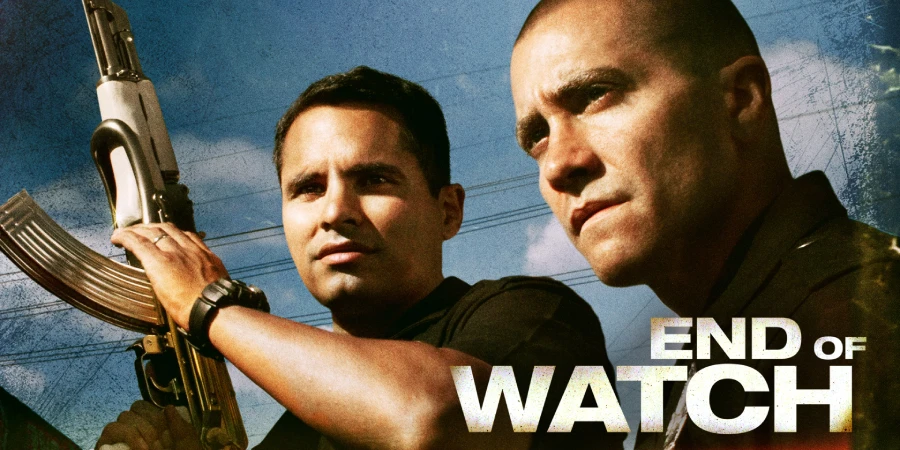

End of Watch is one of those films that quietly walks up to you, earns your trust, and then completely wrecks you emotionally. Directed by David Ayer, this found-footage–style crime drama offers an unfiltered look into the daily lives, brotherhood, and dangers faced by LAPD patrol officers in South Central Los Angeles.
Detailed Summary
Everyday Heroes in a Dangerous Neighborhood
The film follows Officer Brian Taylor (Jake Gyllenhaal) and Officer Mike Zavala (Michael Peña), two LAPD officers assigned to one of the most dangerous districts in Los Angeles. Brian documents their patrols as part of a college project, which becomes the narrative device for the movie’s found-footage style.
What stands out early is the natural chemistry and humor between the two cops. They joke, tease, and rely on each other completely. This isn’t a movie about “super cops” — it’s about working-class officers trying to survive each shift.
Brotherhood, Love, and Normal Life
Outside the job, both men are building lives:
- Brian falls in love with Janet, a law student.
- Mike is married to Gabby, who is pregnant.
These domestic moments are crucial. They humanize the characters and quietly raise the emotional stakes. You begin to realize the film isn’t just about crime—it’s about what these men stand to lose.
The Cartel Connection
Things escalate when Brian and Mike interrupt a routine call and uncover a major drug operation tied to a Mexican cartel. This is the turning point of the film. From here on, their patrol car numbers, names, and faces are known.
The tone shifts subtly:
- Surveillance increases
- Threats become more personal
- Violence feels inevitable
David Ayer deliberately avoids dramatic music cues or obvious warnings. The danger creeps in slowly, just like it would in real life.
The Net Tightens
Gang members begin watching the officers. A chilling scene shows criminals filming Brian and Mike from a distance, mirroring the movie’s own found-footage style. The audience knows what’s coming—but the officers don’t.
This section is all about tension and dread, not action.

Movie Ending
The final act is brutal, sudden, and devastating.
Brian and Mike respond to a call in a hostile neighborhood at night. Almost immediately, they are ambushed by gang members connected to the cartel. Gunfire erupts from every direction.
- Mike Zavala is shot multiple times and collapses in the alley.
- Brian, injured but mobile, refuses to leave him behind.
- Despite calling for backup, Brian realizes help won’t arrive in time.
Mike dies in Brian’s arms.
Moments later, Brian is executed at point-blank range by a gang member. The camera drops. Silence.
Then—unexpectedly—the film cuts to Brian’s funeral.
In a twist that shocks many viewers:
- Brian survived the execution attempt
- His wife Janet is now pregnant
- Mike’s wife Gabby names her child after Brian
The ending is not triumphant. It’s somber, heavy, and realistic. Evil doesn’t fully lose. Good doesn’t fully win. Life simply goes on—scarred.
This ending hits so hard because the film spends so much time convincing you these men are real.
Are There Post-Credits Scenes?
No.
End of Watch has no post-credits scenes. The film ends definitively, and any extra footage would only dilute its emotional impact.
Type of Movie
End of Watch is a gritty crime drama and police procedural presented through a semi–found-footage style, blending realism with emotional storytelling. It prioritizes character and authenticity over spectacle.
Cast
- Jake Gyllenhaal – Officer Brian Taylor
- Michael Peña – Officer Mike Zavala
- Anna Kendrick – Janet Taylor
- Natalie Martinez – Gabby Zavala
- America Ferrera – Officer Orozco
- Frank Grillo – Sergeant Davis
Film Music and Composer
The score was composed by David Sardy, whose minimalist and restrained music allows realism to dominate. Long stretches of the film contain no music at all, increasing immersion and tension.

Filming Locations
The movie was shot almost entirely in South Central Los Angeles.
Why this matters:
- Real neighborhoods and streets enhance authenticity
- Many extras were local residents
- The environment feels lived-in, not staged
David Ayer insisted on shooting in real locations to avoid romanticizing violence or policing.
Awards and Nominations
While not a major awards darling, the film received:
- Strong critical praise
- Recognition for Best Ensemble Cast at several critics’ associations
- Long-term appreciation as one of the most realistic cop films of the 2010s
Behind the Scenes Insights
- Jake Gyllenhaal and Michael Peña went through five months of real LAPD ride-alongs
- Officers reportedly forgot they were actors during patrols
- Much of the dialogue was semi-improvised
- David Ayer is the son of a former police officer, heavily influencing the script
- The cast trained extensively in police tactics and firearms handling
Inspirations and References
- Real-life LAPD patrol experiences
- David Ayer’s earlier work on Training Day
- Documentary-style police footage
- Actual gang-related incidents in Los Angeles
Alternate Endings and Deleted Scenes
- An alternate ending where Brian dies was considered
- A longer hospital aftermath scene was filmed but cut
- A deeper cartel subplot was removed to maintain focus on the officers
The final cut favors emotional realism over narrative closure.
Book Adaptations and Differences
The film is not based on a book, but Brian’s in-movie video diary functions as a literary device, mimicking memoir-style police writing.
Memorable Scenes and Quotes
Key Scenes
- The traffic stop that escalates into a shootout
- Brian and Mike joking in the patrol car before everything changes
- The final alley ambush
- Brian’s wedding scene, quietly full of dread in hindsight
Iconic Quotes
- “You watch my back, I’ll watch yours.”
- “We might not be heroes, but we’re family.”
- “This job will kill you if you let it.”
Easter Eggs and Hidden Details
- Badge numbers used are real LAPD formats
- Gang graffiti references real Los Angeles sets
- The handheld camera quality degrades as danger increases
- Brian’s narration subtly foreshadows the ending
Trivia
- Michael Peña gained weight to look more like a real patrol officer
- Many background actors were former gang members
- Some scenes were shot in one take to preserve realism
- Police departments praised the film’s accuracy
Why Watch?
Watch End of Watch if you want:
- A raw, emotionally honest crime film
- One of the most authentic portrayals of police work ever made
- A story about friendship that hurts in the best way
This is not an action movie. It’s a gut punch with a badge.
Director’s Other Works (Movies)
- Training Day (2001) – Writer
- Harsh Times (2005)
- Street Kings (2008)
- Fury (2014)
- Bright (2017)
- The Beekeeper (2024)