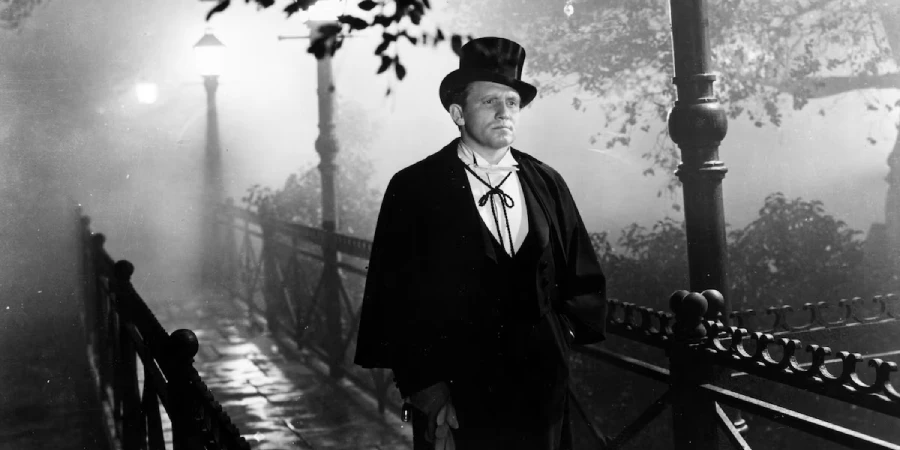

Victorians hid their darkest impulses behind starched collars and polite tea service. Spencer Tracy shatters this facade in the 1941 adaptation of Dr. Jekyll and Mr. Hyde. This film transforms a classic Gothic tale into a Freudian nightmare of repressed sexuality and brutal violence.
Detailed Summary
The Dangerous Experiment
Dr. Harry Jekyll believes every human soul contains two distinct warring personalities. He wants to isolate these sides to cure the world of evil. Consequently, he develops a chemical formula to separate these internal forces after observing a man suffer a mental breakdown in church.
His peers at the university mock his radical theories. Even his future father-in-law, Sir Charles Emery, views his experiments with deep suspicion. Jekyll remains obsessed with proving that a chemical solution can liberate the virtuous side of man from his animalistic urges.
The First Transformation
Jekyll finally consumes his serum alone in his laboratory. The camera captures a hallucinatory sequence involving flowers and water as his psyche fractures. He emerges as the squat, menacing Mr. Hyde.
This new version of the doctor lacks all moral restraint. He takes immediate pleasure in his newfound physical power and lack of guilt. Hyde represents the unbridled Id, free from the social shackles of late-19th-century London society.
The Torture of Ivy
Hyde tracks down a barmaid named Ivy Pearson whom Jekyll had helped earlier. He rescues her from a scuffle only to trap her in a cycle of psychological and physical abuse. He keeps her in a luxurious apartment while his cruelty grows increasingly sadistic.
Ivy lives in constant terror of this monster. She eventually visits Jekyll, not realizing he and Hyde are the same person. The doctor promises her safety, but his control over the transformation begins to slip.
The Descent Into Chaos
Jekyll tries to stop his experiments and commits to his fiancee, Beatrix Emery. However, his body now transforms into Hyde without the assistance of the drug. He finds himself stuck in the park as his monstrous form and must send a message to his friend Dr. Lanyon for help.
Lanyon witnesses the horrifying transition back into Jekyll and learns the truth. The doctor promises to reform once more. Unfortunately, the primal urges of Hyde prove too strong to keep buried for long.

Movie Ending
Hyde murders Ivy in a fit of jealous rage after she speaks of her love for Jekyll. He then flees to the Emery household where he terrifies Beatrix. Sir Charles tries to intervene, but Hyde beats the old man to death with a heavy cane.
The police pursue the murderer through the fog-drenched streets of London. Hyde retreats to his laboratory and manages to drink the antidote just as his friend Lanyon arrives with the authorities. They find Jekyll looking frail and exhausted.
The physical strain of the transformation suddenly causes Jekyll to shift back into Hyde during the interrogation. Lanyon realizes there is no hope for recovery as the monster attacks. A police officer shoots the beast to save Lanyon.
Hyde falls to the floor and slowly reverts to the peaceful face of Harry Jekyll in death. His soul finally finds the separation he sought, though only through total destruction. His transition back to a human form serves as a grim final image for his shocked friends.
Are There Post-Credits Scenes?
No post-credits scenes exist in this 1941 production. This practice did not become common in Hollywood until decades later. The film ends traditionally with a “The End” title card over a final musical swell.
Type of Movie
This film remains a classic example of Gothic Horror and psychological drama. It maintains a dark, brooding tone that emphasizes the bridge between science and madness.
Cast
- Spencer Tracy – Dr. Harry Jekyll / Mr. Hyde
- Ingrid Bergman – Ivy Pearson
- Lana Turner – Beatrix Emery
- Donald Crisp – Sir Charles Emery
- Ian Hunter – Dr. John Lanyon
- Barton MacLane – Sam Higgins
- C. Aubrey Smith – Bishop
- Sara Allgood – Mrs. Higgins
Film Music and Composer
Franz Waxman composed the haunting musical score for this adaptation. He used dissonant themes to reflect the mental instability of the protagonist. Specifically, the music swells during the transformation scenes to heighten the sense of supernatural dread.
Waxman earned praise for his ability to blend traditional orchestral sounds with experimental arrangements. His work underscores the tragedy of Jekyll while making the presence of Hyde feel physically oppressive.
Filming Locations
The production took place entirely on the MGM Studios lot in Culver City. Art directors built elaborate sets to recreate the districts of London. These controlled environments allowed for the heavy use of artificial fog and moody lighting.
Constructing the city in a studio gave the director total control over the atmosphere. This artificiality emphasizes the stifling nature of the Victorian era. The laboratory set stands out for its cold, clinical design that contrasts with the warmth of the Emery home.
Awards and Nominations
The film received three Academy Award nominations. These included Best Cinematography (Black-and-White), Best Film Editing, and Best Score of a Dramatic Picture.
Behind the Scenes Insights
- Ingrid Bergman requested to play the “bad” girl Ivy instead of the refined Beatrix.
- The studio originally wanted her as the virtuous fiancee but she pushed for the more challenging role.
- Spencer Tracy disliked his own performance and felt he was miscast.
- The makeup for Hyde was intentionally more subtle than the 1931 version to focus on psychological changes.
- Director Victor Fleming clashed with Tracy over how aggressive the Hyde character should act.
Inspirations and References
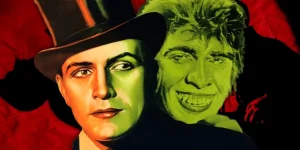
The film adapts the 1886 novella Strange Case of Dr Jekyll and Mr Hyde by Robert Louis Stevenson. It also draws heavy inspiration from the 1931 film version starring Fredric March. Specifically, the 1941 script focuses more on the Freudian elements of the characters’ sexuality.
Alternate Endings and Deleted Scenes
The Hays Code censors closely monitored the production of this film. As a result, certain scenes involving Hyde’s abuse of Ivy were toned down or removed. No alternate endings were filmed because the studio stayed loyal to the source material’s tragic conclusion.
Book Adaptations and Differences
The movie introduces a love triangle that does not exist in the original book. In Stevenson’s novella, Jekyll is an older bachelor and the story functions as a mystery for his lawyer. This film shifts the focus to romantic jealousy and the internal struggle for moral purity.
MGM removed many of the supporting characters from the book to focus on the women in Jekyll’s life. Consequently, the film feels more like a domestic drama than the Victorian detective story found on the page.
Memorable Scenes and Quotes
Key Scenes
- The first transformation sequence featuring surreal, Freudian dream imagery.
- Hyde singing “Champagne Charlie” while tormenting a terrified Ivy.
- The accidental transformation in the park that forces Jekyll to reveal his secret to Lanyon.
- The final confrontation in the lab where the shift between identities becomes uncontrollable.
Iconic Quotes
- “I have no soul, only desires.”
- “You’re a good man, Jekyll, but a better devil.”
- “The experiment is over, and I am the result.”
Easter Eggs and Hidden Details
- The dream sequence uses symbols like a carriage whip to represent Hyde’s desire for dominance.
- Paintings in Jekyll’s home change their appearance depending on his current mental state.
- The bottles in the lab were arranged to look like a cage in certain camera angles.
- Shadows often create the shape of a beast behind Jekyll before he even drinks the serum.
Trivia
- Lana Turner was only 20 years old during the filming of the movie.
- The 1931 version was suppressed by MGM for years to prevent competition with this remake.
- This film marks one of the few horror roles in the career of Spencer Tracy.
- Makeup artists used a special purple light to hide and reveal facial contours during transformations.
Why Watch?
This classic remains essential for fans of psychological horror. The performances by Spencer Tracy and Ingrid Bergman provide a masterclass in intensity. Additionally, the film offers a fascinating look at how 1940s cinema handled the concept of repressed human evil.
Director’s Other Movies
- Gone with the Wind (1939)
- The Wizard of Oz (1939)
- Treasure Island (1934)
- Captains Courageous (1937)
Recommended Films for Fans
- The Picture of Dorian Gray (1945)
- The Wolf Man (1941)
- Gaslight (1944)
- Dr. Jekyll and Mr. Hyde (1931)