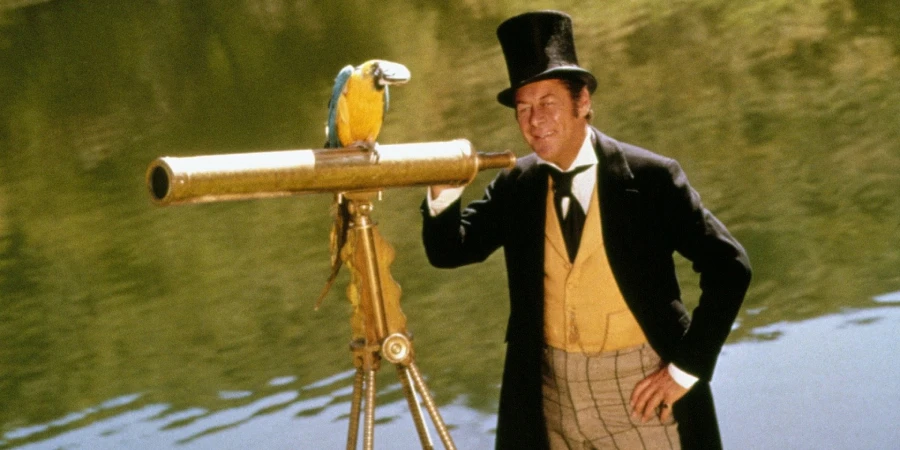

Doctor Dolittle (1967) is a colorful, old-school musical fantasy directed by Richard Fleischer. Adapted from Hugh Lofting’s classic novels, it blends whimsy, spectacle, and lavish musical numbers with the charm of a man who can talk to animals.
Detailed Summary
The Beginning: Dolittle’s Peculiar Genius
Set in Victorian England, the story introduces Dr. John Dolittle, a brilliant but socially awkward physician who becomes disillusioned with treating humans. His turning point arrives when he discovers he can talk to animals — a revelation that transforms his quiet village life into one filled with exotic creatures and wild ambitions.
The Setup: A House Full of Animals and Problems
Dolittle’s home becomes a sanctuary for animals of every kind, from parrots to horses to seals. This leads to rising complaints from townspeople who consider him eccentric (at best) and insane (at worst). His devotion to animals deepens further when he sets his sights on finding the legendary Great Pink Sea Snail, rumored to be enormous and gentle.
The Voyage Begins: Trouble at Sea
Joined by friends Matthew Mugg and Tommy Stubbins, Dolittle sets off on a ship to locate the snail. Along the way, storms, mutinies, and comedic mishaps ensue. Despite these problems, Dolittle’s knowledge of animal languages helps them fend off crises and build alliances with creatures they meet.
Arrival on Sea-Star Island
The crew is eventually shipwrecked on Sea-Star Island, an isolated floating landmass inhabited by Polynesian-inspired cultures. At first treated with hostility, Dolittle uses his animal communication skills to negotiate peace and earn respect. The island later becomes critical because it begins drifting toward colder waters.
The Great Pink Sea Snail
Dolittle finally encounters the mythical creature, discovering that it is both gigantic and gentle — and, more importantly, capable of offering the group safe passage back home. This moment is one of the film’s most iconic and whimsical, delivering on the story’s magical buildup.
Movie Ending
The film’s ending brings together adventure, spectacle, and gentle moral messaging. After leaving Sea-Star Island inside the Great Pink Sea Snail, Dolittle returns to England only to be immediately placed on trial for an earlier misunderstanding that involved helping a seal escape captivity.
At the trial, the townspeople are ready to condemn him, but Dolittle uses his remarkable gift to prove his innocence. Thanks to a helpful push from his animal friends, and from people whose lives he has changed, the court turns sympathetic.
Despite finally being free, Dolittle realizes he no longer truly belongs in a typical English village life. His heart — and his sense of purpose — lie with the animal kingdom.
In a final grand gesture, the giant Lunar Moth arrives to take him away on its back, allowing Dolittle to continue his adventures around the world. The film closes on a tone of magical possibility: Dolittle soaring into the sky, leaving human confines behind and embracing his life’s calling.
It is a definitive ending, yet open-minded enough to suggest his adventures will continue forever.
Are There Post-Credits Scenes?
No, there are no post-credits scenes in Doctor Dolittle (1967). The film ends traditionally, with the credits rolling after the final story moment.
Type of Movie
The film is a musical fantasy adventure grounded in family-friendly storytelling. Its tone is whimsical and theatrical, emphasizing spectacle and classic Hollywood charm.
Cast
- Rex Harrison as Dr. John Dolittle
- Samantha Eggar as Emma Fairfax
- Anthony Newley as Matthew Mugg
- William Dix as Tommy Stubbins
- Richard Attenborough as Albert Blossom
- Peter Bull as General Bellows
Film Music and Composer
The score and songs were composed by Leslie Bricusse, whose work earned the film Academy Award nominations. Memorable musical numbers include If I Could Talk to the Animals, Beautiful Things, and My Friend the Doctor. The soundtrack is central to the film’s personality and longevity.
Filming Locations
Doctor Dolittle was filmed in several locations, notably:
- England, including Wiltshire and St. Lucia (used for Sea-Star Island)
- California, for studio sets such as Dolittle’s home and village
These locations were chosen to bring authenticity to Victorian England and vibrant color to the exotic island sequences. The St. Lucia scenes, in particular, gave the film its lush tropical look, grounding the more fantastical narrative in real, natural beauty.
Awards and Nominations
- Won: Academy Award for Best Original Song (Talk to the Animals)
- Won: Academy Award for Best Visual Effects
- Nominated: Best Picture
- Nominated: Best Cinematography
- Nominated: Best Art Direction
Though the movie faced production troubles, it still achieved substantial recognition in technical and musical categories.
Behind the Scenes Insights
- Rex Harrison allegedly insisted on singing live on set, causing audio headaches for the sound team.
- The large number of live animals created constant unpredictability on set.
- Samantha Eggar’s singing voice was dubbed, a common practice for musicals of the era.
- The production was so expensive and chaotic that it became infamous in Hollywood for decades.
- Several actors reported that the animals frequently “upstaged” them or interfered with takes.
Inspirations and References
The film is based on Hugh Lofting’s Doctor Dolittle books, which he wrote for his children during World War I. The character’s origin was directly inspired by Lofting’s desire to create stories about peaceful worlds unaffected by war, using animals as a symbol of innocence and wisdom.
Alternate Endings and Deleted Scenes
While the film does not have well-documented alternate endings, several musical sequences and comedic interludes were shortened or removed for pacing. Early drafts included an extended village conflict and more scenes on Sea-Star Island that were ultimately cut to reduce runtime.
Book Adaptations and Differences
Compared to the books:
- The movie merges plotlines from multiple Dolittle novels into a single narrative.
- The film increases the romantic subplot between Dolittle and Emma Fairfax, absent from the books.
- Several animal species and story segments are simplified to fit the structure of a Hollywood musical.
The core spirit, however — that humans have much to learn from animals — remains intact.
Memorable Scenes and Quotes
Key Scenes
- Dolittle teaching himself thousands of animal languages.
- The courtroom scene where Dolittle proves his innocence using animal testimony.
- The unveiling of the Great Pink Sea Snail.
- The final ascent into the sky on the Lunar Moth.
Iconic Quotes
- “I do not treat people. I treat animals.”
- “If I could talk to the animals, think of all the things we could discuss.”
- “A journey is best measured not in miles but in wonder.” (paraphrased from the film’s themes)
Easter Eggs and Hidden Details
- The design of the Great Pink Sea Snail was inspired by early concept art from Lofting’s unpublished sketches.
- Many animal extras were “rescues” from various Britain-based sanctuaries.
- Several background villagers are played by crew members due to production overruns.
Trivia
- The production became so expensive it nearly bankrupted 20th Century Fox.
- Rex Harrison’s costuming required constant adjustment to avoid frightening the animals.
- The giant snail was so large it needed its own transportation vehicle.
Why Watch?
If you love lavish classic Hollywood musicals, or stories where kindness and imagination drive the plot, Doctor Dolittle is a charming throwback. It offers old-school spectacle, inventive creatures, and a warm, earnest message that still resonates.
Director’s Other Movies
- 20,000 Leagues Under the Sea (1954)
- The Vikings (1958)
- Fantastic Voyage (1966)
- Tora! Tora! Tora! (1970)
- Soylent Green (1973)
Recommended Films for Fans
- Mary Poppins (1964)
- Chitty Chitty Bang Bang (1968)
- The Sound of Music (1965)
- Bedknobs and Broomsticks (1971)