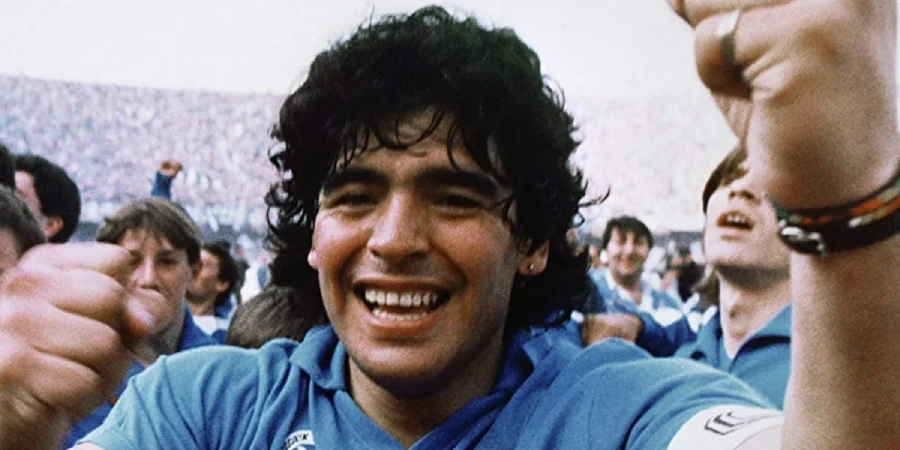

Asif Kapadia’s documentary presents two distinct individuals trapped in one body. On one hand, there is Diego, the vulnerable boy from the slums. On the other hand, there is Maradona, the football god and public persona. This film chronicles the tragic story of how Maradona ultimately consumed Diego whole.
Detailed Summary
Arrival in Naples
The film opens with the chaotic arrival of Diego Maradona in Naples, Italy, in 1984. He transfers from FC Barcelona to SSC Napoli for a world-record fee. Consequently, the city of Naples, often dismissed as the poor, crime-ridden south of Italy, sees him as a savior. The press conference is a circus. Moreover, one reporter immediately asks about the mafia’s involvement in his transfer, hinting at the pressures to come.
The God of Naples
Maradona’s initial years are a triumph. He quickly elevates Napoli from a struggling club into a powerhouse. As a result, in 1987, he leads them to their first-ever Italian league championship, the Scudetto. The city erupts in a celebration that lasts for weeks. In addition, Maradona is treated as a deity. However, this intense adoration comes with a price. He has no privacy, and his every move is scrutinized. He finds solace and escape with the powerful Giuliano clan, a prominent family in the Camorra crime syndicate, who provide him with parties, protection, and cocaine.
The Hand of God and Global Stardom
The documentary jumps to the 1986 World Cup in Mexico. Here, Maradona cements his global legend during the quarter-final match against England. First, he scores the infamous “Hand of God” goal, punching the ball into the net. Just four minutes later, in stark contrast, he scores the “Goal of the Century,” a breathtaking solo run past half the English team. Argentina goes on to win the World Cup, and Maradona is undeniably the greatest player on the planet. This victory, however, only inflates the “Maradona” persona, further distancing him from the humble “Diego.”
The Downfall Begins
Returning to Naples as a world champion, the pressure intensifies. His cocaine use becomes a full-blown addiction, carefully hidden by the club and his criminal connections. Meanwhile, a woman named Cristiana Sinagra claims Maradona is the father of her son, Diego Jr. For years, Maradona publicly denies this, a painful betrayal that haunts the narrative. The film shows his then-wife, Claudia Villafañe, confronting him. Ultimately, his personal life begins to unravel under the weight of his lies and addictions.
The Betrayal of 1990
The turning point comes during the 1990 World Cup, which Italy hosts. In a cruel twist of fate, the semi-final match pits Maradona’s Argentina against Italy, and the game is played in Naples. Before the match, Maradona controversially asks the Neapolitans to cheer for him over their own country. The Italian press brands him “the devil.” Ultimately, Argentina wins the match on penalties, with Maradona scoring his. From that moment on, the man who was once Naples’s god becomes its most hated enemy.
Leaving in Disgrace
After the World Cup, the tide has irrevocably turned. The protection he once enjoyed vanishes. In 1991, Maradona fails a drug test for cocaine and receives a 15-month ban from football. Shortly thereafter, Italian authorities issue a warrant for his arrest for cocaine possession and distribution. The film shows raw, harrowing footage of a bloated, broken Maradona leaving Naples in the dead of night, a disgraced figure fleeing the city he once ruled.


Movie Ending
The film’s ending is a somber reflection on Maradona’s tragic fall. It doesn’t focus heavily on his later career or his post-playing life. Instead, the narrative concludes with his ignominious departure from Naples in 1991. The final scenes juxtapose the vibrant, god-like figure who arrived in 1984 with the broken man who fled seven years later. Audio interviews with Maradona himself play over the footage, where he laments the loss of the quiet life he could have had. He admits that while Maradona the footballer could handle anything, Diego the man needed his family and a normal existence. The documentary powerfully concludes that the persona he created to survive the pressure, Maradona, ultimately destroyed the man, Diego.
Are There Post-Credits Scenes?
There are no post-credits scenes in Diego Maradona.
Type of Movie
Diego Maradona is an archival biographical documentary. It uses exclusively sourced footage from the time, including news reports, home videos, and previously unseen material from Maradona’s personal archive. Consequently, the tone is visceral, dramatic, and ultimately tragic, creating an immersive experience rather than a retrospective analysis with modern talking heads.
Cast
- Diego Maradona – Himself
- Claudia Villafañe – Herself (Maradona’s then-wife)
- Corrado Ferlaino – Himself (President of SSC Napoli)
- Cristiana Sinagra – Herself
- Pelé – Himself (Archival footage)
Film Music and Composer
The score for Diego Maradona was composed by Antonio Pinto. Pinto is a Brazilian composer known for his work on films like City of God (2002) and fellow Kapadia documentary Amy (2015). The music is a blend of tense, pulsating electronic synths and orchestral pieces. Notably, the score effectively mirrors Maradona’s own psyche, swinging from euphoric and celebratory to dark and ominous, perfectly capturing his dual nature.


Filming Locations
The documentary is built from archival footage, not new filming. Therefore, the primary location featured is Naples, Italy. The city itself is a central character in the film. Its passionate, chaotic, and deprived nature is shown as the perfect crucible for Maradona’s genius and his demons. In addition, other key locations seen in archival footage include Buenos Aires, Argentina, his home country, and various stadiums from the 1986 and 1990 World Cups.
Awards and Nominations
Diego Maradona was critically acclaimed and received several major award nominations. Most notably, it was nominated for the BAFTA Award for Best Documentary. In addition, it was selected for screening at the Cannes Film Festival, where it competed for the L’Œil d’or (Golden Eye) prize for best documentary.
Behind the Scenes Insights
- Director Asif Kapadia and his team sifted through over 500 hours of never-before-seen personal footage from Maradona’s archives. This access was granted by Maradona himself.
- Kapadia conducted all his interviews with Maradona purely over audio. He never met him face-to-face for the film, as he believed this method yields more honest and intimate responses.
- The film deliberately focuses on the Naples years. Kapadia felt this period represented the peak of Maradona’s powers and the core of his tragic story, where both Diego and Maradona were in their most extreme forms.
- Similarly to his other films Senna and Amy, Kapadia completely avoids using modern-day “talking head” interviews on screen. Instead, all commentary is provided via voiceover, keeping the viewer immersed in the archival footage.
Inspirations and References
The film’s primary inspiration is the true, tumultuous life of Diego Maradona himself. It is not an adaptation of a specific book or article. Instead, it is a piece of original cinematic journalism. It draws inspiration from director Asif Kapadia’s signature style, previously seen in Senna (2010) and Amy (2015), which focuses on telling a life story purely through archival footage to create a visceral, present-tense narrative.
Alternate Endings and Deleted Scenes
Given the 500 hours of available footage, an immense amount of content was left on the cutting room floor. Director Asif Kapadia has stated that there was enough material for a much longer series. For instance, the film could have delved deeper into Maradona’s post-Naples career, his struggles with health and obesity, and his time as a coach. However, Kapadia made a deliberate choice to focus tightly on the Naples years as the defining chapter of his life, meaning any scenes outside that specific era were likely the first to be cut.
Book Adaptations and Differences
Diego Maradona is not based on a book. It is an original documentary constructed from primary source material, including archival film and audio interviews conducted specifically for the project.



Memorable Scenes and Quotes
Key Scenes
- The Presentation at Stadio San Paolo: The incredible footage of 85,000 fans filling a stadium just to watch Maradona kick a ball for the first time as a Napoli player, perfectly establishing the messianic expectations placed upon him.
- The “Goal of the Century”: The director uses the raw, multi-angle broadcast footage of his 1986 World Cup goal against England, accompanied by the ecstatic commentary, capturing the sheer genius of the moment.
- The Confrontation with Claudia: A raw home video shows Claudia Villafañe calmly confronting a dazed Maradona about his infidelities and the rumors of his illegitimate child. This scene, as a result, provides a rare, painful glimpse behind the public mask.
- The Escape from Naples: The grainy, late-night footage of a clearly distressed and overweight Maradona being whisked away by car after his drug ban and arrest warrant is a haunting final image of his Italian dream turning into a nightmare.
Iconic Quotes
- “When you’re on the pitch, life goes away. Problems go away. Everything goes away.” – Maradona on finding escape in football.
- “I asked for a house, he gave me a palace. I asked for a car, he gave me a Ferrari. I wanted a team, he made us the best in the world.” – A Napoli fan explaining Maradona’s impact.
- “There was Diego, and there was Maradona. I was dealing with Maradona.” – Fernando Signorini, his personal trainer, on his dual personality.
- “To go from nothing to the top of the world… I didn’t know how to handle it.” – Maradona reflecting on his overwhelming fame.
Easter Eggs and Hidden Details
- Early Camera Awareness: In early footage from his youth in Argentina, a very young Diego is already incredibly aware of and comfortable with the camera, foreshadowing his life lived in the media spotlight.
- The Giuliano Clan Home Videos: The footage from parties with the Camorra’s Giuliano family is not just about excess. On the other hand, it shows Diego looking relaxed and genuinely happy in a way he rarely does with the press, highlighting why he was drawn to their world.
- Changing Physicality: The documentary subtly tracks Maradona’s physical transformation. He arrives in Naples a lean athlete. By the end, he appears bloated and unwell, a visual representation of the toll taken by addiction and pressure.
Trivia
- Asif Kapadia’s team restored the archival footage to 4K quality, making decades-old news reports and home videos look remarkably clear and modern.
- During the extensive interviews, Maradona recorded over 40 hours of audio for the film.
- The film’s working title was simply Maradona, but the name was later changed to Diego Maradona to emphasize the central theme of his divided self.
- Corrado Ferlaino, the Napoli president, admits on camera for the first time the extent of the club’s efforts to cover up Maradona’s drug use, including swapping urine samples for drug tests.
Why Watch?
This film is a raw, electrifying portrait of genius and self-destruction. Using breathtaking unseen footage, it places you directly inside the whirlwind of Maradona’s life. More than just a sports documentary, it’s a profound human tragedy you cannot look away from.
Director’s Other Movies
- Senna (2010)
- Amy (2015)
- The Warrior (2001)
Recommended Films for Fans
- Senna (2010)
- Amy (2015)
- Icarus (2017)
- O.J.: Made in America (2016)