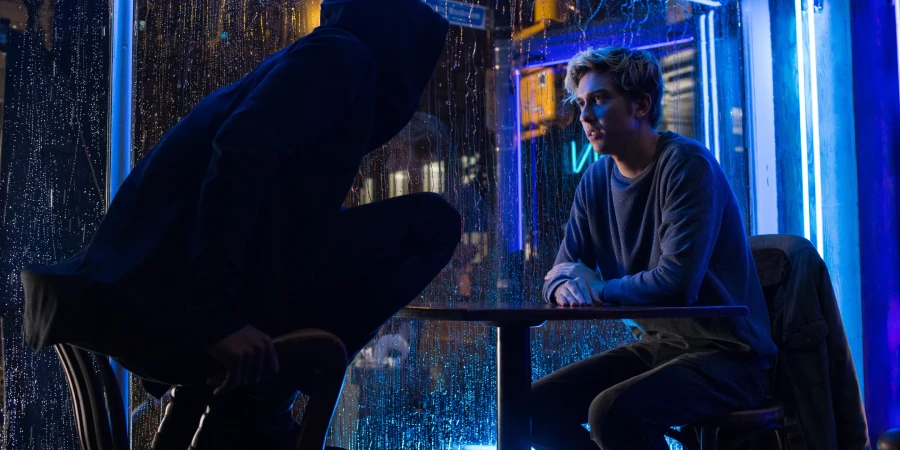

Netflix’s Death Note (2017) is a dark fantasy thriller directed by Adam Wingard and loosely inspired by the iconic Japanese manga and anime series created by Tsugumi Ohba and Takeshi Obata. This adaptation takes bold liberties with the source material, relocating the story to the United States and reshaping characters, themes, and tone. Love it or hate it, it’s a film that definitely sparks discussion.
Detailed Summary
The Discovery of the Death Note
Light Turner is a smart but socially awkward high school student living in Seattle. His life changes when a mysterious black notebook literally falls from the sky. This notebook, the Death Note, comes with simple but terrifying rules: anyone whose name is written in it will die, as long as the writer visualizes the person’s face.
Soon after, Light meets Ryuk, a grotesque Shinigami (death god) who dropped the notebook out of boredom. Ryuk explains that the notebook belongs to the human world now and that Light can use it freely. No moral guidance, no consequences for Ryuk. Just entertainment.
From Justice to Obsession
Initially, Light uses the Death Note to kill criminals, believing he is making the world a better place. The media quickly notices a pattern in the deaths, and the anonymous killer is dubbed “Kira.” Light begins to enjoy the power and recognition far more than the justice itself.
Light shares his secret with Mia Sutton, a manipulative and ambitious classmate. Unlike Light, Mia fully embraces the Death Note’s potential and pushes him toward mass murder, global control, and fame. This marks a crucial shift: the notebook stops being a tool and becomes an addiction.
Enter L: The Mind Game Begins
Interpol assigns the case to L, a brilliant but emotionally detached detective. L narrows down the suspect pool quickly and sets his sights on Light. A psychological chess match begins, though this version leans more into emotional chaos than cold calculation.
L recruits Light’s father, Detective James Turner, which adds personal stakes and emotional tension. As suspicion grows, Light becomes increasingly reckless, driven by fear of exposure and Mia’s escalating demands.
Power Slips Out of Control
As the body count rises, the relationship between Light and Mia deteriorates. Mia secretly writes names in the Death Note without Light’s consent and even plots against him. Ryuk, as always, remains neutral and amused, reminding Light that this was never about justice, only human nature.
The story spirals into betrayals, shifting alliances, and desperate attempts to outthink everyone else.
Movie Ending
The final act takes place during a dramatic showdown at a school carnival by the Seattle waterfront. Light executes a multi-layered plan involving pre-written Death Note instructions, manipulation of police movements, and psychological baiting.
Mia attempts to betray Light by writing his name in a torn Death Note page, believing she has secured her victory. However, Light anticipated this and wrote instructions earlier that cause Mia to fall from a ferris wheel to her death before his own name can be completed. This moment is crucial: it confirms that Light has fully embraced manipulation and murder, even against someone he claimed to love.
Detective Turner confronts Light, but Ryuk reveals the final blow: Ryuk himself writes Light Turner’s name in the Death Note. As Ryuk explains, he never promised to protect Light forever. When humans become boring or cornered, Shinigami move on.
Light dies screaming, begging, and utterly powerless, realizing too late that he was never in control. L survives, the Kira case is effectively ended, and the world is left with the unsettling knowledge that such power once existed.
Are There Post-Credits Scenes?
Yes. There is a mid-credits scene where Ryuk is shown writing new names into the Death Note, strongly implying that the notebook remains in the human world and that the cycle could begin again. There is no post-credits scene after the full credits.
Type of Movie
Death Note (2017) is a dark fantasy psychological thriller with strong horror elements. It blends supernatural mythology with crime drama and teen tragedy, leaning more toward emotional intensity than intellectual deduction.
Cast
- Nat Wolff as Light Turner
- Lakeith Stanfield as L
- Margaret Qualley as Mia Sutton
- Shea Whigham as Detective James Turner
- Willem Dafoe as Ryuk (voice and motion capture)
Film Music and Composer
The score was composed by Atticus Ross, known for his atmospheric and unsettling soundscapes. The music emphasizes tension and dread rather than heroism, reinforcing the film’s bleak tone. The soundtrack also features tracks from artists like Metallica, matching the film’s aggressive mood.

Filming Locations
The movie was filmed primarily in Vancouver, British Columbia, standing in for Seattle. Urban streets, high schools, and waterfront locations were chosen to ground the supernatural story in a realistic, modern American setting. This realism contrasts sharply with the fantastical elements, making the violence feel more immediate and disturbing.
Awards and Nominations
The film did not receive major award nominations. However, Willem Dafoe’s performance as Ryuk was widely praised by critics and audiences, often cited as the standout element of the movie despite overall mixed-to-negative reception.
Behind the Scenes Insights
- Willem Dafoe recorded Ryuk’s dialogue separately and never met most of the cast during filming.
- Ryuk was entirely CGI, with Dafoe’s facial structure influencing the final design.
- Director Adam Wingard aimed to make the story more emotional and chaotic than the anime.
- The filmmakers intentionally avoided copying the anime shot-for-shot to differentiate the adaptation.
Inspirations and References
The film is inspired by the Death Note manga (2003–2006) and anime series. It also draws influence from American teen thrillers and crime dramas, shifting the focus from philosophical justice to personal corruption and fear.
Alternate Endings and Deleted Scenes
No official alternate endings were released, but interviews suggest that several extended L investigation scenes were cut to reduce runtime. Early drafts reportedly gave L a darker moral edge, closer to the original source.
Book Adaptation and Differences
While based on the manga, the movie makes major changes:
- Light is more emotional and less god-like in intelligence
- Mia replaces and merges elements of the character Misa
- L is more openly aggressive and emotionally expressive
- The story emphasizes loss of control rather than intellectual dominance

Memorable Scenes and Quotes
Key Scenes
- Light’s first experiment with the Death Note
- Ryuk’s terrifying first appearance
- The ferris wheel climax
- Light’s death and Ryuk’s final monologue
Iconic Quotes
- Ryuk: “Humans are so interesting.”
- Light: “I’m fixing the world.”
- L: “Monsters think they’re right.”
Easter Eggs and Hidden Details
- Ryuk eats apples constantly, a direct nod to the anime
- The Death Note rules shown briefly reference original manga rules
- Light’s classroom number matches a key chapter number from the manga
- Ryuk’s design subtly includes Dafoe’s facial proportions
Trivia
- The Death Note prop was handmade with over 60 written rules
- Lakeith Stanfield studied both anime and FBI profiler behavior
- The film was originally planned as a theatrical release
- Adam Wingard is a long-time fan of the original manga
Why Watch?
If you’re curious about how far power can corrupt a normal person, this film offers a grim, fast-paced take on that idea. While controversial, it’s an interesting reinterpretation that works best when viewed as its own universe, not a direct replacement for the anime.
Director’s Other Works
- You’re Next (2011)
- The Guest (2014)
- Blair Witch (2016)
- Godzilla vs. Kong (2021)