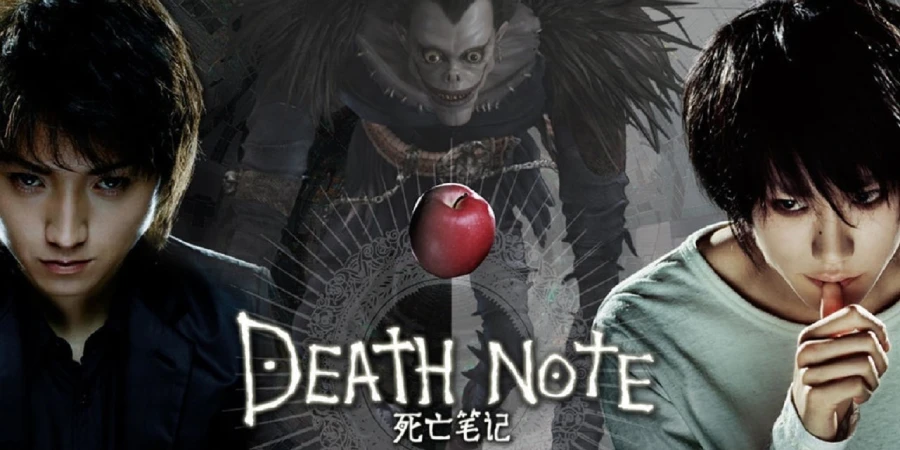

Death Note (2006) is a Japanese live-action adaptation of the legendary manga created by Tsugumi Ohba and Takeshi Obata. Directed by Shusuke Kaneko, this film focuses on psychological tension, moral dilemmas, and the dangerous seduction of absolute power. Unlike later Western adaptations, this version stays remarkably faithful to the spirit of the original source material.
Detailed Summary
Discovery of the Death Note
High school prodigy Light Yagami stumbles upon a mysterious black notebook dropped by a Shinigami (death god) named Ryuk. The rules are simple and terrifying: write a person’s name while picturing their face, and they will die. Initially skeptical, Light tests the notebook—and realizes it works.
This moment marks the birth of Kira, Light’s self-appointed identity as the god of a new world.
Light’s Moral Descent
At first, Light uses the Death Note to kill criminals, believing he is cleansing the world of evil. The film carefully shows how justice slowly mutates into ego. Light no longer sees himself as human but as the ultimate authority over life and death.
Ryuk, observing with amusement, makes it clear he is not Light’s ally, only a spectator enjoying chaos.
The Arrival of L
As mysterious deaths spread worldwide, the enigmatic detective L enters the scene. Using sharp psychological profiling, L quickly narrows Kira’s location down to Japan—and soon, to Light himself.
The movie becomes a mental chess match, where every move Light makes is countered by L’s deductions.
FBI Agents and the Noose Tightens
Foreign investigators sent to Japan begin dying under suspicious circumstances. One agent’s fiancée, FBI agent Raye Penber’s partner, becomes a crucial turning point, as Light manipulates her into writing her own name in the Death Note.
This is one of the film’s darkest moments, fully exposing Light’s cruelty and willingness to sacrifice innocents.
Light vs L: Face to Face
Light and L eventually meet in person. Their interactions are filled with subtext, mistrust, and subtle psychological warfare. L suspects Light almost completely but lacks concrete proof, while Light struggles to maintain his flawless public image.
The tension escalates as Light’s father, a police officer, joins the investigation—raising the emotional stakes dramatically.
Movie Ending
The final act centers on Light’s increasingly desperate attempts to eliminate L. A second Death Note enters the story through Misa Amane, a model who worships Kira after he kills her parents’ murderer. She gains the Shinigami Eyes, allowing her to see names and lifespans, at the cost of half her remaining life.
L orchestrates a final test to expose Kira by placing surveillance, traps, and psychological pressure on Light and Misa. Light appears cornered—but executes a long-planned gambit. By temporarily relinquishing ownership of the Death Note, Light loses his memories of being Kira, appearing innocent under scrutiny.
Once suspicion is lifted, Light regains the Death Note and his memories. He immediately resumes his role as Kira.
The climax unfolds when L confronts Light directly, confident but still without undeniable proof. Light believes he has finally won. However, L reveals that he has written Light’s name in the Death Note as an experiment—testing whether Light would die. Light survives, momentarily thinking L has failed.
But the twist comes fast: L never wrote Light’s name. Instead, he tricked Light into exposing his intentions. The movie ends with Light technically victorious yet increasingly isolated, corrupted, and trapped by his own god complex.
The final shot reinforces the central theme: absolute power does not bring peace—it brings loneliness and madness.
Are There Post-Credits Scenes?
No.
There are no post-credits or mid-credits scenes in Death Note (2006). The story concludes fully before the credits roll, though the sequel (Death Note: The Last Name, 2006) continues the narrative directly.
Type of Movie
Death Note (2006) is a psychological thriller with strong elements of crime, mystery, and supernatural horror. The film focuses less on action and more on intellectual duels, moral decay, and suspense-driven storytelling.
Cast
- Tatsuya Fujiwara as Light Yagami
- Kenichi Matsuyama as L
- Asaka Seto as Misa Amane
- Shido Nakamura as Ryuk (voice and motion capture)
- Shunji Fujimura as Soichiro Yagami
Kenichi Matsuyama’s portrayal of L is widely considered definitive and iconic.
Film Music and Composer
The score was composed by Kenji Kawai, known for Ghost in the Shell. The music uses low, ominous tones and minimalistic themes to enhance tension rather than overwhelm scenes, perfectly matching the film’s psychological weight.


Filming Locations
The movie was shot entirely in Japan, primarily in:
- Tokyo (urban investigation scenes)
- Studio-built interiors for interrogation and surveillance rooms
These realistic settings ground the supernatural elements, making the story feel disturbingly plausible.
Awards and Nominations
- Best Actor (Kenichi Matsuyama) – Japanese Academy Awards (Nominee)
- Best New Actor (Kenichi Matsuyama) – Won multiple Japanese film awards
- Praised for adaptation fidelity and performances rather than visual spectacle
Behind the Scenes Insights
- Kenichi Matsuyama studied animal behavior to shape L’s posture and movements.
- Ryuk’s design was overseen by manga creators to ensure accuracy.
- The director intentionally avoided excessive CGI to keep the story grounded.
- The film was shot back-to-back with its sequel.
Inspirations and References
- Based on the manga Death Note (2003–2006)
- Influenced by crime novels and classic detective fiction
- Philosophical themes echo Nietzsche’s Übermensch and utilitarian ethics
Alternate Endings and Deleted Scenes
- No officially released alternate ending
- Several extended dialogue scenes between Light and L were cut for pacing
- Some deleted scenes were later included in DVD extras
Book Adaptations and Differences
While largely faithful, the movie:
- Compresses timelines significantly
- Softens some of Light’s cruelty compared to the manga
- Focuses more heavily on the Light–L rivalry than side characters
The core themes and character arcs remain intact.


Memorable Scenes and Quotes
Key Scenes
- Light’s first test of the Death Note
- The FBI agent manipulation sequence
- Light and L’s first face-to-face meeting
- The memory-loss twist
Iconic Quotes
- Ryuk: “Humans are so interesting.”
- Light: “I am justice.”
- L: “There’s no such thing as coincidence.”
Easter Eggs and Hidden Details
- Death Note rules shown onscreen mirror manga panels exactly
- L’s sweets obsession is consistently accurate to the source
- Ryuk’s apple addiction references Shinigami boredom lore
Trivia
- The Death Note prop was hand-written for realism
- Ryuk’s voice actor never met the main cast during filming
- The film directly inspired multiple anime-to-live-action adaptations
Why Watch?
If you enjoy intellectual thrillers, morally complex characters, and slow-burn tension, Death Note (2006) is essential viewing. It’s a rare example of a live-action anime adaptation that respects its source and its audience.
Director’s Other Works
- Gamera 2: Attack of Legion (1996)
- Gamera 3: Revenge of Iris (1999)
- Death Note: The Last Name (2006)