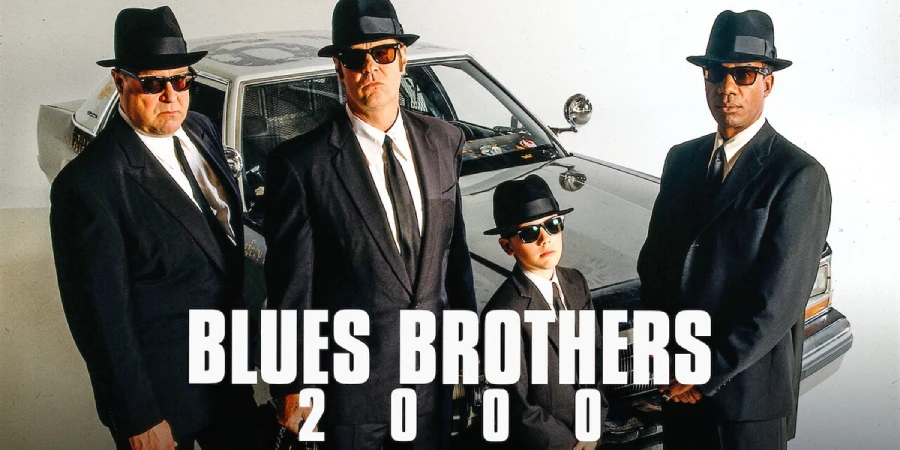

Blues Brothers 2000 is the long-awaited sequel to John Landis’ legendary 1980 musical comedy The Blues Brothers. While it carries the same chaotic energy, musical soul, and road-trip madness of the original, it also attempts to introduce a new generation of Blues Brothers by expanding the band with fresh faces and big-name musical cameos.
Detailed Summary
Elwood Blues Returns from Prison
Elwood Blues (Dan Aykroyd) is released from prison only to learn that Jake—his brother and partner in musical crime—has passed away. This moment sets a more somber emotional tone than the first film. Still, Elwood quickly returns to form, seeking a new purpose. He reconnects with Cab (Joe Morton), who reluctantly becomes the film’s moral compass.
The New Mission and the New Band
After learning that Curtis and Sister Mary Stigmata have also passed away, Elwood sets out on a familiar mission: rebuild the band and go on the road. He recruits a new child sidekick named Buster and reconnects with old band members such as Matt “Guitar” Murphy and Donald “Duck” Dunn.
One of the film’s key elements is Elwood assembling the crew while causing increasingly ridiculous levels of property damage, keeping true to the spirit of the original.
Conflicts on the Road
The band becomes the target of multiple antagonists:
- A militia group
- Local police
- Russian mobsters
- The state troopers
These groups chase them from gig to gig, creating the signature Blues Brothers chaos.
At the same time, Cab struggles with confronting his true heritage and identity, which becomes important by the climax.
The Battle of the Bands Competition
The major plot direction leads the team to a massive battle of the bands showdown held in Louisiana. The Blues Brothers go up against the powerful and intimidating “Louisiana Gator Boys,” featuring real-life musical icons like B.B. King, Eric Clapton, Dr. John, and many more.
This sequence is one of the film’s most memorable highlights, filled with extended musical performances that function as a nostalgic homage to classic blues.
Movie Ending
In the finale, the Blues Brothers arrive at the competition despite being pursued by police, militia, and the Russian mafia. Their performance becomes a musical redemption moment for Cab, who finally embraces the blues and joins the band fully.
The Louisiana Gator Boys ultimately win the competition, but the Blues Brothers’ performance earns respect from every musician present. The real triumph is symbolic, not competitive.
Immediately after the competition, all the groups chasing the Blues Brothers finally converge on them. A massive, absurd, and intentionally over-the-top vehicle destruction sequence follows, reminiscent of the 1980 film’s iconic pileups.
Elwood, Cab, and the rest of the band are captured, but in true Blues Brothers fashion, they quickly end up back on the road. The final scene features the reassembled group playing energetic blues music, emphasizing the movie’s core message: the music lives on, no matter what chaos trails behind them.
Are There Post-Credits Scenes?
No. Blues Brothers 2000 does not include any post-credits scenes.
Type of Movie
The film is a musical comedy adventure with elements of fantasy and satire, blending road-trip humor with large-scale musical set pieces.
Cast
- Dan Aykroyd as Elwood Blues
- John Goodman as Mighty Mack
- Joe Morton as Cab Chamberlain
- J. Evan Bonifant as Buster
- Aretha Franklin as Mrs. Murphy
- B.B. King as Malvern Gasperon
- Eric Clapton, Dr. John, James Brown, Bo Diddley, Isaac Hayes, and many others in musical cameo roles
Film Music and Composer
Music is the soul of this movie. The soundtrack includes performances by world-famous blues artists and features contributions from the Blues Brothers Band. The score incorporates blues, soul, jazz, and gospel elements, crafted to revive the spirit of the original film’s musical legacy. Paul Shaffer also contributed heavily to the film’s musical arrangements.

Filming Locations
The film was primarily shot in Toronto, Hamilton, and Surrounding Ontario regions, standing in for various U.S. locales. Additional scenes were filmed in Louisiana, especially for the Battle of the Bands sequence.
These locations were chosen for their ability to mimic American urban landscapes and rural Southern atmospheres. Louisiana’s inclusion was particularly important because of its historical connection to blues culture.
Awards and Nominations
While the film didn’t win major awards, it received attention for its soundtrack, ensemble musical performances, and choreography at several music-focused award circuits. However, critically and commercially, it didn’t match the success of the first film.
Behind the Scenes Insights
- John Landis returned to direct, hoping to recapture the magic of the original.
- Many musicians agreed to appear because they were fans of the first movie.
- The production struggled emotionally with the absence of John Belushi, whose presence defined the original.
- Joe Morton’s character arc was partially created to fill Belushi’s missing dynamic.
- Dan Aykroyd and John Goodman performed several of their own musical segments live.
- The script went through multiple rewrites due to studio nervousness about reviving a 1980 cult film.
Inspirations and References
The movie continues the legacy of the original Blues Brothers film, itself inspired by Aykroyd and Belushi’s Saturday Night Live characters. It also pays homage to:
- Classic blues culture
- Road-trip comedies
- American musical traditions
- The idea of the “wandering band bringing joy wherever they go,” echoing folk and blues mythology
Alternate Endings and Deleted Scenes
Several deleted scenes exist, including extended musical numbers that were trimmed for pacing. One alternate ending concept (never filmed) included the band being teleported onto an alien ship, leaning further into the film’s surreal humor. But ultimately, the ending remained grounded in the blues theme.
Book Adaptations and Differences
The movie was loosely novelized, but no major official book version serves as a primary source. The story remains original to the screenplay and not adapted from literature. Differences between the film and novelization are mostly minor dialogue changes and additional interior monologues for Elwood.
Memorable Scenes and Quotes
Key Scenes
- Elwood learning of Jake’s death and visiting the old orphanage
- The band’s reunion in the jazz club
- Russian mobsters chasing the band during their road trip
- The explosive Battle of the Bands showdown
- Cab embracing the blues on stage
- The final chaotic pursuit and massive car destruction sequence
Iconic Quotes
- “I’m on a mission… from God.”
- “The blues aren’t just about music. They’re about truth.”
- “You can’t stop the music, no matter how many cars you throw at us.”
Easter Eggs and Hidden Details
- The “mission from God” line returns, now as a referential joke rather than a dramatic moment.
- Many extras in musical scenes are real musicians.
- The number “23” appears frequently, referencing Belushi’s favorite number.
- Ray Charles’ portrait appears briefly as a tribute.
Trivia
- John Goodman’s singing surprised the production team; he was far better than expected.
- The film holds one of the highest counts of celebrity musician appearances in cinema history.
- It was nearly titled The Blues Brothers Reborn.
- J. Evan Bonifant performed most of his own dancing and harmonica work.
Why Watch?
Because it’s a celebration of blues culture, legendary musicians, and chaotic comedy. While not as iconic as the 1980 original, it offers unforgettable performances and a nostalgic, musical road trip. If you appreciate live music, musical legends, and quirky comedy, this film is worth your time.
Director’s Other Movies
- The Blues Brothers (1980)
- An American Werewolf in London (1981)
- Trading Places (1983)
- Into the Night (1985)
- Three Amigos! (1986)
- Coming to America (1988)
- Beverly Hills Cop III (1994)
Recommended Films for Fans
- The Blues Brothers (1980)
- Ghostbusters (1984)
- Wayne’s World (1992)
- O Brother, Where Art Thou? (2000)
- The Commitments (1991)