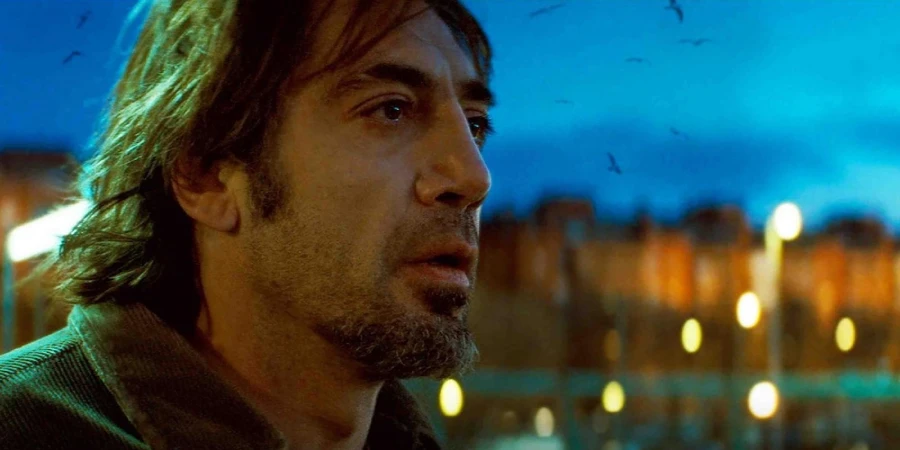

Few films stare so unflinchingly into the abyss of human suffering as Biutiful. Director Alejandro G. Iñárritu plunges viewers into the chaotic world of Uxbal, a dying hustler in Barcelona. He scrambles to secure his children’s future in the face of his own mortality. Ultimately, the film finds a strange, haunting grace in the city’s grimiest corners.
Detailed Summary
Uxbal’s Hustle
The story introduces us to Uxbal, a man living in the shadows of Barcelona. He makes a living as a middleman, connecting undocumented Chinese immigrants with illegal construction jobs and vendors of counterfeit goods. Moreover, Uxbal possesses a strange gift: he can communicate with the recently deceased. He often attends wakes, charging families a fee to pass along final messages from their loved ones. However, his personal life is a wreck. He cares for his two young children, Ana and Mateo, while navigating a toxic relationship with his bipolar ex-wife, Marambra.
A Grim Diagnosis
Uxbal’s persistent health problems, including blood in his urine, lead him to a doctor. The diagnosis is devastating: terminal prostate cancer that has spread to his liver and bones. Consequently, the doctor gives him only a few months to live. This news ignites a desperate urgency in Uxbal. Therefore, every decision he makes becomes weighted with the knowledge that his time is running out. He must secure his children’s future before he dies.
The Sweatshop Tragedy
In an attempt to make a large sum of money quickly, Uxbal makes a fatal error. He manages a group of Chinese workers living in a cramped, cold basement. To protect them from the winter chill, he purchases several cheap space heaters. Uxbal’s associate warns him they are low quality, but he proceeds anyway. The next morning, he discovers the horrifying truth. As a result of the faulty heaters, all twenty-five workers have died from carbon monoxide poisoning. This tragedy becomes the film’s agonizing centerpiece.
A Desperate Search for Redemption
Panicked and consumed by guilt, Uxbal enlists his corrupt police contact to help dispose of the bodies. Together, they dump the corpses into the sea. However, the plan goes awry, and the bodies soon wash up on the shoreline, creating a public scandal. Meanwhile, Uxbal tries to do right by Ige, a Senegalese immigrant he had previously tried to deport. He gives her the money he had saved, entrusting her with the care of his children after he is gone. In the end, his search for redemption is a painful, fragmented journey filled with small acts of kindness amidst crushing failure.



Movie Ending
The ending of Biutiful is both heartbreaking and spiritually transcendent. In his final days, a severely weakened Uxbal lies in bed. His daughter Ana lies down with him. He gives her a diamond ring that his father once gave his mother. Uxbal then tells Ana that he sees her deceased grandfather on the ceiling, a man he never met. As he looks up, his breathing slows and he quietly passes away.
The very last scene mirrors the opening shot. Uxbal is seen in a snowy, silent forest. There, he meets a younger version of his father, who died in exile before Uxbal was born. They have a quiet, simple conversation. Consequently, this suggests Uxbal has finally found peace and has been reunited with the family he never knew. The ring he gives Ana symbolizes the continuation of this generational connection, even through death. The ending, therefore, is not about a heavenly reward but about finding serenity and closure.
Are There Post-Credits Scenes?
No, there are no post-credits scenes in Biutiful. The story concludes definitively with Uxbal’s death and spiritual reunion with his father. As a result, any additional scene would likely detract from the film’s powerful, contemplative ending.
Type of Movie
Biutiful is a social-realist drama with elements of magical realism. The film grounds itself in the gritty, unglamorous reality of Barcelona’s underground economy and immigrant struggles. However, its tone is deeply melancholic and spiritual. The supernatural element of Uxbal’s ability to speak with the dead introduces a layer of existential mystery. Ultimately, it is a character study about mortality, fatherhood, and the desperate search for grace.
Cast
- Javier Bardem – Uxbal
- Maricel Álvarez – Marambra
- Hanaa Bouchaib – Ana
- Guillermo Estrella – Mateo
- Diaryatou Daff – Ige
- Eduard Fernández – Tito
- Cheikh Ndiaye – Ekweme
- Luo Jin – Liwei
Film Music and Composer
The haunting score for Biutiful was composed by the legendary Gustavo Santaolalla. A frequent collaborator with director Iñárritu, Santaolalla is known for his minimalist and evocative style. Specifically, he often uses the ronroco, a small stringed instrument, to create a sense of sparse, aching melody. For this film, his music perfectly complements the somber and spiritual tone. Notably, the track “Biutiful” serves as the main theme, capturing the film’s blend of despair and fragile hope.


Filming Locations
Biutiful was filmed almost entirely on location in Barcelona, Spain. However, Iñárritu intentionally avoided the city’s picturesque tourist spots. Instead, he focused on the working-class and immigrant neighborhoods of Santa Coloma and El Raval. This choice was crucial for establishing the film’s authenticity. As a result, the cluttered apartments, grimy streets, and industrial warehouses feel lived-in and real. The location itself becomes a character, representing the harsh reality that Uxbal and so many others navigate daily.
Awards and Nominations
Biutiful received significant critical acclaim, particularly for its lead performance. Javier Bardem won the Best Actor award at the 2010 Cannes Film Festival for his portrayal of Uxbal. In addition, he earned a nomination for the Academy Award for Best Actor. The film itself was also nominated for the Academy Award for Best Foreign Language Film, representing Mexico. Furthermore, it received nominations at the Golden Globes, the BAFTAs, and the Goya Awards.
Behind the Scenes Insights
- Director Alejandro G. Iñárritu saw the film as a deeply personal project, reflecting on fatherhood and mortality following the death of his own father.
- Many of the immigrant characters in the film were played by non-professional actors who had lived experiences similar to those portrayed on screen.
- Javier Bardem described the role of Uxbal as one of the most challenging of his career, requiring him to inhabit a constant state of physical and emotional agony.
- The title, Biutiful, comes from the way Uxbal’s daughter, Ana, misspells the word “beautiful” in a drawing. Iñárritu felt this captured the idea of finding imperfect beauty amidst ugliness.
Inspirations and References
While not a direct adaptation of any single work, Biutiful was heavily inspired by the real-life plights of undocumented immigrants in Spain. Iñárritu and his co-writers conducted extensive research into the underground economies and living conditions in Barcelona’s immigrant communities. In addition, the film’s spiritual themes draw from a more universal exploration of mortality and the afterlife, but they are not tied to a specific religious or literary text. The story is a wholly original creation born from journalistic observation and personal reflection.
Alternate Endings and Deleted Scenes
Information about significant alternate endings or a large number of deleted scenes for Biutiful is not widely available. The theatrical cut is considered the definitive version of the story. Director Alejandro G. Iñárritu is known for his precise vision, and the final film reflects the tight, focused narrative he intended to create. Consequently, any material left on the cutting room floor likely consisted of minor trims to improve pacing rather than substantial plot changes.
Book Adaptations and Differences
Biutiful is not based on a book. It is an original screenplay written by Alejandro G. Iñárritu, Armando Bó Jr., and Nicolás Giacobone. This film marked a notable shift for Iñárritu, as it was his first feature film made after parting ways with his longtime writing partner, Guillermo Arriaga. In contrast to their previous collaborations like Amores Perros and Babel, which featured intersecting, non-linear storylines, Biutiful tells a single, linear story focused entirely on one protagonist.


Memorable Scenes and Quotes
Key Scenes
- The Sweatshop Discovery: Uxbal’s slow, agonizing walk through the basement as he finds the bodies of the Chinese workers is a masterclass in silent, horrified acting.
- The Bodies on the Beach: The haunting image of the plastic-wrapped corpses washing up on a beautiful Barcelona beach is a brutal visual representation of Uxbal’s guilt made public.
- The Final Goodbye: Uxbal’s last conversation with Ana is incredibly tender and devastating. He tries to impart a lifetime of love and memory into a few final moments.
Iconic Quotes
- Uxbal: “Look at my face. Don’t forget me, okay? Please, don’t forget me.”
- Uxbal: (To his children) “What’s in there? Under the ceiling? Your great-grandfather. I’m telling you.”
- Uxbal: (To Ige) “Take care of my children like I have taken care of you.”
Easter Eggs and Hidden Details
- Moth and Owl Symbolism: Black moths and owls appear throughout the film, both on ceilings and in Uxbal’s visions. These creatures often symbolize death and transformation, foreshadowing Uxbal’s journey.
- The Ring: The diamond ring passed from Uxbal’s father to his mother, then to Uxbal, and finally to Ana, represents a continuous and unbroken chain of love that transcends death.
- Opening and Closing Shots: The film begins and ends in a silent, snowy forest. This cyclical structure suggests that death is not an end but a return to a place of origin and peace.
Trivia
- Javier Bardem became the first actor in history to be nominated for the Best Actor Oscar for a performance entirely in the Spanish language.
- Iñárritu originally wrote the film with a much younger protagonist in mind but rewrote it specifically for Bardem after they met.
- The title’s misspelling, “Biutiful,” is a direct plot point taken from Ana’s drawing and reflects the film’s central theme of finding flawed beauty.
- The film’s gritty aesthetic was achieved by shooting almost exclusively with handheld cameras, giving it a documentary-like feel.
Why Watch?
Watch Biutiful for Javier Bardem’s monumental, career-defining performance. While undeniably bleak, the film is a deeply moving and humane portrait of fatherhood and mortality. Its raw honesty provides a profound, if painful, cinematic experience unlike any other.
Director’s Other Movies
- Amores Perros (2000)
- 21 Grams (2003)
- Babel (2006)
- Birdman (2014)
- The Revenant (2015)
- Bardo, False Chronicle of a Handful of Truths (2022)
Recommended Films for Fans
- The Sea Inside (2004)
- Gomorrah (2008)
- City of God (2002)
- A Prophet (2009)
- Broken Embraces (2009)