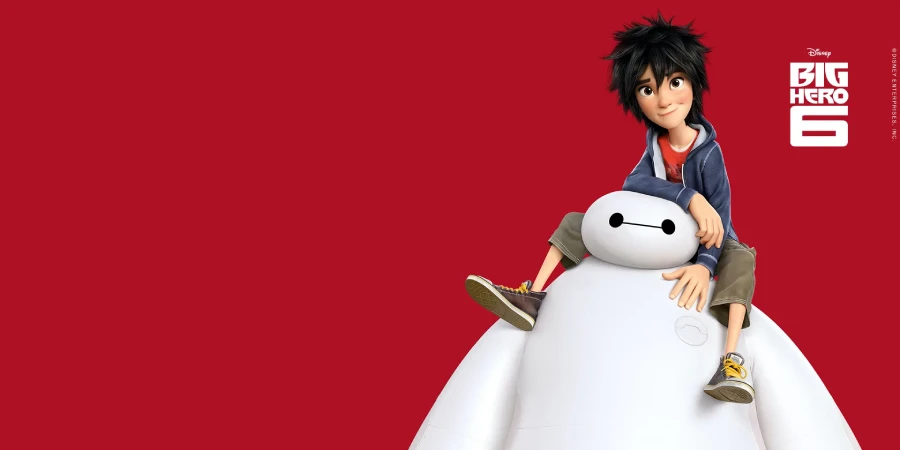

Big Hero 6 is one of Disney’s most heartfelt and visually polished animated films, blending superhero action with emotional depth.
Detailed Summary
The Beginning: Hiro, Tadashi, and the Spark of Innovation
Hiro Hamada is a 14-year-old prodigy who prefers illegal robot fights over college. His older brother Tadashi encourages him to pursue something greater and introduces him to the San Fransokyo Institute of Technology. Hiro is amazed by the futuristic inventions at the lab, especially Tadashi’s project: Baymax, a soft, inflatable healthcare robot programmed to help humans physically and emotionally.
Hiro eventually creates microbots—tiny magnetic robots capable of forming anything the user imagines—earning him a scholarship. But after a tragic fire at the exhibition building, Tadashi dies while trying to save the professor trapped inside. This sets the emotional foundation of the movie.
Reawakening Through Baymax
Hiro falls into grief, isolating himself until he accidentally activates Baymax. The gentle robot becomes Hiro’s support system and leads him into a mystery: Hiro discovers that someone is using his stolen microbots for sinister purposes. This solidifies Hiro’s new mission: uncover the truth behind his brother’s death.
Building the Team
Hiro recruits Tadashi’s friends—Go Go, Wasabi, Honey Lemon, and Fred. Hiro upgrades Baymax with armor and combat programming, transforming the group into an amateur superhero team. Their quirky personalities mix with impressive abilities, forming the foundation of the Big Hero 6 squad.
They eventually uncover that the masked villain “Yokai” is using the microbots to reopen a dangerous portal-like device called a teleportation gate.
The Masked Villain Revealed
After several battles, the team discovers that Professor Callaghan, the man Tadashi tried to save, is actually Yokai. He survived the fire using Hiro’s microbots and orchestrated everything to avenge the disappearance of his daughter, who vanished during a teleportation experiment.
Hiro is enraged and nearly forces Baymax to kill Callaghan, but Baymax reminds him of Tadashi’s teachings. This moment is a crucial emotional pivot, grounding Hiro back in compassion and integrity.

Movie Ending
The climax unfolds around the unstable teleportation gate, which Callaghan intends to use to destroy industrialist Alistair Krei, whom he blames for his daughter’s loss. The Big Hero 6 team intervenes.
Inside the collapsing portal, Hiro and Baymax find Callaghan’s daughter, Abigail, suspended in hyperspace stasis but alive. They rescue her, but Baymax is damaged. In an emotional farewell, Baymax uses his final rocket fist to propel Hiro and Abigail to safety.
Baymax’s sacrifice is one of the film’s most poignant moments. Hiro returns home mourning Baymax’s loss until he discovers something hidden inside the fist: Baymax’s healthcare chip.
Using the chip, Hiro rebuilds Baymax, allowing the gentle robot to “return” with all his memories and personality. The team officially becomes the superhero group Big Hero 6, protecting San Fransokyo with newfound purpose.
Are There Post-Credits Scenes?
Yes. There is a humorous post-credit scene featuring Fred in his family mansion. He accidentally reveals a secret room and discovers that his father (voiced by Stan Lee) is a former superhero. It’s a playful nod to comic book culture and teases potential future adventures.
Type of Movie
Big Hero 6 is a family-friendly animated superhero action-comedy with strong emotional and sci-fi elements. It combines heartfelt character arcs with high-energy battles and inventive world-building.
Cast
- Ryan Potter as Hiro Hamada
- Scott Adsit as Baymax
- Daniel Henney as Tadashi
- Jamie Chung as Go Go
- Damon Wayans Jr. as Wasabi
- Genesis Rodriguez as Honey Lemon
- T.J. Miller as Fred
- James Cromwell as Professor Callaghan
Film Music and Composer
The score was composed by Henry Jackman, who blends emotional orchestral themes with energetic electronic elements. Fall Out Boy’s “Immortals” serves as the movie’s signature anthem.
Filming Locations
Though animated, the conceptual “location” is the hybrid city of San Fransokyo, inspired by a mix of San Francisco and Tokyo. Developers traveled extensively to both cities to combine:
- San Francisco’s architecture, fog, and iconic hills
- Tokyo’s neon lights, signage, and futuristic urban density
This mixture is crucial to the film’s identity. It gives the movie a unique cultural flavor, visual charm, and a sense of a technologically advanced society.
Awards and Nominations
- Won: Academy Award for Best Animated Feature (2015)
- Nominated: Annie Awards (multiple categories)
- Won: Kids’ Choice Award for Favorite Animated Movie
- Won: BAFTA nomination for Best Animated Film
Behind the Scenes Insights
- The creators worked with medical robotics experts, shaping Baymax’s inflatable design after real soft-robotics research.
- Baymax’s trademark “balalala” fist bump was improvised during animation tests.
- Hiro’s expressions were created using advanced facial rigging, allowing over 200 micro-emotions.
- San Fransokyo’s city design required one of the largest rendering systems Disney had ever built.
- Tadashi’s character was purposely created for the movie, not the comics, to give Hiro an emotional core.
Inspirations and References
- Loosely based on the Marvel comic series “Big Hero 6”, though heavily reimagined.
- Influenced by soft robotics research at Carnegie Mellon and MIT.
- The city design draws from cyberpunk culture, anime aesthetics, and classic superhero stories.
- Abigail’s hyperspace scene is inspired by “Interstellar”-style dimensional visuals.
Alternate Endings and Deleted Scenes
- A deleted scene showed Hiro dealing with a darker period of grief before meeting Baymax again.
- Another removed scene featured an extended training montage for the team, cut for pacing.
- One alternative ending explored Baymax retaining partial damage as a reminder of sacrifice, but the filmmakers chose a more hopeful rebuild.
Book Adaptation and Differences
The movie is loosely inspired by the Marvel comic series, but major differences include:
- The original team is more adult and darker in tone.
- Baymax in the comics can transform into a dragon-like mech.
- Hiro’s comic backstory is more complex and involves genetic experiments.
- The film introduces Tadashi, who doesn’t exist in the comics.
- The movie focuses heavily on emotional themes rather than espionage or traditional superhero violence.
Memorable Scenes and Quotes
Key Scenes
- Hiro activating Baymax for the first time and the “Are you satisfied with your care?” sequence.
- Baymax in low-battery mode, behaving like a sleepy toddler.
- Microbot chase through San Fransokyo revealing Yokai.
- The emotional portal rescue of Abigail.
- Baymax’s sacrifice and the iconic “I will always be with you.”
Iconic Quotes
- Baymax: “I am not fast.”
- Hiro: “Tadashi is here.”
- Baymax: “Are you satisfied with your care?”
- Go Go: “Woman up!”
Easter Eggs and Hidden Details
- A Wreck-It Ralph figurine appears in Hiro’s room.
- A Sparky reference from “Frankenweenie” can be found in the robotics lab.
- Stan Lee appears twice (portrait in Fred’s house, then in person).
- One background billboard references “The Princess Diaries”, a nod to Disney’s live-action line.
- Baymax’s movement is inspired by baby penguins and toddlers.
Trivia
- More than 80,000 unique buildings were designed for San Fransokyo.
- Baymax’s voice actor Scott Adsit recorded lines in a calm, almost whisper-like tone.
- Hiro is the youngest protagonist in a Disney animated feature.
- The portal effect was designed using over 200 layers of fractal imaging.
Why Watch?
Because it delivers action, heart, futuristic tech, and a surprisingly emotional story. It’s a film that appeals to kids and adults alike, balancing humor with deeper themes of grief, healing, and found family. And let’s be honest: Baymax is one of the most lovable characters in modern animation.
Director’s Other Works
Directed by Don Hall and Chris Williams, who also worked on:
- Moana (2016)
- Raya and the Last Dragon (2021) – Don Hall
- Bolt (2008) – Chris Williams
- The Princess and the Frog (2009) – Don Hall (story)
Recommended Films for Fans
- How to Train Your Dragon (2010)
- The Iron Giant (1999)
- Zootopia (2016)
- Meet the Robinsons (2007)
- Spider-Man: Into the Spider-Verse (2018)