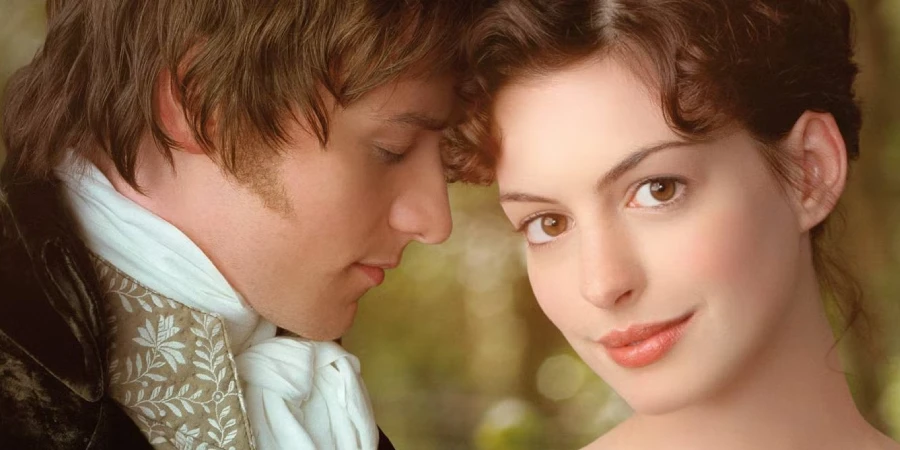

Becoming Jane (2007) is a romantic biographical drama that imagines the formative years of Jane Austen, focusing on the emotional experiences that may have shaped her worldview and later literary themes. Rather than adapting one of Austen’s novels, the film tells a “what if” story: what if Jane Austen lived a love story worthy of her own books—but could not keep it?
Detailed Summary
A Young Woman Who Refuses to Settle
The story is set in late 18th-century England, where Jane Austen (Anne Hathaway) is a sharp-witted, independent young woman who dreams of becoming a writer. Unlike most women of her time, Jane openly rejects the idea of marrying purely for financial security. Her parents, though loving, are under social and economic pressure to see her married well.
The Arrival of Tom Lefroy
Jane’s life changes with the arrival of Tom Lefroy (James McAvoy), an Irish law student staying with relatives nearby. Tom is intelligent, sarcastic, and dismissive of social conventions—an intellectual equal who immediately clashes with Jane. Their verbal sparring gradually turns into mutual admiration and then deep emotional attachment.
Love Versus Social Reality
As Jane and Tom grow closer, their bond becomes increasingly risky. Tom’s future depends on wealthy patrons, and Jane has no fortune to offer. Their love challenges the rigid class system of the era, where marriage is less about affection and more about survival.
A Choice That Defines a Life
When Jane receives a marriage proposal from Mr. Wisley, a wealthy and respectable man, she initially accepts for the sake of her family’s financial stability. However, she later withdraws from the engagement, realizing that a loveless marriage would destroy her spirit and creativity.
Jane and Tom consider eloping, believing love might conquer all—but reality intervenes in a devastating way.


Movie Ending
Jane and Tom plan to run away together, ready to defy society for love. However, Jane discovers that Tom’s family—particularly his mother and siblings—are financially dependent on him. If Tom were to marry Jane, he would lose his patrons, condemning his family to poverty.
In a moment of painful clarity, Jane realizes that their love would come at the cost of many innocent lives, not just their own happiness. She makes the devastating decision to leave Tom, choosing responsibility over desire.
Years later, Jane is shown as a successful author, her novels subtly shaped by the emotional restraint, irony, and longing born from this lost love. In the final scene, Jane encounters Tom again—now married, with a daughter. He introduces his child to Jane, who reads from one of her novels. The moment is restrained, bittersweet, and filled with unspoken emotion.
Jane walks away alone, but fulfilled in a different way: she has chosen art, independence, and legacy over romantic fulfillment.
This ending directly suggests that Jane Austen’s emotional sacrifices became the fuel for her enduring literary voice.
Are There Post-Credits Scenes?
No. Becoming Jane does not include any post-credits or mid-credits scenes. The emotional resolution occurs entirely within the final moments of the film.
Type of Movie
Becoming Jane is a romantic biographical drama that blends historical fiction with emotional storytelling. It focuses less on strict historical accuracy and more on emotional truth—how lived experience can shape creative genius.
Cast
- Anne Hathaway as Jane Austen
- James McAvoy as Tom Lefroy
- Julie Walters as Mrs. Austen
- James Cromwell as Reverend Austen
- Maggie Smith as Lady Gresham
- Laurence Fox as Mr. Wisley
Film Music and Composer
The score was composed by Adrian Johnston, known for emotionally restrained yet evocative compositions. The music subtly underscores Jane’s inner conflict rather than overpowering scenes, reinforcing the film’s themes of restraint, longing, and emotional discipline.
Filming Locations and Their Importance
- Ireland (County Meath, Dublin) – Used extensively for English countryside settings, representing Jane’s rural upbringing and emotional freedom.
- England (Hampshire, London) – Authentic locations tied to Jane Austen’s real-life environment, grounding the story in historical realism.
These locations emphasize the contrast between open countryside (freedom and imagination) and formal interiors (social constraint).
Awards and Nominations
- Nominated for Best Costume Design at the Academy Awards (2008)
- Nominated for Best Actress (Anne Hathaway) at several critics’ associations
- Won Best Romantic Drama at smaller international film festivals
Behind the Scenes Insights
- Anne Hathaway trained extensively in British dialect and period etiquette to authentically portray Austen.
- James McAvoy described the film as “a love story built on what cannot be said.”
- Director Julian Jarrold emphasized emotional realism over strict biography.
- Many letters attributed to Austen were studied to shape Jane’s dialogue.
Inspirations and References
- Inspired by Jane Austen: A Life by Carol Shields
- Influenced by Austen’s surviving letters and family accounts
- Stylistically echoes Austen adaptations such as Pride and Prejudice (1995, 2005)
Alternate Endings and Deleted Scenes
- An extended reunion scene between Jane and Tom was reportedly trimmed to maintain emotional subtlety.
- Early drafts included a more overt declaration of regret, later removed to preserve Austen-like restraint.
No alternate filmed ending has been officially released.
Book Adaptations and Differences
The film is not a direct adaptation of a novel written by Jane Austen. Instead, it fictionalizes her early life. Unlike Austen’s books, which often end in marriage, Becoming Jane ends in separation, intentionally reversing the familiar formula to explain the emotional origins of her fiction.

Memorable Scenes and Quotes
Key Scenes
- Jane rejecting a financially secure proposal for love
- The carriage scene where Jane realizes the cost of elopement
- The final reunion years later, filled with restrained emotion
Iconic Quotes
- “I cannot make speeches, Emma… If I loved you less, I might be able to talk about it more.”
- “Happiness in marriage is entirely a matter of chance.”
Easter Eggs and Hidden Details
- Jane’s dialogue subtly mirrors lines from Pride and Prejudice and Sense and Sensibility
- Tom Lefroy’s wit resembles early versions of Mr. Darcy
- Jane’s notebooks resemble actual surviving Austen manuscripts
Trivia
- Anne Hathaway was cast partly due to her expressive restraint rather than traditional period-film casting
- James McAvoy learned Irish legal history to ground his character
- The film was shot in under three months
Why Watch?
Watch this film if you enjoy emotionally intelligent romance, historical drama, and stories about women choosing purpose over comfort. It offers a deeply human explanation for why Jane Austen wrote about love the way she did.
Director’s Other Works
- Kinky Boots (2005)
- Brideshead Revisited (2008)
- Red Riding: In the Year of Our Lord 1974 (2009)