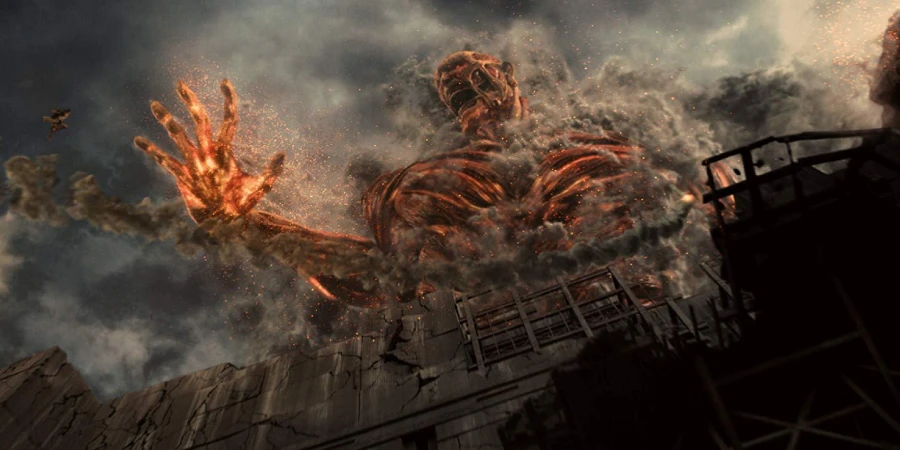

Attack on Titan: End of the World is the second and final part of the 2015 Japanese live-action adaptation of Hajime Isayama’s globally famous manga. Directed by Shinji Higuchi, this film completes the story begun in Attack on Titan (2015) and takes several bold, controversial departures from its source material. Buckle up: this is darker, messier, and far more tragic than many viewers expected.
Detailed Summary
Humanity on the Brink
The film opens immediately after the catastrophic events of the first movie. Humanity is cornered inside the last surviving city, protected by massive walls. Titans roam freely, supplies are running low, and morale is collapsing. Eren Yeager is imprisoned, labeled a potential threat rather than a savior after revealing his Titan-shifting ability.
The tone is grim and desperate. This is not a heroic uprising story; it’s about a society already broken.
Eren’s Identity and the Military’s Fear
As Eren remains detained, the military debates whether he should be executed. His power is seen as uncontrollable, and the leadership fears that another Titan is the last thing humanity needs. Mikasa and Armin struggle emotionally, torn between loyalty to Eren and the fear of what he might become.
Meanwhile, Titans continue their assault, pushing the city closer to total collapse.
The Truth About Titans
A major narrative shift occurs when the film reveals the origin of the Titans. Unlike the anime/manga, Titans here are the result of failed human experiments conducted by the government and military. These experiments were designed to create super-soldiers but instead created monsters.
This revelation reframes the entire conflict: Titans are not an external enemy, but humanity’s own creation.
Shikishima’s Role
Shikishima, a character unique to the live-action films, emerges as a central figure. Calm, charismatic, and mysterious, he reveals himself as another Titan shifter. Unlike Eren, Shikishima believes Titans represent the next stage of human evolution.
He positions himself as both a savior and executioner, arguing that the old world deserves to end.
Collapse of the Walls
The Titans breach the city’s defenses completely. Civilian casualties skyrocket, and chaos overtakes any remaining structure. Mikasa leads evacuation efforts, while Armin attempts to expose the truth behind the government’s lies.
The film becomes less about fighting Titans and more about whether humanity deserves to survive at all.
Movie Ending
The final act is bleak and uncompromising.
Eren transforms into his Titan form one last time to confront Shikishima. Their battle is not just physical but ideological: Eren fights for flawed humanity, while Shikishima fights for a Titan-dominated future. The fight devastates the surrounding area, symbolizing the complete destruction of the old world.
Eren ultimately sacrifices himself. He uses the last of his strength to destroy the Titan production system, ensuring that no more Titans can be created. This act kills him but permanently ends the Titan threat.
Shikishima also dies, his vision of forced evolution rejected.
In the aftermath, the walls are gone, the city is ruined, and most of humanity is dead. Mikasa and Armin survive, standing in an open world with no walls, no Titans, and no certainty. The film ends on a quiet, haunting note: freedom has been achieved, but at an unbearable cost.
There is no triumphant victory—only survival and grief.
Are There Post-Credits Scenes?
No. Attack on Titan: End of the World does not include a post-credits or mid-credits scene. The story ends definitively with the film’s final moments, reinforcing its bleak sense of closure.
Type of Movie
This is a dark science-fiction action film blended with post-apocalyptic horror and dystopian tragedy. Unlike typical blockbuster adaptations, it leans heavily into existential despair and moral ambiguity.
Cast
- Haruma Miura as Eren Yeager
- Kiko Mizuhara as Mikasa Ackerman
- Kanata Hongō as Armin Arlert
- Hiroki Hasegawa as Shikishima
- Satomi Ishihara as Hange Zoë
Film Music and Composer
The score is composed by Shirō Sagisu, best known for his work on Neon Genesis Evangelion. His music amplifies the film’s apocalyptic tone with heavy choral arrangements, ominous percussion, and emotional piano themes.

Filming Locations
The movie was shot primarily in Japan, using abandoned industrial zones, quarries, and rural landscapes.
- Hashima Island–style sets inspired the ruined city aesthetic
- Outdoor locations helped ground the CGI Titans in physical space
- Real locations enhanced the film’s raw, oppressive atmosphere, making the destruction feel tangible
Awards and Nominations
- Nominated for Best Visual Effects at the Japan Academy Film Prize
- Recognized at multiple Asian film festivals for technical achievements
Despite mixed critical reception, the film was praised for its ambitious production scale.
Behind the Scenes Insights
- Hajime Isayama approved major story changes and encouraged a new interpretation
- Director Shinji Higuchi prioritized practical effects over full CGI whenever possible
- Actors performed many scenes in heavy harnesses to simulate Titan movement
- The darker ending was intentionally designed to contrast with typical blockbuster finales
Inspirations and References
- Based on Attack on Titan manga by Hajime Isayama
- Influenced by classic kaiju films like Godzilla
- Themes echo post-war Japanese cinema and disaster narratives
- Visual style draws from Evangelion-like existentialism
Alternate Endings and Deleted Scenes
Early drafts reportedly included a more hopeful ending where remnants of the military rebuild society. This was scrapped in favor of a more fatalistic conclusion. Several character development scenes for Mikasa and Hange were shortened for pacing.
Book Adaptations and Differences
While based on the manga, the film diverges significantly:
- Titans are man-made experiments, not a mysterious ancient curse
- Shikishima replaces several manga antagonists
- The political and mythological depth of the manga is simplified
- Eren’s fate is drastically altered compared to the source material

Memorable Scenes and Quotes
Key Scenes
- The full Titan breach of the city
- Eren’s final transformation
- Mikasa leading civilians through burning ruins
- The ideological confrontation between Eren and Shikishima
Iconic Quotes
- “If humanity survives, it won’t be because we were strong.”
- “Freedom isn’t free. It’s paid in lives.”
Easter Eggs and Hidden Details
- Military insignias reference classic kaiju films
- Experimental Titan footage mirrors real-world wartime propaganda
- Background monitors briefly show failed Titan prototypes
- Wall inscriptions reference themes from the original manga
Trivia
- The film was shot back-to-back with Part 1
- Titans were animated using a hybrid of motion capture and hand animation
- Some Titan roars are modified animal sounds
- The production involved over 3,000 extras
Why Watch?
If you want a bold, uncompromising adaptation that isn’t afraid to challenge fans, this film is worth watching. It offers a unique, darker take on Attack on Titan that stands apart from the anime and manga—flawed, controversial, but undeniably ambitious.
Director’s Other Works
- Shin Godzilla (2016)
- Lorelei: The Witch of the Pacific Ocean (2005)
- Attack on Titan (2015)
Recommended Films for Fans
- Shin Godzilla (2016)
- The Host (2006)
- Neon Genesis Evangelion: The End of Evangelion (1997)
- Snowpiercer (2013)
- Battle Royale (2000)