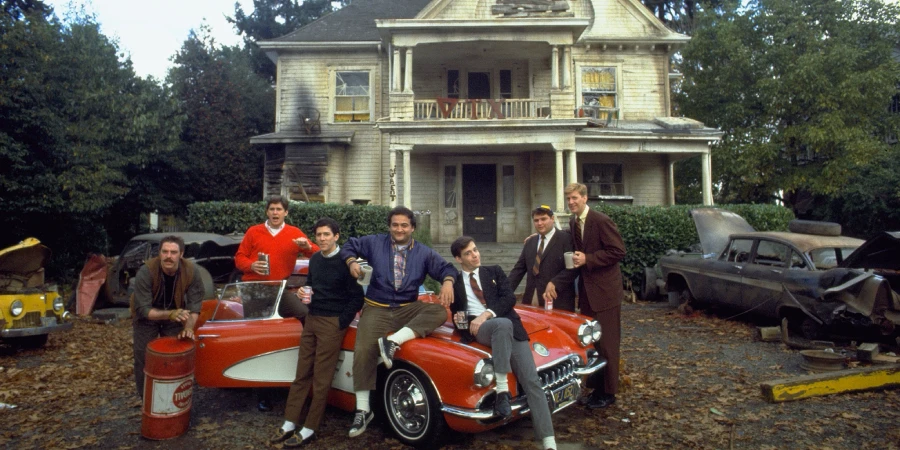

National Lampoon’s Animal House is one of the most influential comedies ever made. Directed by John Landis and produced on a modest budget, the film didn’t just become a hit — it practically defined the modern college comedy and launched the careers of several actors, most notably John Belushi.
Set in 1962 at the fictional Faber College, the story follows the chaos between two fraternities: the rule-abiding, elitist Omega House and the loud, anarchic, beer-soaked Delta Tau Chi.
Detailed Summary
Freshmen Enter the World of Fraternities
The movie begins with two naive freshmen, Larry Kroger and Kent Dorfman, looking to join a fraternity. They are rejected by the prestigious Omega House and end up at the notorious Delta Tau Chi, a fraternity already on probation due to its constant misconduct.
Here they meet the unforgettable members: Bluto (John Belushi), Otter, Boon, Pinto, D-Day, and Flounder. From the start, the Deltas are presented as lovable but uncontrollable agents of chaos.
Dean Wormer’s War Against the Deltas
Dean Vernon Wormer despises Delta House and is actively trying to shut them down. He collaborates with the smug Omega fraternity to spy on them and gather evidence that will justify expelling them from campus.
This sets up the core conflict: authority vs. rebellion.
The Toga Party
One of the most iconic sequences in comedy history, the Toga Party shows Delta House at peak madness. Loud music, alcohol, dancing, and complete lack of control define the scene. This moment cements Delta’s identity as the ultimate anti-establishment group.
Road Trip Chaos and Personal Disasters
A series of episodic misadventures follows:
Otter and Boon try to seduce a mayor’s daughter.
Bluto disrupts a cafeteria with his famous food fight.
Pinto experiences an awkward romantic situation with a young girl he believes is older.
Flounder wrecks his brother’s car after borrowing it for a road trip.
These scenes are less about plot progression and more about escalating absurdity and character-driven comedy.
Probation Turns Into Expulsion
After continued misconduct and Omega sabotage, Dean Wormer expels the entire Delta House. This seems like the end of the road for them, with authority finally winning.
But Delta House doesn’t go quietly.



Movie Ending
Instead of accepting defeat, the Deltas decide to take revenge during the college’s official Founder’s Day parade. They construct an absurd float disguised as a cake, sneak into the parade, and then literally break the parade apart from the inside.
Chaos erupts in the streets. The marching band collapses, floats crash, people run in panic, and the entire event descends into total anarchy. Bluto leads the destruction like a gleeful general of mayhem.
The parade scene is not just slapstick; it’s the film’s thesis statement: irreverence defeats order through pure absurdity.
After the riot, the movie cuts to freeze frames showing where each character ends up years later. Ironically, many Delta members go on to successful lives, including political office, while Dean Wormer’s future is far less flattering.
The message is clear and deeply comedic: the rule-breakers turned out fine.
Are There Post-Credits Scenes?
No. The film ends with the freeze-frame epilogues and credits. There are no post-credits or mid-credits scenes.
Type of Movie
Animal House is a raunchy, anarchic college comedy that mixes satire, slapstick, and social rebellion into a story that mocks authority, elitism, and academic hypocrisy.
Cast
- John Belushi as John “Bluto” Blutarsky
- Tim Matheson as Eric “Otter” Stratton
- John Vernon as Dean Vernon Wormer
- Verna Bloom as Marion Wormer
- Thomas Hulce as Larry Kroger (Pinto)
- Stephen Furst as Kent Dorfman (Flounder)
- Bruce McGill as D-Day
- James Widdoes as Hoover
Film Music and Composer
The score was composed by Elmer Bernstein. The soundtrack features early rock and roll and R&B tracks that reinforce the early 1960s setting and give the movie a rebellious musical energy.

Filming Locations
The movie was filmed primarily at the University of Oregon in Eugene. The campus architecture perfectly matched the early-60s college aesthetic the filmmakers wanted. Many fraternity house exteriors and parade scenes were shot in real college streets, adding authenticity to the chaos.
Awards and Nominations
- National Film Registry selection by the Library of Congress for cultural significance
- Writers Guild of America nomination for Best Comedy Adapted from Another Medium
Behind the Scenes Insights
- John Belushi improvised many of Bluto’s most famous moments, including the cafeteria food fight.
- The studio expected the film to fail and gave it a very small budget.
- The cast lived together during filming, creating real fraternity-like bonds.
- Some scenes were filmed without permits, especially the parade destruction shots.
Inspirations and References
The film was inspired by real college experiences of the writers from their time at Dartmouth College and the humor style of National Lampoon magazine.
Alternate Endings and Deleted Scenes
Several extended party scenes and character bits were cut for pacing. There was no radically different alternate ending, but early drafts had even more outrageous parade destruction that was toned down for practicality.
Book Adaptations and Differences
The movie was not based on a novel but on stories and humor pieces from National Lampoon. A novelization was released after the film’s success.

Memorable Scenes and Quotes
Key Scenes
- The cafeteria food fight started by Bluto
- The Toga Party sequence
- The road trip and car destruction
- The parade sabotage finale
Iconic Quotes
- “Toga! Toga! Toga!”
- “Was it over when the Germans bombed Pearl Harbor? Hell no!”
- “Fat, drunk, and stupid is no way to go through life, son.”
Easter Eggs and Hidden Details
- The college year (1962) subtly references pre-counterculture America just before major social change.
- Bluto’s GPA is revealed as 0.0 very briefly on a report sheet.
- Omega members are often framed visually higher than Delta members to emphasize status contrast.
Trivia
- John Belushi was paid far less than many co-stars despite being the breakout star.
- The film’s budget was around $3 million and became a massive box office success.
- Many colleges banned screenings of the movie in the late 70s.
Why Watch?
Because this is the blueprint for every college comedy that came after it. If you’ve ever seen a fraternity joke in a movie, it probably started here. It’s loud, messy, politically incorrect, and still incredibly funny.
Director’s Other Works (Movies)
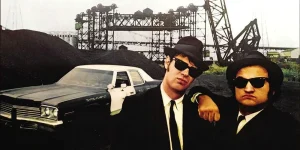
- The Blues Brothers (1980)
- An American Werewolf in London (1981)
- Trading Places (1983)
- Coming to America (1988)
Recommended Films for Fans
- Caddyshack (1980)
- Porky’s (1981)
- Revenge of the Nerds (1984)
- Old School (2003)
- Superbad (2007)