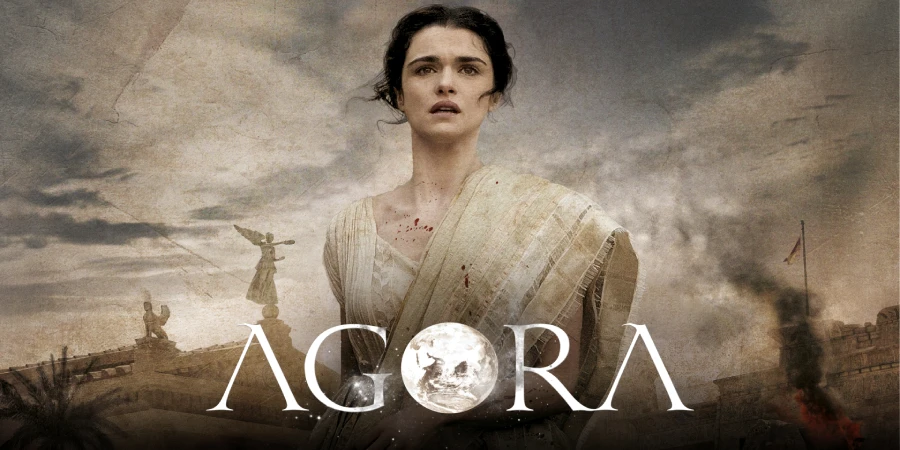

Agora (2009) is a historical drama directed by Alejandro Amenábar that blends philosophy, science, religion, and political power into a tragic portrait of one of history’s most turbulent eras. Set in Roman Egypt, the film explores the clash between reason and fanaticism through the life of a remarkable woman whose ideas were centuries ahead of her time.
This is not a light watch. It is thoughtful, slow-burning, and deliberately unsettling.
Detailed Summary
Alexandria: A City on the Brink
The story takes place in 4th-century Alexandria, a multicultural city where pagans, Christians, and Jews live together under fragile peace. The famous Library of Alexandria, though already diminished from its ancient glory, remains a powerful symbol of knowledge and classical learning.
At the center of this intellectual world is Hypatia, a philosopher, mathematician, and astronomer who teaches Platonic thought. She believes the universe can be understood through reason rather than religious dogma, an idea that quietly threatens all sides.
Hypatia and Her Students
Hypatia teaches openly to male students, an extraordinary position for a woman in this era. Among her pupils are:
- Orestes, who later becomes the Roman prefect of Alexandria
- Synesius, a devoted student who later converts to Christianity and becomes a bishop
- Davus, her enslaved assistant, who secretly loves her
These relationships form the emotional core of the film, especially as politics and faith begin to override loyalty and reason.
Religious Tensions Escalate
As Christianity gains political power, violent clashes erupt between religious groups. Pagan temples are attacked, Jewish communities are expelled, and ancient texts are destroyed. One of the most harrowing scenes shows the storming of the Serapeum, where priceless scrolls are smashed, burned, or discarded.
Hypatia’s refusal to convert to Christianity or marry is increasingly viewed as dangerous. Her independence becomes political.
Science Versus Faith
While chaos unfolds in the streets, Hypatia works on astronomical theories. She questions the geocentric model of the universe and moves closer to a heliocentric understanding, even contemplating elliptical orbits centuries before Kepler.
These scenes emphasize the film’s central theme: truth does not depend on belief.
Power Shifts and Betrayals
As Christians dominate Alexandria, former students now hold power. Orestes struggles to govern fairly, while Bishop Cyril pushes religious authority into political control. Synesius is torn between faith and respect for his former teacher.
Davus, broken by love and fear, ultimately joins the Christian mob, hoping faith will give him purpose and belonging.



Movie Ending
Hypatia is falsely accused of being a witch and a corrupter of men, blamed for political conflicts between Orestes and the Church. The accusation is not about belief but control. A woman who thinks freely cannot be allowed to exist.
A Christian mob captures her in the streets. She is dragged into a church, stripped, and prepared for a brutal execution.
In a final, deeply tragic moment, Davus suffocates Hypatia before the mob can torture her to death. This act is portrayed ambiguously: both merciful and cowardly. Her body is then desecrated and burned.
The film ends not with triumph, but silence. Hypatia’s discoveries are lost, her voice erased. The camera pulls away from Earth, reminding the viewer that while humanity destroys knowledge, the universe remains indifferent and vast.
The ending reinforces the film’s message: progress can be destroyed, but truth never belonged to those who silenced it.
Are There Post-Credits Scenes?
No. Agora does not include any post-credits or mid-credits scenes. The film ends definitively, allowing the weight of its conclusion to linger without distraction.
Type of Movie
Agora is a historical drama with strong philosophical and political themes, blending biographical storytelling with reflections on science, religion, and power. It leans more toward intellectual tragedy than traditional epic spectacle.
Cast
- Rachel Weisz as Hypatia
- Max Minghella as Davus
- Oscar Isaac as Orestes
- Sam Neill as Theon
- Michael Lonsdale as Bishop Theophilus
- Sami Samir as Bishop Cyril
Rachel Weisz’s performance is widely regarded as the emotional anchor of the film.
Film Music and Composer
The score was composed by Dario Marianelli, whose music is subtle, mournful, and restrained. Rather than dominating scenes, it underscores the tragedy with quiet intensity, emphasizing loss rather than heroism.


Filming Locations and Their Importance
- Malta: The primary filming location, chosen for its ancient architecture and open landscapes.
- Fort Ricasoli: Used extensively to recreate Alexandria and its streets.
- Large-scale sets were built to represent the Serapeum and Library, emphasizing how monumental knowledge once was.
These locations reinforce the film’s sense of historical weight and authenticity.
Awards and Nominations
While Agora was overlooked by major international awards, it received:
- Goya Awards: 7 wins including Best Original Screenplay and Best Production Design
- Multiple nominations for cinematography and costume design
The lack of Oscar recognition is often cited as controversial.
Behind the Scenes Insights
- Alejandro Amenábar spent years researching late Roman Egypt and early Christianity.
- Rachel Weisz studied ancient philosophy and mathematics to portray Hypatia authentically.
- The film was controversial in several countries due to its portrayal of religious extremism.
- Oscar Isaac has stated this was one of the roles that helped launch his international career.
Inspirations and References
- Historical accounts of Hypatia of Alexandria
- Writings by ancient philosophers such as Plato and Aristotle
- Scientific works related to early astronomy
- Enlightenment-era critiques of religious dogmatism
Alternate Endings and Deleted Scenes
No alternate ending was filmed. However, several classroom scenes explaining Hypatia’s theories in more detail were removed to maintain pacing and accessibility for general audiences.
Book Adaptations and Historical Differences
The film is not based on a single book, but rather on historical sources. Major differences include:
- Hypatia’s scientific discoveries are speculative but plausible
- Davus is a fictional character used to represent the moral struggle of the era
- Some events are compressed chronologically for dramatic impact



Memorable Scenes and Quotes
Key Scenes
- The destruction of the Serapeum
- Hypatia explaining planetary motion using sand
- The silent execution scene
- The final shot pulling away from Earth into space
Iconic Quotes
- “All formal dogmatic religions are fallacious.”
- “You do not question what you believe, you believe what you do not question.”
Easter Eggs and Hidden Details
- Several astronomical diagrams shown match real ancient calculations
- Camera transitions from Earth to space reflect Hypatia’s cosmic perspective
- Religious symbols subtly dominate the frame as the film progresses, visually showing power shifts
Trivia
- Rachel Weisz was pregnant during parts of filming
- The film was banned or heavily criticized in some religious communities
- The budget was unusually high for a philosophical historical drama
- Many extras were local Maltese residents
Why Watch Agora?
Watch Agora if you are interested in:
- The cost of intellectual freedom
- The historical roots of science and intolerance
- Films that challenge rather than comfort
- Tragic stories based on real events
It is a film that stays with you, not because it entertains, but because it warns.
Director’s Other Works
- The Sea Inside (2004)
- The Others (2001)
- Open Your Eyes (1997)
- Regression (2015)