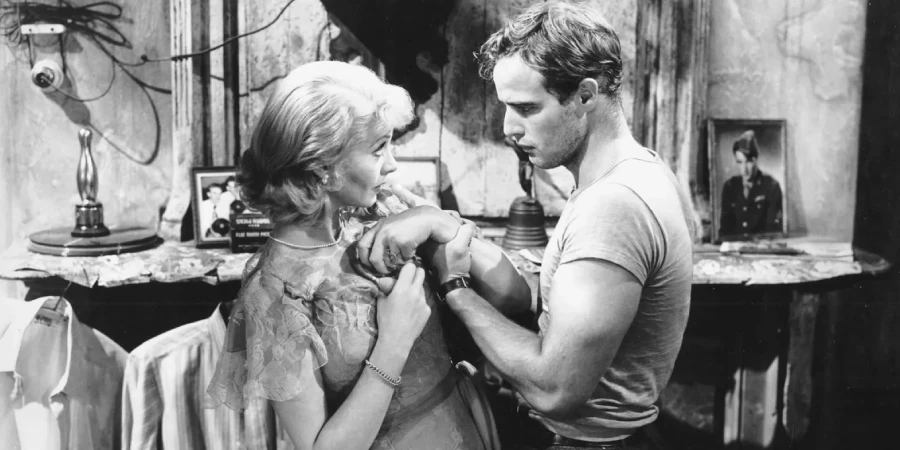

Blanche DuBois arrives in New Orleans seeking refuge, but finds only a battleground. A Streetcar Named Desire is not just a story of a woman’s downfall. Instead, it is a ferocious collision between illusion and brutal reality, set in a cramped apartment simmering with heat and resentment.
Detailed Summary
Blanche’s Arrival in New Orleans
Blanche DuBois, a fading Southern belle, arrives at the squalid New Orleans apartment of her sister, Stella, and her husband, Stanley Kowalski. She claims to be on a leave of absence from her teaching job. However, Blanche is clearly fragile and carries an air of genteel desperation.
Her refined, delicate sensibilities immediately clash with Stanley’s crude, animalistic nature. He is instantly suspicious of her, especially after learning that the family estate, Belle Reve, has been “lost.”
Poker Night and Violence
During a heated poker game, Stanley becomes enraged by the noise from Blanche and Stella’s chatter. Drunk and furious, he explodes, throwing their radio out the window. When Stella tries to intervene, he strikes her.
Stella flees upstairs to her neighbor Eunice’s apartment, but Stanley, full of remorse, stumbles into the courtyard. Consequently, he bellows his now-iconic cry: “STELLA!” Stella, drawn by his raw passion, returns to him in a dramatic reconciliation that horrifies Blanche.
A Glimmer of Hope with Mitch
Blanche finds a potential savior in Harold “Mitch” Mitchell, one of Stanley’s more sensitive poker buddies. He is captivated by her supposed purity and gentility. Their courtship offers Blanche a chance to escape her past and secure a stable future.
She carefully maintains this illusion, always meeting him in dim lighting and spinning tales of her delicate nature. Mitch, who cares for his sick mother, sees her as the respectable woman he needs.
The Past Comes Calling
Meanwhile, Stanley’s suspicions about Blanche intensify. He begins digging into her past in her hometown of Laurel, Mississippi. He uncovers a sordid history of promiscuity and learns she was fired from her teaching job for having a relationship with a seventeen-year-old student.
Stanley learns she was not on a leave of absence but was run out of town. He now holds the power to destroy her carefully constructed new life.
Blanche’s Birthday and Betrayal
On Blanche’s birthday, Stanley cruelly reveals everything he has learned to both Stella and Mitch. He presents Blanche with a bus ticket back to Laurel as a “gift.” Later, Mitch confronts Blanche, forcing her into the harsh glare of a bare lightbulb.
He tells her she is not clean enough to bring into the house with his mother and ends their relationship. Her last hope for escape is now gone.
The Final Confrontation
While Stella is at the hospital giving birth, Stanley returns to the apartment to find a drunken Blanche lost in her fantasies. She tells him she is leaving to join a fictional millionaire admirer. He plays along for a moment before tearing her fantasy apart.
He corners her, and despite her resistance, he assaults her. The film strongly implies that Stanley rapes Blanche, a final, brutal act that shatters her sanity completely.



Movie Ending
The film’s ending is devastating. Weeks later, we find Blanche in a nearly catatonic state, being prepared for a trip. Stella, who has chosen not to believe Blanche’s story about the assault, has arranged to have her sister committed to a mental institution.
When doctors arrive, Blanche initially resists, but one doctor treats her with gentleness. Responding to this small act of decency, she utters her famous last line, “Whoever you are, I have always depended on the kindness of strangers,” and allows him to lead her away. As Stanley calls for Stella, she takes her baby and goes upstairs to Eunice, sobbing that she will not return to him. However, the theatrical ending implies a different outcome, with Stella staying with Stanley, choosing his world over her sister’s truth.
Are There Post-Credits Scenes?
No, there are no post-credits scenes in A Streetcar Named Desire.
Type of Movie
A Streetcar Named Desire is a Southern Gothic psychological drama. Its tone is intense, claustrophobic, and emotionally raw, exploring themes of desire, madness, and the clash between old-world gentility and modern brutishness.
Cast
- Vivien Leigh – Blanche DuBois
- Marlon Brando – Stanley Kowalski
- Kim Hunter – Stella Kowalski
- Karl Malden – Harold “Mitch” Mitchell
Film Music and Composer
The groundbreaking score was composed by Alex North. He created one of the first jazz-oriented film scores, a revolutionary move at the time. The music is not simply background noise; it is a character in its own right.
Specifically, the sultry, bluesy jazz reflects the steamy atmosphere of New Orleans and the raw passions of the characters. Notably, different musical motifs are used to represent the conflicting worlds of Blanche and Stanley.

Filming Locations
Most of the film was shot on meticulously designed soundstages at Warner Bros. Studios in Burbank, California. Director Elia Kazan intentionally used shrinking sets to heighten the sense of claustrophobia as Blanche’s world closes in on her.
Some exterior shots, however, were filmed on location in New Orleans to establish authenticity. These include Blanche’s arrival at the Louisville & Nashville Railroad station and views of the actual streetcars.
Awards and Nominations
A Streetcar Named Desire was a critical triumph, earning twelve Academy Award nominations. It won four Oscars, a major achievement for any film.
The wins included Best Actress for Vivien Leigh, Best Supporting Actor for Karl Malden, and Best Supporting Actress for Kim Hunter. It also won for Best Art Direction. Marlon Brando’s legendary performance, interestingly, did not win him the Best Actor award that year.
Behind the Scenes Insights
- Marlon Brando, Kim Hunter, and Karl Malden all reprised their roles from the original Broadway production. Vivien Leigh, who had played Blanche in the London stage version, was chosen for the film over Broadway’s Jessica Tandy for her star power.
- Director Elia Kazan found the tension between Brando’s method acting and Leigh’s classical training beneficial. He would reportedly stoke this tension on set to elicit more authentic performances.
- Marlon Brando’s audition for the play was memorable. He hitchhiked to Tennessee Williams’s home, fixed his plumbing, and then gave a reading that immediately won him the part of Stanley.
Inspirations and References
The film is a direct adaptation of the 1947 Pulitzer Prize-winning play of the same name by Tennessee Williams. The play drew heavily from Williams’s own life experiences and personal struggles.
For instance, many scholars believe the character of Blanche was inspired by Williams’s own sister, Rose, who was institutionalized after undergoing a lobotomy.
Alternate Endings and Deleted Scenes
The 1951 theatrical release was heavily edited to comply with the motion picture Hays Code and pressure from the Catholic Legion of Decency. Several minutes of footage were cut by the studio against Elia Kazan’s wishes.
Key cuts included softening the overt references to Blanche’s husband being gay and trimming the pivotal assault scene to make it less explicit. Furthermore, the ending was altered to punish Stanley; Stella’s final line implies she is leaving him, a departure from the play where she stays. A 1993 “director’s cut” restored this trimmed footage, presenting a version closer to Kazan’s original vision.
Book Adaptations and Differences
This film is based on a play, not a book. The primary differences between the theatrical film and Tennessee Williams’s original play stem from the censorship of the era. The play is far more explicit about the reasons for Blanche’s husband’s suicide (she discovered him with another man).
In addition, Stanley’s final triumph in the play is more absolute. Stella’s decision to stay with him, choosing carnal desire over her sister’s sanity, is one of the play’s most chilling statements. The original film’s ending, in contrast, attempts to give Stella a moral out that Williams never intended.


Memorable Scenes and Quotes
Key Scenes
- “STELLA!”: After hitting his pregnant wife, Stanley’s raw, guttural scream for forgiveness from the courtyard is one of cinema’s most parodied yet powerful moments.
- The Paper Lantern: Mitch tears the paper lantern off the lightbulb, forcing Blanche into the harsh light to see her aged face, symbolizing the destruction of her illusions.
- The Kindness of Strangers: Blanche’s final exit, where she accepts the arm of the asylum doctor, represents her complete and tragic detachment from reality into a world of fantasy.
Iconic Quotes
- “I have always depended on the kindness of strangers.”
- “STELLA! Hey, Stella!”
- “I don’t want realism. I want magic! Yes, yes, magic! I try to give that to people. I misrepresent things to them. I don’t tell the truth, I tell what ought to be the truth.”
- “We’ve had this date with each other from the beginning.”
Easter Eggs and Hidden Details
- The very names of the streetcars Blanche rides are symbolic. She takes a streetcar named “Desire,” transfers to one named “Cemeteries,” and gets off at a street called “Elysian Fields,” the resting place of heroes in Greek mythology. Her journey is a metaphor for her life path.
- Blanche’s constant bathing is a recurring motif. She tells Stella she’s bathing to “calm my nerves,” but it symbolically represents her desperate, futile attempt to wash away the sins and impurities of her past.
- Blanche often sings the song “It’s Only a Paper Moon.” Its lyrics (“It’s a Barnum and Bailey world, just as phony as it can be… but it wouldn’t be make-believe if you believed in me”) perfectly mirror her philosophy of creating illusions.
Trivia
- Marlon Brando’s tight-fitting t-shirts in the film were so influential they are credited with popularizing the garment as mainstream outerwear for men.
- Vivien Leigh, who had bipolar disorder, found playing the mentally unstable Blanche DuBois profoundly difficult. She later said the role “tipped me over into madness.”
- Despite the iconic “STELLA!” cry, Marlon Brando says the line only once in the entire film.
Why Watch?
Watch for the towering performances that defined a generation of acting. This film is a raw, unflinching look at human fragility and the brutal consequences of colliding realities. It remains as potent and shocking today as it was in 1951.
Director’s Other Movies
- On the Waterfront (1954)
- East of Eden (1955)
- Splendor in the Grass (1961)
- Baby Doll (1956)
Recommended Films for Fans
- Cat on a Hot Tin Roof (1958)
- Who’s Afraid of Virginia Woolf? (1966)
- The Glass Menagerie (1950)
- Rebel Without a Cause (1955)