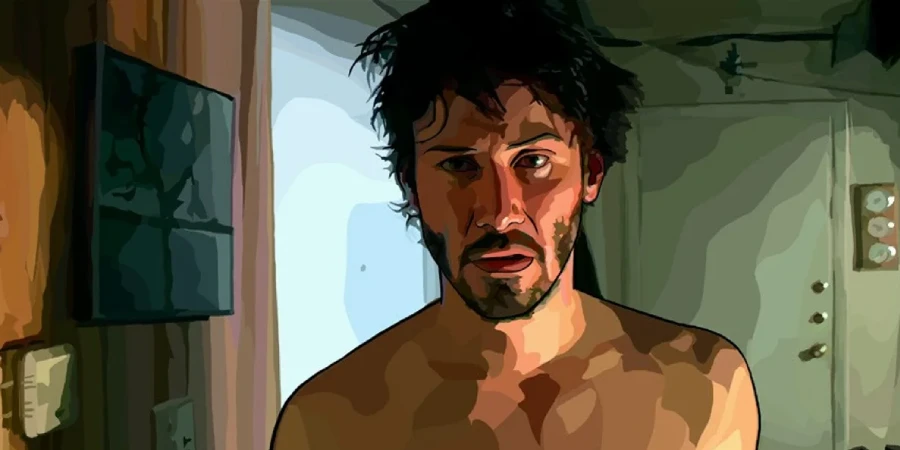

Richard Linklater’s A Scanner Darkly is one of the most distinctive sci-fi movies of the 2000s, blending rotoscoped animation with a paranoid story adapted from Philip K. Dick’s novel.
Detailed Summary
The Near Future: Surveillance, Paranoia, and Substance D
The film is set in a dystopian near-future America where the highly addictive drug Substance D has become an epidemic. Law enforcement is overwhelmed, and the government has turned to advanced surveillance mechanisms and undercover agents.
Our protagonist, Bob Arctor (Keanu Reeves), is a deep-cover narcotics agent tasked with infiltrating the local drug scene. He lives with a small group of eccentric addicts, including Freck (Rory Cochrane) and Barris (Robert Downey Jr.), whose unpredictable behavior adds to the film’s anxious tone.
The Scramble Suit and a Fragmented Identity
Bob reports to his superiors while wearing a scramble suit, a device that constantly shifts his appearance so no one—including his bosses—knows his real identity. Bob’s superior refers to him only as Agent Fred.
Things take a turn when Fred is ordered to investigate Bob Arctor himself. This puts Bob into a bizarre situation where he must spy on… himself. The film uses this to explore identity breakdown and the psychological impact of living undercover.
Donna, Substance D, and Trust Issues
Bob becomes emotionally attached to Donna (Winona Ryder), a fellow addict and small-time dealer. Their unstable relationship adds emotional tension, particularly because Bob trusts her more than anyone else, despite her evasive behavior.
As Substance D eats away at Bob’s cognitive functions, he struggles to distinguish reality from hallucination. Even simple conversations become labyrinths of paranoia.
The Conspiracy Revealed
The deeper Bob sinks into addiction, the more he becomes a pawn in a larger scheme. He believes his friends might be spying on him, but the truth is more chilling: Bob is being intentionally sacrificed by the government as part of a covert plan to infiltrate New Path, a supposed rehabilitation facility suspected of producing Substance D.

Movie Ending
By the end, Bob/Agent Fred is a broken man. Long-term Substance D use has severely damaged his brain, leaving him cognitively unstable. His personality dissolves, and the contrast between Bob and Fred disappears entirely.
The government’s true plan comes into focus:
- Donna is revealed to be an undercover officer, far more experienced than Bob ever realized. She was assigned to monitor him, not love him.
- Bob’s addiction was encouraged so he would be mentally impaired enough to pass into New Path rehabilitation undetected.
- New Path, the rehab organization, is secretly growing the blue flowers used to produce Substance D.
In the final scene, now known as Bruce, Bob works on a New Path farm, barely aware of who he once was. But he retains a flicker of recognition. He discovers the Substance D flowers on the farm—the very source of the drug that destroyed him—and pockets one as evidence.
The film ends with a tragic but bittersweet hope: even in his shattered state, Bob may eventually expose the conspiracy. It’s a quiet, devastating finale underscoring the human cost of systemic corruption.
Are There Post-Credits Scenes?
There is no post-credits scene.
However, before the credits finish, the film displays a dedication list naming real friends and family of Philip K. Dick who struggled with or died from drug addiction, giving emotional weight to the story.
Type of Movie
A Scanner Darkly is a philosophical sci-fi drama blended with dark comedy and psychological thriller elements. It’s contemplative, unsettling, and heavily character-driven rather than action-oriented.
Cast
- Keanu Reeves as Bob Arctor / Agent Fred
- Winona Ryder as Donna Hawthorne
- Robert Downey Jr. as James Barris
- Woody Harrelson as Ernie Luckman
- Rory Cochrane as Charles Freck
Film Music and Composer
The soundtrack is composed by Graham Reynolds, with minimalist, atmospheric tracks that mirror Bob’s mental deterioration and the film’s unsettling tone. The score mixes electronic textures with subdued acoustic elements to maintain a constant sense of disorientation.

Filming Locations and Their Importance
The movie was primarily shot in Austin, Texas, and surrounding areas. The choice is important because:
- Linklater’s experiences in Austin’s counterculture informed much of the film’s tone.
- The suburban neighborhoods reflect Philip K. Dick’s intention: addiction and paranoia don’t occur in far-off dystopias—they happen in ordinary places.
- The rotoscoping technique required extensive studio work, which was done locally.
Awards and Nominations
- Nominated for Best Animated Feature at the Annie Awards
- Won several small festival awards for animation and innovation
- Frequently cited in academic circles for its groundbreaking rotoscoping approach
It didn’t sweep mainstream awards, but it developed a strong cult following and critical respect.
Behind the Scenes Insights
- The film used a unique digital rotoscoping process, with animators tracing over live-action footage frame by frame.
- Linklater previously used the technique in Waking Life (2001), but A Scanner Darkly applied it more consistently and realistically.
- The cast performed full scenes physically before animators transformed them, allowing for more organic expressions than typical animation.
- The filmmakers tried to stay unusually faithful to Philip K. Dick’s novel, even keeping large portions of the dialogue intact.
- Reeves said he consciously avoided “acting big” because the rotoscoping would amplify even small motions.
Inspirations and References
- Based on Philip K. Dick’s novel A Scanner Darkly (1977).
- The story is semi-autobiographical—Dick himself struggled with addiction and paranoia in the 1970s.
- Many characters are inspired by real people Dick lived with in drug communes.
- The scramble suit concept influenced later pop-culture depictions of shifting identity technology.
Alternate Endings and Deleted Scenes
Very few alternate endings exist because Linklater wanted to remain loyal to the book. Minor scenes were trimmed for pacing, including:
- Additional hallucination sequences for Freck
- A longer transition of Bob’s cognitive decline
- More footage of daily life inside New Path
None radically changed the story.
Book Adaptation and Differences
Although highly faithful, a few differences stand out:
- The novel includes deeper internal monologues showing Bob’s psychological deterioration.
- The book’s political critique is sharper, whereas the film softens it slightly to focus more on personal tragedy.
- Donna’s character has more complexity in the novel and her relationship with Bob is more ambiguous.
Still, it remains one of the closest adaptations of a Philip K. Dick work.

Memorable Scenes and Quotes
Key Scenes
- Bob is ordered to investigate himself, creating a heartbreaking identity loop.
- Freck’s hallucination of seeing strange creatures cataloging his sins.
- The scramble suit demonstration—still one of the coolest sci-fi visuals of the 2000s.
- Bob, now mentally destroyed, discovering the blue flowers at New Path.
Iconic Quotes
- “What does a scanner see?”
- “Whatever it is that’s watching, it’s not human.”
- “I saw death rising from the earth.”
Easter Eggs and Hidden Details
- Many background characters resemble people from Linklater’s earlier films, a nod from the animation team.
- Substance D flower fields match Philip K. Dick’s original descriptions to microscopic detail.
- Freck’s hallucinations include imagery inspired by Dick’s unpublished personal sketches.
- The scramble suit’s human-face mosaic includes likenesses of the animators themselves.
Trivia
- Reeves took the role partly because he admired Dick’s writings and the novel personally affected him.
- Several animators had to be replaced mid-production due to the intense workload of rotoscoping.
- Philip K. Dick’s daughters praised the film as the most faithful adaptation of his work to date.
- Downey Jr. improvised many lines, which animators then had to carefully preserve.
Why Watch?
Because A Scanner Darkly is one of the rare sci-fi films that’s emotionally intimate, visually experimental, and philosophically profound.
If you want a film that questions identity, surveillance, addiction, and the cost of loyalty—not with explosions, but with psychological depth—this is a must-see.
Director’s Other Works
- Slacker (1990)
- Dazed and Confused (1993)
- Before Sunrise (1995)
- Waking Life (2001)
- School of Rock (2003)
- Boyhood (2014)
- Before Midnight (2013)
Recommended Films for Fans
- Waking Life (2001)
- Blade Runner (1982)
- The Congress (2013)
- Brazil (1985)
- Pi (1998)
- Enemy (2013)