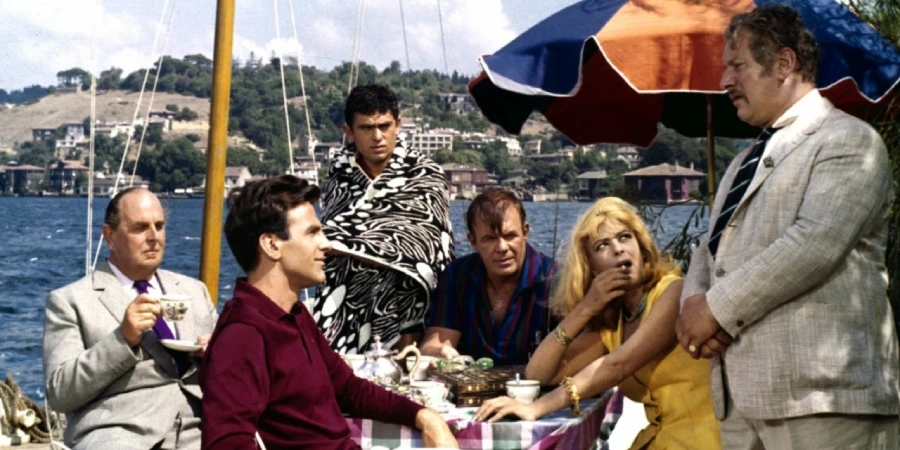
Jules Dassin’s Topkapi is a stylish, witty, and meticulously constructed heist film that turns a jewel robbery into an elegant game of nerves, timing, and human error. Set largely in Istanbul and centered on the legendary Topkapi Palace, the film blends suspense, humor, and character-driven storytelling in a way that influenced the heist genre for decades.
Detailed Summary
The Scheme Is Born: A Jewel Too Tempting to Ignore
Elizabeth Lipp (Melina Mercouri), a glamorous and reckless con artist, becomes obsessed with stealing the priceless emerald-encrusted dagger displayed in the Topkapi Palace museum in Istanbul. Her fascination quickly turns into a full-blown plan. She recruits her former lover and professional mastermind Walter Harper (Maximilian Schell), who has the technical knowledge and discipline to turn her fantasy into a real operation.
From the start, the tone is clear: this is a heist driven as much by ego and personality as by criminal expertise.
The Team: Specialists with Fragile Egos
Walter assembles a highly specialized crew:
- Giulio (Gilles Ségal), an acrobat and expert climber
- Hans (Robert Morley), a gadget-loving engineer
- Cedric Page (Robert Stephens), a nervous small-time hustler who becomes the operation’s unexpected weak link
Cedric is not meant to be part of the plan, but after being arrested for smuggling and pressured by Turkish police, he is forced to act as an informant. The police, suspicious of the group, use Cedric as their eyes and ears, creating a double-layered tension: the thieves versus the authorities, and the team versus Cedric’s nerves.
Istanbul as a Character
The film luxuriates in Istanbul’s atmosphere. Markets, rooftops, mosques, and the Bosphorus are not mere backgrounds. They create a sense of authenticity and exotic tension. The plan unfolds slowly, with reconnaissance of the museum, timing the guards, measuring the alarm systems, and calculating every step.
This is where Topkapi becomes a blueprint for later heist films: the pleasure is in watching the plan take shape piece by piece.
The Heist Preparation: Precision and Paranoia
The famous heist sequence is built around Giulio being lowered from the ceiling into the museum chamber where the dagger is displayed. Every movement must be perfectly controlled. The floor is alarmed. Any vibration will trigger the system.
Meanwhile, Cedric, under police pressure, becomes increasingly unstable. His anxiety adds a ticking time bomb to the carefully engineered plan.

Movie Ending
The climactic heist scene is one of the most iconic in cinema history. Giulio is suspended by ropes from the ceiling, slowly descending toward the display case. The tension is unbearable. Every sway of the rope, every breath, every bead of sweat matters. He successfully retrieves the dagger without triggering the alarm.
But the true drama unfolds after the theft.
Cedric, overwhelmed by fear and guilt, panics and inadvertently reveals too much to the police. The authorities move in and arrest the entire group. The plan, which was technically flawless, collapses because of human weakness rather than mechanical failure.
However, the ending has a brilliant ironic twist. The Turkish police never actually find the dagger. Through clever misdirection and timing, the thieves had already hidden it in a way that the authorities overlooked. Though they are arrested and deported, they still technically succeed. The jewel is not recovered.
The final note of the film leaves us with a sense of amused admiration: the perfect crime was ruined by people, not by the plan, yet the treasure remains out of reach of the law.
Are There Post-Credits Scenes?
No. The film ends definitively without any post-credits or mid-credits scenes.
Type of Movie
Topkapi is a heist crime film blended with comedy and suspense, where meticulous planning, character quirks, and psychological tension matter more than action.
Cast
- Melina Mercouri as Elizabeth Lipp
- Maximilian Schell as Walter Harper
- Peter Ustinov as Cedric Page
- Robert Morley as Hans
- Gilles Ségal as Giulio
- Akim Tamiroff as Gervais
Film Music and Composer
The score was composed by Manos Hadjidakis, whose playful yet suspenseful music perfectly complements the film’s elegant tone and light satirical edge.

Filming Locations and Their Importance
The film was shot extensively on location in Istanbul, particularly around:
- Topkapi Palace Museum
- The Grand Bazaar
- Streets and rooftops of historic Istanbul
- The Bosphorus waterfront
These real locations give the film an authenticity that studio sets could never replicate. The palace itself is central to the film’s identity, turning a real historical landmark into the stage for cinematic tension.
Awards and Nominations
- Peter Ustinov won the Academy Award for Best Supporting Actor
- Nominated for Best Art Direction (Academy Awards)
- Won BAFTA Award for Best Actor in a Supporting Role (Ustinov)
Behind the Scenes Insights
- Jules Dassin insisted on filming inside the actual Topkapi Palace for realism.
- Security restrictions made filming extremely complex and limited the crew’s movement.
- Peter Ustinov improvised several of Cedric’s nervous mannerisms.
- Melina Mercouri and Dassin were married, and their creative partnership shaped the tone of the film.
Inspirations and References
The film is based on the novel The Light of Day by Eric Ambler. Dassin adapted it to emphasize humor and character psychology rather than pure thriller elements.
Alternate Endings and Deleted Scenes
Early script versions reportedly had a darker ending where the gang permanently lost the dagger. Dassin chose the more ironic ending to preserve the film’s playful tone. Some slower reconnaissance scenes were trimmed for pacing.
Book Adaptations and Differences
In Ambler’s novel, the tone is more serious and less comedic. The character of Cedric is less humorous and more tragic. The film adaptation leans into satire and irony, making Cedric the emotional and comedic center.


Memorable Scenes and Quotes
Key Scenes
- Giulio’s slow descent from the museum ceiling
- Cedric’s increasingly frantic interactions with Turkish police
- The team’s rooftop escape sequences across Istanbul
Iconic Quotes
- Cedric: “I’m not cut out for international crime!”
- Walter: “The plan is perfect. It’s people who are the problem.”
Easter Eggs and Hidden Details
- Real Topkapi guards appear as extras in several scenes
- The dagger prop was modeled after actual Ottoman artifacts
- Background conversations in markets are unscripted and real
Trivia
- The film is considered a direct influence on Mission: Impossible (1996)’s famous vault scene
- Peter Ustinov almost declined the role that later won him an Oscar
- The heist sequence took weeks to choreograph and shoot
Why Watch?
Because this is one of the smartest and most elegant heist films ever made. It proves that suspense can come from silence, patience, and human frailty rather than explosions or speed.
Director’s Other Works (Movies)
- Rififi (1955)
- Never on Sunday (1960)
- Phaedra (1962)
- 10:30 P.M. Summer (1966)