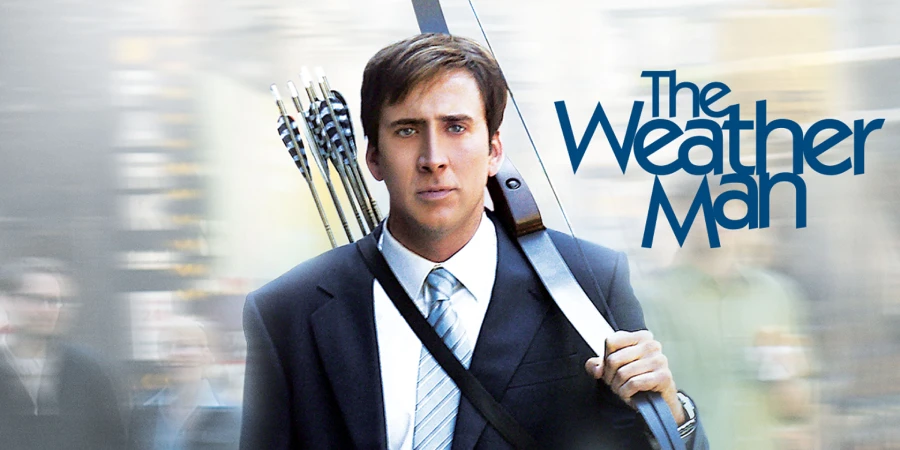

Gore Verbinski’s The Weather Man (2005) is a bittersweet dramedy about failure, maturity, and the uncomfortable, hilarious messiness of adult life.
Detailed Summary
Dave Spritz: A Man with a Drizzle of Problems
Dave Spritz (Nicolas Cage) is a Chicago weatherman with a solid on-camera presence and a chaotic off-camera life. Although he earns decent money and has a respectable public job, his personal life is falling apart. His marriage is over, his kids are struggling, and his father—Pulitzer Prize-winning author Robert Spritzel (Michael Caine)—holds him to a much higher standard.
Early scenes show Dave’s awkward attempts to fix things: trying to bond with his children, chasing after his ex-wife (Hope Davis), and obsessing over being pelted with fast food by viewers who don’t like him. The comedic tone hides a deeper sadness: Dave is a man who feels like a disappointment in every category of his life.
The Shadow of a Great Father
Dave’s father is diagnosed with lymphoma, which forces Dave to confront his own inadequacy. Their strained but loving relationship becomes the emotional backbone of the film. Robert’s calm wisdom stands in stark contrast to Dave’s frantic attempts to hold his life together.
The Big “Hello America” Opportunity
A major turning point arrives when Dave is invited to audition for “Hello America,” a prestigious national morning show. This could change everything for him: more money, a move to New York, and—he hopes—a chance to finally be someone his father respects.
Parenting, Missteps, and Harsh Realities
Dave simultaneously tries to help his son, who is at risk of being manipulated by a predatory counselor at a rehab program. His daughter faces her own insecurities. Dave’s attempts to guide them are often clumsy but genuine, showing the movie’s theme: trying matters more than succeeding.


Movie Ending
At the end of the film, Dave lands the job with “Hello America,” earning a huge salary and relocating to New York. Moving forward with this opportunity marks a significant character shift: he finally stops trying to force his old life to work and accepts who he is, flaws included.
However, his personal life doesn’t magically fix itself. His ex-wife remarries, his children stay in Chicago, and Dave must learn to live with the distance. What changes is Dave himself:
- He embraces archery, which becomes a metaphor for focus and control.
- He finally understands that his father didn’t need him to be successful—just responsible.
- He accepts that “perfect” isn’t real, and “doing your best” actually counts.
In the film’s closing moments, Dave walks through New York, now recognized less by fast-food-throwers and more by admiring viewers. His father has passed away, but his influence remains strong. Dave’s narration reveals that he’s not a perfect man—but he’s no longer ashamed of the messy in-between.
It’s not a tidy Hollywood ending. It’s more honest: not everything works out, but some things do, and that’s enough.
Are There Post-Credits Scenes?
No. The Weather Man has no mid-credits or post-credits scenes.
Type of Movie
The Weather Man is a dark comedy-drama—an offbeat blend of humor and emotional realism that focuses on personal growth, failure, and the awkwardness of middle-aged identity.
Cast
- Nicolas Cage as Dave Spritz
- Michael Caine as Robert Spritzel
- Hope Davis as Noreen
- Gemmenne de la Peña as Shelly
- Nicholas Hoult as Mike
- Michael Rispoli as Russ
- Gil Bellows as Don
Film Music and Composer
The film’s score was composed by Hans Zimmer, who surprisingly opted for a minimalist, sometimes whimsical tone rather than his signature epic style. The soundtrack supports the movie’s subtle emotional beats and the dry humor woven through Dave’s misadventures.

Filming Locations
- Chicago, Illinois: Most of the film was shot in Chicago, capturing its winter bleakness and urban monotony. The city becomes a visual extension of Dave’s emotional landscape—cold, indifferent, and full of slippery sidewalks and uncomfortable truths.
- New York City, New York: Scenes tied to Dave’s new job were shot in NYC. New York represents opportunity, reinvention, and a brighter (though still challenging) future.
Awards and Nominations
The Weather Man didn’t make major awards circuits but received attention for its screenplay and performances. Nicolas Cage and Michael Caine both earned praise from critics for bringing depth to a relatively understated story.
Behind the Scenes Insights
- Gore Verbinski chose a subdued tone to contrast his prior film, Pirates of the Caribbean.
- Nicolas Cage trained with real meteorologists to understand on-camera weather presentation.
- Michael Caine reportedly accepted the role because he was drawn to the father-son themes.
- The script originally had more slapstick humor, which Verbinski trimmed in favor of sincerity.
- The archery motif was added later in production to symbolize Dave’s emotional “aim.”
Inspirations and References
The film is adapted from a screenplay by Steve Conrad (who later wrote The Pursuit of Happyness). It’s not based on a novel but heavily inspired by introspective character-led dramas exploring existential crisis and quiet personal breakthroughs.
Alternate Endings and Deleted Scenes
Several deleted scenes explored Dave’s failing marriage in more detail and added interactions with his father. An early draft ended with Dave returning to Chicago permanently, but this was changed to give the character a more hopeful, forward-moving arc.
Book Adaptation and Differences
The movie is not based on a book, though its introspective narration gives it a literary, memoir-like feel.
Memorable Scenes and Quotes
Key Scenes
- Dave being repeatedly hit with fast food items by strangers—a funny yet metaphorical representation of public pressure.
- Dave’s powerful final conversation with his father about responsibility and regret.
- The archery montage, symbolizing Dave finding focus.
- The tense confrontation with the predatory counselor helping Dave’s son.
Iconic Quotes
- “Easy doesn’t enter into grown-up life.”
- “The hard thing to understand is that life is easy. We make it hard.”
- “I’m not sure I ever really knew what I was doing.”
Easter Eggs and Hidden Details
- Dave’s archery habit subtly mirrors his attempts to “aim” his life correctly.
- Many scenes hide weather metaphors—rain during emotional lows, sun during clarity.
- The food-throwing motif was inspired by real incidents experienced by local TV personalities.
- Dave’s name “Spritz” is a weather pun (spritz = spray of water).
- Background shots often show reflections of Dave, symbolizing his identity crisis.
Trivia
- Gore Verbinski considered casting Bill Murray before choosing Nicolas Cage.
- Cage insisted on filming several takes with real fast-food items thrown at him.
- The film was shot in sequence, unusual for a studio production.
- Verbinski used natural lighting in many scenes to maintain realism.
- Steve Conrad wrote the script while working odd jobs, mirroring Dave’s themes of inadequacy.
Why Watch?
Because The Weather Man is quietly powerful, oddly funny, and unusually honest. It’s one of Nicolas Cage’s most grounded performances and delivers an emotionally resonant story about growth, acceptance, and the freedom of letting go of perfection.
Director’s Other Movies
- MouseHunt (1997)
- The Ring (2002)
- Pirates of the Caribbean: The Curse of the Black Pearl (2003)
- Pirates of the Caribbean: Dead Man’s Chest (2006)
- Pirates of the Caribbean: At World’s End (2007)
- Rango (2011)
- The Lone Ranger (2013)