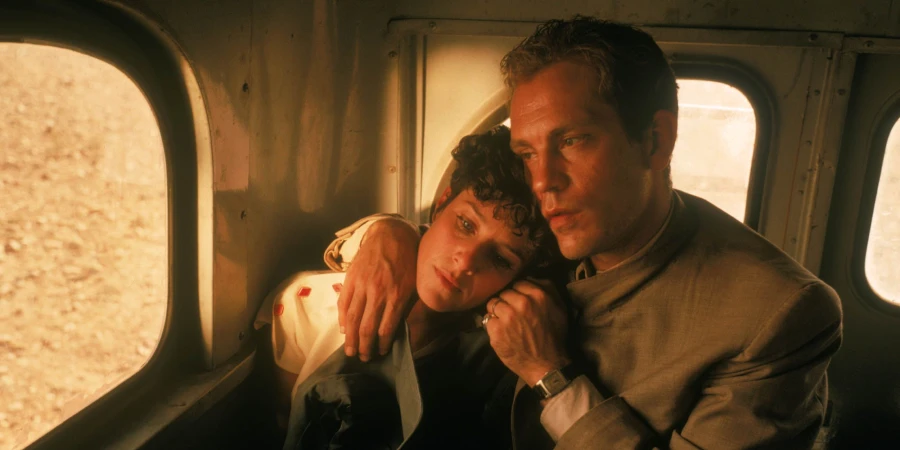

Bernardo Bertolucci’s The Sheltering Sky is not a film about a journey; it is a film about being lost. It chronicles the complete psychological and physical disintegration of American expatriates adrift in the vast North African desert. Consequently, watching it feels less like observing a story and more like succumbing to a beautiful, terrifying hallucination from which there is no escape.
Detailed Summary
Arrival in Tangier and a Fractured Marriage
The film opens in 1947 as a wealthy and sophisticated American couple, Port Moresby (John Malkovich) and his wife Kit (Debra Winger), arrive in Tangier, Morocco. They are accompanied by their friend, George Tunner (Campbell Scott). Port immediately establishes their philosophy; they are “travelers,” not “tourists,” seeking an authentic experience far from modern civilization. However, their marriage is clearly strained. They sleep in separate rooms and communicate with a palpable distance, nevertheless bound by a decade of shared history.
The Journey Deeper into the Desert
Seeking to escape the Westernized influences of Tangier, the trio travels deeper into the Sahara. Port, however, grows increasingly irritated by Tunner’s presence. As a result, he arranges to travel separately from Kit and Tunner for a portion of the journey, a decision that widens the emotional chasm between him and his wife. During this separation, Kit and Tunner have a brief, passionless affair. Meanwhile, Port has a lonely and disconcerting encounter with a prostitute, reflecting his own profound alienation.
Port’s Final Days
The couple eventually reunites in a remote village, but the damage is done. Their journey continues into progressively more desolate locations. Unfortunately, Port falls gravely ill with what is diagnosed as typhoid fever. Kit is forced to care for him in a decrepit French fort, isolated and without proper medical supplies. Port’s condition rapidly deteriorates, leading to delirious rants and a painful, agonizing death. Consequently, Kit is left utterly alone and traumatized in the middle of the vast, indifferent desert.
Lost in the Sahara
Shattered by Port’s death, Kit abandons his body and all her possessions, walking out into the desert. She is eventually found by a Tuareg caravan led by a young man named Belqassim. In her fugue state, she becomes his lover, traveling with the caravan disguised as a young boy. For instance, she lives a silent, primal existence, completely detached from her former identity. This period represents her total surrender to the void she and Port were so desperately seeking, albeit in a terrifying form.
Movie Ending
The film’s ending is both haunting and profoundly ambiguous. After arriving at Belqassim’s home, his other wives discover Kit is a woman and grow jealous. They cruelly cast her out into the city streets, where she is found wandering in a catatonic state by authorities. She is subsequently taken to a hospital back in Tangier, the city where her journey began. Officials from the American consulate, including Mrs. Lyle, attempt to help her.
However, Kit remains entirely non-verbal and detached, a ghost of her former self. Just as it seems she is being repatriated, she slips away from her handlers at the consulate. The final shot finds her in the original Tangier cafe, the same one from the film’s opening scene. She looks around, an unreadable expression on her face, before melting into the anonymous crowd. Finally, the camera focuses on an old man observing from a corner table: the author Paul Bowles. He delivers the novel’s famous closing lines, reminding the audience of life’s fragility and the finite number of moments we have.
The ending signifies that Kit has not been “saved” but has simply completed a horrific, circular journey. She has ventured into the abyss and, instead of finding meaning, has lost her identity entirely. Therefore, her disappearance into the crowd suggests she has become one with the anonymous, transient world she and Port once romanticized from a safe distance. She is now truly, and perhaps permanently, a traveler with no destination.
Are There Post-Credits Scenes?
No, there are no post-credits or mid-credits scenes in The Sheltering Sky. The film concludes definitively once the final credits begin to roll.
Type of Movie
The Sheltering Sky is a psychological drama and an art-house film. Its tone is overwhelmingly existential, meditative, and melancholic. The narrative eschews conventional plot mechanics, instead focusing on atmosphere, stunning cinematography, and the internal, philosophical decay of its characters. Consequently, it is an immersive and often disorienting experience that prioritizes mood and theme over a fast-paced story.
Cast
- Debra Winger – Kit Moresby
- John Malkovich – Port Moresby
- Campbell Scott – George Tunner
- Jill Bennett – Mrs. Lyle
- Timothy Spall – Eric Lyle
- Paul Bowles – Narrator / Man in Cafe
Film Music and Composer
The haunting and iconic musical score for The Sheltering Sky was composed by the legendary Japanese composer Ryuichi Sakamoto. The music is an essential element of the film’s hypnotic atmosphere. Moreover, it expertly blends sweeping, melancholic orchestral themes with traditional North African instruments and melodies. This fusion perfectly mirrors the characters’ immersion in an alien landscape. Notably, the main theme became one of Sakamoto’s most famous works, and his score won the Golden Globe Award for Best Original Score.

Filming Locations
Director Bernardo Bertolucci and cinematographer Vittorio Storaro shot the film on location in North Africa, which was crucial to its authenticity. The key filming locations included:
- Morocco: Specifically the cities of Tangier and Ouarzazate, which provided the backdrop for the initial stages of the journey.
- Algeria: The deep desert locations, including the remote Hoggar Mountains, were filmed here.
- Niger: Portions of the Tuareg caravan journey were filmed in Niger.
These locations are not just backdrops; they are an active character in the story. The vast, sun-scorched emptiness of the Sahara serves as a powerful visual metaphor for the characters’ internal desolation and the existential void they face.
Awards and Nominations
The Sheltering Sky received critical acclaim for its technical achievements. Its most significant wins include:
- Golden Globe Awards: Winner for Best Original Score (Ryuichi Sakamoto).
- BAFTA Awards: Winner for Best Cinematography (Vittorio Storaro).
- Los Angeles Film Critics Association Awards: Winner for Best Music (Ryuichi Sakamoto).
- New York Film Critics Circle Awards: Winner for Best Cinematography (Vittorio Storaro).
Behind the Scenes Insights
- Director Bernardo Bertolucci had wanted to adapt Paul Bowles’s novel for over a decade before he was finally able to secure the funding and rights.
- The physical presence of author Paul Bowles himself in the film was a significant meta-commentary. He appears as a silent observer in the Tangier cafe, watching his characters, and provides the film’s narration.
- Filming conditions in the Sahara desert were famously arduous. The cast and crew battled extreme heat, sandstorms, and logistical nightmares to capture the film’s stunning visuals.
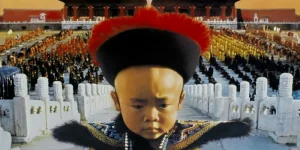
- Cinematographer Vittorio Storaro, known for his work on Apocalypse Now and The Last Emperor, used his signature anamorphically filmed style to emphasize the breathtaking scale of the desert landscapes.
Inspirations and References
The film is a direct adaptation of the 1949 novel of the same name by American expatriate author Paul Bowles. The book is considered a masterpiece of 20th-century existentialist literature. Furthermore, the novel itself was semi-autobiographical, drawing heavily on Bowles’s own experiences living in North Africa with his wife, the writer Jane Bowles, and their complex, often troubled relationship.
Alternate Endings and Deleted Scenes
There are no known official alternate endings for The Sheltering Sky. Bertolucci’s final cut is the definitive version. While scenes from the novel were inevitably condensed or cut for the film adaptation to maintain a feasible runtime, no significant deleted scenes have ever been released to the public. As a result, the theatrical version remains the only one available.
Book Adaptations and Differences
While the film is a largely faithful adaptation of Paul Bowles’s novel, The Sheltering Sky, there are key differences in tone and execution.
The novel is more internal, relying on Bowles’s stark prose to convey the characters’ psychological unraveling. In contrast, the film uses Vittorio Storaro‘s epic cinematography and Ryuichi Sakamoto‘s score to externalize that dread. The book’s ending is also arguably bleaker and more ambiguous; it strongly implies Kit has been committed to an asylum or is permanently lost to a state of insanity, leaving her fate more open-ended than the film’s circular narrative.
The most significant departure, however, is the physical inclusion of Paul Bowles himself. His presence as a “witness” in the cafe adds a meta-fictional layer, suggesting the characters are trapped in a story from which their own creator cannot save them. This element is, of course, not present in the original novel.

Memorable Scenes and Quotes
Key Scenes
- Port’s Death: The harrowing sequence where Kit nurses a delirious Port in a remote, fly-infested room is unforgettable. It is a brutal and unflinching depiction of death’s squalor, devoid of any Hollywood sentimentality.
- The Tuareg Caravan: The long, silent sequences of Kit, disguised as a boy, traveling with the caravan are visually stunning and deeply hypnotic. Her complete submission to this new, wordless life is a powerful representation of her psychological break.
- The Cafe: The film’s opening and closing scenes in the Tangier cafe perfectly frame the narrative. It begins as a place of observation and intellectual detachment and ends as the site of Kit’s final, silent disappearance.
Iconic Quotes
- “We are not tourists. We are travelers. A tourist is someone who thinks of going home the moment they arrive. A traveler is someone who may not come back at all.” – Port
- “The sky here is very strange. I often have the sensation when I look at it that it’s a solid thing, up there, protecting us from what’s behind.” – Kit
- “Because we don’t know when we will die, we get to think of life as an inexhaustible well. Yet everything happens only a certain number of times… How many more times will you watch the full moon rise? Perhaps twenty. And yet it all seems limitless.” – Narrator (Paul Bowles)
Easter Eggs and Hidden Details
- The Author’s Watch: The most prominent hidden detail is the recurring presence of author Paul Bowles. He appears at the beginning and end, silently watching his creations, serving as a Greek chorus and a reminder of the story’s fictional, yet inescapable, nature.
- Color Symbolism: Cinematographer Vittorio Storaro used a deliberate color palette. The harsh yellows and oranges of the daytime desert are associated with Port and the masculine, while the deep blues and indigos of the night sky are linked to Kit and the feminine.
- Foreshadowing Sickness: Early scenes contain subtle hints of decay and uncleanliness. For instance, flies buzz around food and characters complain about minor ailments, subtly foreshadowing the devastating arrival of typhoid.
Trivia
- This was the final film role for British actress Jill Bennett (Mrs. Lyle). She tragically died by suicide shortly after completing her scenes.
- Debra Winger spoke openly about the difficult shoot and reportedly contracted a serious illness while filming on location in Africa.
- At the time, the film’s budget of approximately $25 million was considered quite large for a philosophical art-house drama with limited commercial appeal.
- Author Paul Bowles, then in his late 70s, was living in Tangier when the film was shot there and was actively involved, lending his presence and famous voice to the production.
Why Watch?
This film is a sensory masterpiece. It offers a hypnotic, beautiful, and terrifying look into existential dread. If you appreciate stunning cinematography, a haunting score, and a story that values mood over plot, The Sheltering Sky is an essential and unforgettable experience.
Director’s Other Movies
- The Conformist (1970)
- Last Tango in Paris (1972)
- 1900 (1976)
- The Last Emperor (1987)
- Stealing Beauty (1996)
Recommended Films for Fans
- The English Patient (1996)
- The Passenger (1975)
- Out of Africa (1985)
- Babel (2006)
- Walkabout (1971)