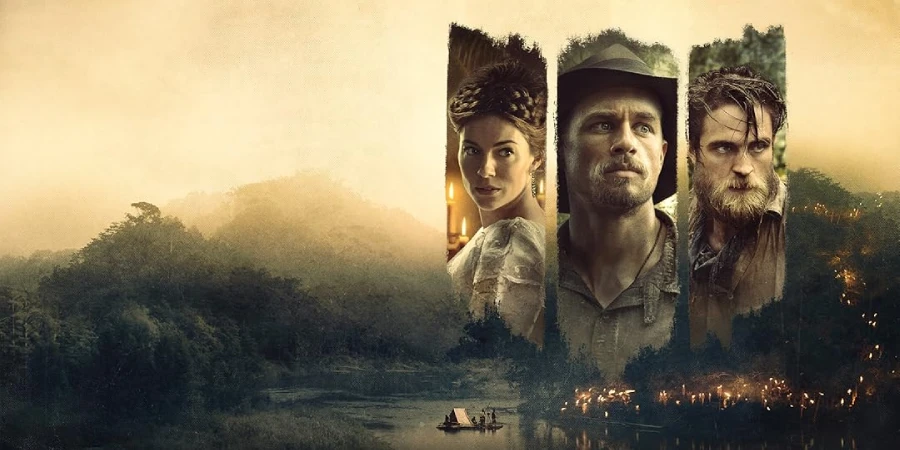

Obsession is a jungle of its own, swallowing ambitions whole. The Lost City of Z, in contrast, charts one man’s descent into this beautiful, terrifying wilderness of the mind. Director James Gray presents the true story of Percy Fawcett, whose search for an ancient civilization becomes a lifelong pilgrimage. Consequently, his journey blurs the line between noble exploration and destructive mania.
Detailed Summary
This is your comprehensive, spoiler-heavy guide to the dense jungles of The Lost City of Z. We follow British explorer Percy Fawcett on a decades-long quest that costs him everything.
The Call to Adventure
In 1905, Major Percy Fawcett (Charlie Hunnam) is a skilled but un-decorated British officer. He is furthermore desperate to restore his family’s tarnished name. The Royal Geographical Society (RGS) offers him a mission to map the border between Bolivia and Brazil. Although dangerous, Fawcett sees this as a chance for glory. He leaves behind his pregnant wife, Nina (Sienna Miller), and young son, Jack, to embark on the journey with his aide-de-camp, Henry Costin (Robert Pattinson).
First Foray and a Glimmer of Z
The Amazonian jungle is brutal and unforgiving. The expedition faces disease, starvation, and skirmishes with local tribes. During their travels, however, their guide speaks of a legendary city covered in gold. Fawcett initially dismisses it as a myth. Later, he discovers sophisticated, broken pottery deep in the jungle, which suggests a complex civilization once existed there. He dubs this theoretical lost city “Z”. Upon his return to London, the RGS scoffs at his theory, believing natives are mere savages incapable of building such a metropolis.
Ridicule and a Second Attempt
Despite the scientific community’s derision, Fawcett secures funding for a second expedition, this time joined by wealthy adventurer James Murray (Angus Macfadyen). The journey quickly goes sour. Murray, for instance, is unprepared for the jungle’s hardships. He develops a severe leg infection and panics, ultimately sabotaging the group’s supplies to force a retreat. Fawcett sends him back with a local guide but must abandon the expedition. Unfortunately, Murray survives and later vilifies Fawcett in the press, claiming he was abandoned to die.
The Trenches of War
Fawcett’s ambitions are once again put on hold with the outbreak of World War I. He serves bravely in the trenches of France, where a chlorine gas attack temporarily blinds him. During his recovery, he learns that the RGS has vindicated him after Murray confessed to his lies. Meanwhile, his son Jack (now played by Tom Holland), who has grown up largely without a father, resents his obsession with the Amazon. However, after reading his father’s journals, Jack’s resentment turns into shared fascination.
The Final, Fateful Journey
Years later, in 1925, an older Fawcett decides to mount one last expedition to find Z. This time, a determined Jack insists on joining him, mending their fractured relationship. Supported by American financiers, the father-son duo returns to the Amazon, leaving Costin and a worried Nina behind. They travel deeper into uncharted territory than ever before. Eventually, they are captured by an indigenous tribe. Instead of killing them, the tribe subjects them to a strange, spiritual ritual. Both Percy and Jack are carried off into the darkness, never to be seen again.
Movie Ending
The ending of The Lost City of Z is intentionally ambiguous, leaving the final fate of Percy and Jack Fawcett a mystery. After being captured by an Amazonian tribe, the two explorers are shown participating in a nocturnal ceremony. The tribe’s leader tells them their souls are not of this world and that they must belong “elsewhere.” Following this, they are given a soporific drink and carried away into the jungle’s darkness.
The film deliberately avoids showing their deaths. Instead, it suggests a spiritual transcendence or a complete assimilation into the “green desert” that Fawcett so loved. The final scene cuts to years later in London. Nina Fawcett meets with members of the RGS, who claim to have given up the search. Nina, however, presents her husband’s compass, stating she has proof he was successful. As she leaves, she glances into a hallway mirror and sees a reflection of Percy walking out of the jungle, a symbolic vision suggesting his spirit and legacy have finally returned home.
Are There Post-Credits Scenes?
No, there are no post-credits scenes or mid-credits scenes in The Lost City of Z. Once the credits begin to roll, the film is officially over.
Type of Movie
The Lost City of Z is a biographical adventure drama. In contrast to many jungle adventure films, its tone is not one of high-octane action. Instead, the film adopts a meditative, somber, and almost hallucinatory quality. It prioritizes psychological depth and the theme of obsession over thrilling set pieces, resulting in a slow-burn epic about ambition and its human cost.
Cast
- Charlie Hunnam – Percy Fawcett
- Robert Pattinson – Henry Costin
- Sienna Miller – Nina Fawcett
- Tom Holland – Jack Fawcett
- Angus Macfadyen – James Murray
- Ian McDiarmid – Sir George Goldie
- Franco Nero – Baron de Gondoriz
Film Music and Composer
The haunting and melancholic score for The Lost City of Z was composed by Christopher Spelman, a frequent collaborator with director James Gray. The music largely avoids traditional, bombastic adventure themes. Instead, it relies on lush, atmospheric orchestrations and classical-inspired pieces to underscore Fawcett’s internal, psychological journey. Consequently, the score enhances the film’s dreamlike and tragic tone, weaving through the narrative with works from composers like Stravinsky, Ravel, and Debussy to create a rich auditory tapestry.

Filming Locations
To achieve its striking authenticity, The Lost City of Z was filmed in several key locations. The scenes set in England and Ireland were shot primarily in Northern Ireland, utilizing historic sites like Belfast City Hall, Methodist College Belfast, and the countryside of County Antrim. For the treacherous Amazon sequences, the production moved to Santa Marta, Colombia. Filming in the real jungle environment provided an incredible sense of scale and verisimilitude, immersing both the actors and the audience in the same oppressive, beautiful environment that Fawcett himself experienced.
Awards and Nominations
While not a major awards behemoth, The Lost City of Z received critical acclaim and recognition from various circles. Notably, director James Gray was nominated for Outstanding Directorial Achievement by the Directors Guild of America. The film also earned a nomination for Best Cinematography at the Independent Spirit Awards and was listed on numerous critics’ top-ten lists for 2017.
Behind the Scenes Insights
- Director James Gray wrote a letter to the descendants of Percy Fawcett to ask for their blessing before making the film.
- Charlie Hunnam famously employed method acting, refusing to speak to his longtime girlfriend for five months during shooting to better understand Fawcett’s isolation.
- Initially, Benedict Cumberbatch was cast as Percy Fawcett but had to drop out due to scheduling conflicts, leading to Hunnam’s casting.
- The cast and crew endured genuinely difficult conditions while filming in the Colombian jungle, including a terrifying moment when their boat nearly capsized in a storm.
- Robert Pattinson wanted his character, Henry Costin, to look as authentic as possible. As such, he grew a massive beard that he described as “disgusting.”
Inspirations and References
The film is directly based on the true story of British explorer Percy Fawcett. His harrowing expeditions into the Amazon in the early 20th century, his theories about an advanced indigenous civilization, and his mysterious 1925 disappearance with his son Jack are all factual. This narrative was famously chronicled in the non-fiction book that served as the film’s primary source material.
Alternate Endings and Deleted Scenes
Director James Gray has stated that the film’s final cut is very close to his original vision, and there are no known alternate endings. However, some scenes were cut for pacing. For instance, a notable deleted scene involved a more extended sequence of the expedition building their own boat from scratch in the jungle. Gray chose to trim these moments to maintain the film’s focus on Fawcett’s psychological state over procedural survival details.
Book Adaptations and Differences
The Lost City of Z is a faithful adaptation of David Grann’s 2009 non-fiction book, The Lost City of Z: A Tale of Deadly Obsession in the Amazon. The primary difference lies in the narrative structure. Grann’s book operates on a dual timeline, interweaving Fawcett’s historical journey with Grann’s own modern-day expedition to retrace Fawcett’s steps. In contrast, James Gray’s film streamlines the story, focusing exclusively on Fawcett’s experiences. This change turns the story from a journalistic investigation into a singular, immersive biographical drama.
Memorable Scenes and Quotes
Key Scenes
- The Opera: Fawcett and Nina attend an opera about a jungle explorer. The scene masterfully cross-cuts with imagery of the Amazon, visually connecting Fawcett’s civilized life with the wild obsession brewing within him.
- The RGS Confrontation: Upon his return, Fawcett passionately argues for the existence of Z in front of a dismissive Royal Geographical Society, declaring, “We have been so arrogant and so blind.”
- The Final Ritual: The film’s haunting climax shows Fawcett and his son being led by an indigenous tribe into the darkness, a powerful, ambiguous sequence that eschews a concrete answer for a more spiritual conclusion.
Iconic Quotes
- “To dream, to seek the unknown, to look for what is beautiful is its own reward. A man’s reach should exceed his grasp, or what’s a heaven for?” – Percy Fawcett
- “We have been so arrogant and so blind. We know nothing. Our map of the world is a blank space.” – Percy Fawcett
- “I had hoped to find a city of gold. But I have come to believe the city’s glory is not in its gold, but in its artistic and scientific accomplishments.” – Percy Fawcett
Easter Eggs and Hidden Details
- The Compass: Fawcett’s compass appears repeatedly throughout the film. It serves as a practical tool, a symbol of his guiding obsession, and ultimately, the only physical link between his lost world and the family he left behind.
- Spiritual Imagery: The film subtly builds a visual language that suggests Fawcett’s journey is spiritual, not just physical. Shots often linger on light filtering through the canopy or the dark, ink-like river water, creating an almost religious atmosphere.
- Class Division: Pay close attention to the costumes and settings in England. They starkly contrast the raw, classless environment of the jungle, highlighting Fawcett’s desire to escape the rigid social structures of his time.
Trivia
- Tom Holland (Jack Fawcett) and Robert Pattinson (Henry Costin) share no scenes and reportedly never met during the production.
- The film was a passion project for director James Gray, who worked on the script for several years before securing funding.
- Brad Pitt was one of the film’s producers and was at one point attached to star as Percy Fawcett.
- Sienna Miller extensively researched the real Nina Fawcett and fought for her character to be portrayed as an intelligent, independent woman rather than just a pining wife.
Why Watch?
For a haunting look at ambition’s true price, this film is essential viewing. It trades frantic action for a slow, mesmerizing burn. Moreover, its magnificent cinematography and powerful performances create a profound meditation on what it means to chase a dream, even into oblivion.
Director’s Other Movies
- Little Odessa (1994)
- The Yards (2000)
- We Own the Night (2007)
- Two Lovers (2008)
- The Immigrant (2013)
- Ad Astra (2019)
- Armageddon Time (2022)
Recommended Films for Fans
- Aguirre, the Wrath of God (1972)
- Apocalypse Now (1979)
- The Mission (1986)
- Embrace of the Serpent (2015)
- The Revenant (2015)