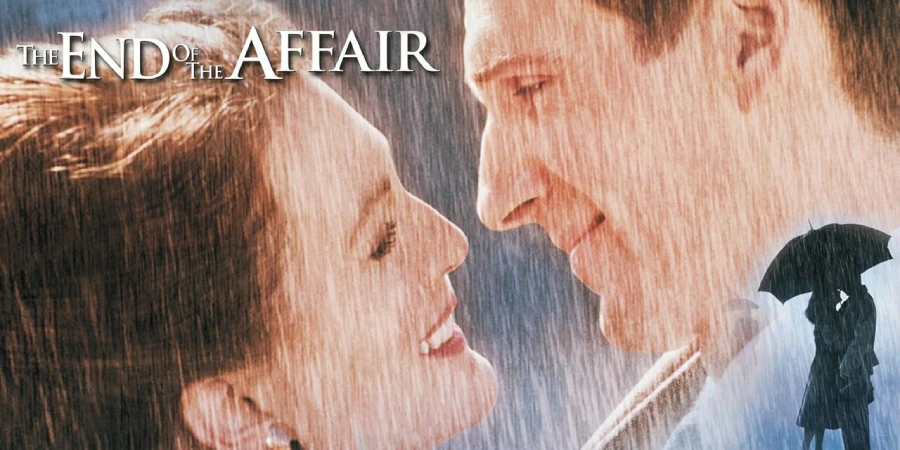

The End of the Affair (1999) is a deeply emotional romantic drama adapted from Graham Greene’s novel of the same name. Directed by Neil Jordan, the film explores love, jealousy, faith, obsession, and the painful distance between desire and belief. It is not a conventional love story but rather a haunting examination of what happens after passion collides with guilt, morality, and God.
Detailed Summary
A Passion Born in Wartime London
Set primarily in London during and after World War II, the story centers on Maurice Bendrix, a cynical novelist, and Sarah Miles, the wife of civil servant Henry Miles. Maurice and Sarah begin a secret affair during the chaos of wartime bombings. Their relationship is intense, obsessive, and emotionally consuming.
Maurice loves Sarah with possessive desperation. Sarah loves him deeply but is more conflicted, carrying emotional and spiritual uncertainties that Maurice refuses to acknowledge.
The Sudden and Unexplained Breakup
Without warning, Sarah abruptly ends the affair. She refuses to explain her decision and cuts Maurice out of her life entirely. Her silence devastates him.
Maurice becomes convinced that Sarah has left him for another man. This belief grows into obsession, bitterness, and paranoia. He hires a private detective to follow her, desperate to uncover the truth behind her disappearance from his life.
Discovery of Sarah’s Diary
The detective uncovers Sarah’s private diary. Through it, Maurice begins to read her inner thoughts, allowing the audience to witness the story from Sarah’s perspective for the first time.
What Maurice discovers is not infidelity, but faith.
During a bombing raid earlier in the affair, Maurice was knocked unconscious. Believing him dead, Sarah made a desperate promise to God: if Maurice lived, she would give him up forever.
Maurice survived.
Sarah kept her promise.
Love Versus God
The diary reveals Sarah’s growing belief in God and her fear that loving Maurice would mean betraying her vow. Torn between physical love and spiritual obligation, she chooses sacrifice over desire.
Maurice reacts with fury. He despises God, viewing Him as a rival who has stolen Sarah from him. The conflict becomes deeply philosophical: human love versus divine love, desire versus submission.
A Relationship That Never Truly Ends
Despite her vow, Sarah cannot completely stay away from Maurice. They meet again, still drawn to each other, but now burdened by guilt and emotional exhaustion.
Sarah becomes increasingly ill, both physically and spiritually. She seeks peace through faith but never finds full comfort. Maurice remains angry, emotionally violent in his jealousy, and incapable of forgiveness.
Their love continues, but only as suffering.



Movie Ending
Sarah’s illness worsens and she eventually dies from pneumonia. Her death is quiet, unromantic, and devastating. There is no final reunion, no dramatic farewell, no resolution between her and Maurice.
After her death, Maurice reads the remainder of her diary and letters. He learns that Sarah never stopped loving him. Her decision was not rejection but sacrifice. She believed that choosing God was the only way to save Maurice’s life, even if it destroyed her own happiness.
In the aftermath, strange events occur. Henry Miles believes Sarah has performed a miracle involving a child’s healing. People begin to speak of her as a possible saint.
Maurice is enraged.
He confronts God directly, shouting that he hates Him, accusing Him of cruelty and theft. Yet paradoxically, his hatred becomes proof of belief. His obsession with God mirrors his obsession with Sarah.
The film ends ambiguously. Maurice remains alive, bitter, grieving, and spiritually unsettled. He has not found peace, love, or faith but he has lost his certainty in disbelief.
The affair may have ended in life, but it continues endlessly in memory, guilt, and longing.
Are There Post-Credits Scenes?
No. There are no post-credits or mid-credits scenes. The film ends definitively with its final emotional beat.
Type of Movie
The End of the Affair is a romantic drama with strong elements of psychological tragedy and spiritual philosophy. It blends intimate emotional storytelling with existential questions about faith, morality, and obsession.
Cast
- Ralph Fiennes as Maurice Bendrix
- Julianne Moore as Sarah Miles
- Stephen Rea as Henry Miles
- Ian Hart as Parkis
- Heather-Jay Jones as Smythe
Film Music and Composer
The score was composed by Michael Nyman, whose minimalist style adds enormous emotional weight. The repeating piano themes mirror Maurice’s obsessive thought patterns and Sarah’s emotional restraint. The music is widely considered one of the film’s greatest strengths.



Filming Locations
- London, England – primary setting and filming location
- Hampstead Heath – representing emotional isolation and reflection
- Period interiors recreated to reflect wartime and post-war London
The gloomy streets and bomb-damaged city visually reinforce the emotional ruin of the characters.
Awards and Nominations
- Academy Awards (2000)
- Nominated: Best Actress (Julianne Moore)
- BAFTA Awards
- Nominated: Best Actress
- Golden Globe Awards
- Nominated: Best Actress
Julianne Moore’s performance was universally praised and remains one of her most acclaimed roles.
Behind the Scenes Insights
- Graham Greene initially disliked film adaptations of his novels but approved this version.
- Julianne Moore described Sarah as one of the most emotionally complex characters she ever played.
- Neil Jordan emphasized silence and facial expression over dialogue.
- Much of the narration comes directly from Greene’s original text.
- Ralph Fiennes has stated Maurice is intentionally unlikeable and emotionally cruel.
Inspirations and References
- Based on the novel The End of the Affair by Graham Greene
- Influenced by Catholic theology and post-war existentialism
- Themes echo works by Dostoyevsky and Camus
- Draws heavily from Greene’s own struggles with faith and infidelity
Alternate Endings and Deleted Scenes
No alternate ending was filmed. However:
- Several extended diary narration scenes were removed.
- Additional interactions between Sarah and Henry were shortened.
- The studio pushed for a less religious focus, but Neil Jordan resisted.
Book Adaptation and Differences
Major differences between the novel and the film include:
- The film intensifies the romantic aspect more than the book.
- Maurice is harsher and more cynical in the novel.
- The book places heavier emphasis on Catholic doctrine.
- The film softens some theological monologues for accessibility.
Despite these changes, the adaptation remains one of the most faithful Greene adaptations ever made.


Memorable Scenes and Quotes
Key Scenes
- The bombing scene that triggers Sarah’s vow
- Maurice reading the diary for the first time
- Sarah praying in despair
- The final confrontation between Maurice and God
Iconic Quotes
- “I love you. I hate you. I want you dead.”
- “You can’t love and serve two masters.”
- “He had taught me to love him, and then God took him away.”
Easter Eggs and Hidden Details
- The diary handwriting subtly changes as Sarah’s faith grows.
- Religious imagery increases gradually in the background.
- Church bells are heard whenever Sarah makes a moral choice.
- Maurice’s apartment remains unchanged, symbolizing emotional stagnation.
Trivia
- This is the second film adaptation of the novel after the 1955 version.
- Julianne Moore cried between takes due to emotional exhaustion.
- Michael Nyman reused thematic variations from his earlier works.
- The film was shot in chronological emotional order when possible.
Why Watch?
You should watch The End of the Affair if you appreciate:
- Emotionally demanding cinema
- Love stories without happy endings
- Complex female characters
- Films that challenge belief and morality
- Performances driven by internal conflict rather than spectacle
This is not a comfort movie. It is a beautiful emotional wound.
Director’s Other Works
- The Crying Game (1992)
- Interview with the Vampire (1994)
- Michael Collins (1996)
- Breakfast on Pluto (2005)
- Ondine (2009)