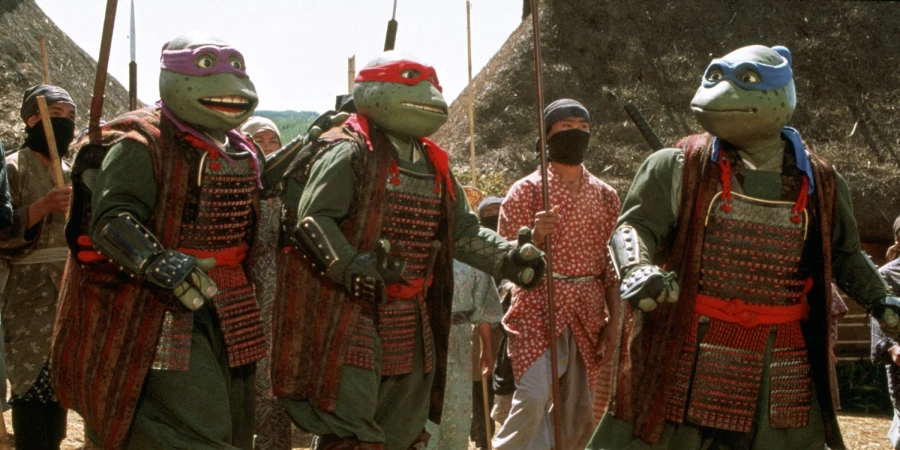

Released in 1993, Teenage Mutant Ninja Turtles III is the most unusual entry in the original live-action TMNT trilogy. Instead of urban crime-fighting in New York, the turtles travel back to feudal Japan in a time-travel adventure that blends martial arts, historical fiction, and light family comedy. It is sillier, lower-budget, and tonally lighter than its predecessors—but it has its own strange charm.
Detailed Summary
The Ancient Scepter and the Time Portal
The story begins in modern-day New York, where April O’Neil (Paige Turco) purchases an ancient Japanese scepter at a flea market. Unbeknownst to her, the artifact contains magical powers that swap people across time.
When April reads the inscription, she is suddenly transported to 17th-century feudal Japan, swapping places with a Japanese prince who had been holding the other half of the scepter centuries earlier.
Yes, this is a full-blown magical time-travel story now.
The Turtles Follow April to Feudal Japan
Once the turtles realize April has vanished, they discover the scepter’s power and intentionally send themselves back to rescue her. However, there’s a catch: the scepter works by swapping equal numbers of living beings across time. So when the turtles travel back, four feudal Japanese warriors are accidentally sent to 1990s New York.
This parallel chaos creates comedic tension in both timelines.
Feudal Japan: War, Rebellion, and Culture Clash
In 17th-century Japan, the turtles find themselves in the middle of a conflict between Lord Norinaga and a group of oppressed villagers. Norinaga is being manipulated by a corrupt English arms dealer named Walker (Stuart Wilson), who profits from supplying firearms.
The turtles must navigate samurai culture, language barriers, and their own fish-out-of-water situation while protecting April and helping the villagers fight oppression.
Unlike previous films, Shredder does not appear, and the central conflict becomes more historical and political than personal.
Growth and Teamwork
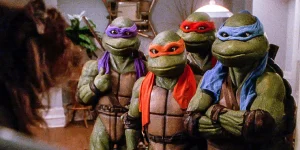
Throughout the film, the turtles bond with the villagers, particularly a young boy named Yoshi. Leonardo reflects on honor and leadership, Raphael struggles with authority (as usual), Donatello tinkers with ancient technology, and Michelangelo provides comic relief.
The film leans heavily into themes of honor, courage, and standing up against tyranny.


Movie Ending
In the climax, the turtles assist the villagers in staging a rebellion against Lord Norinaga and Walker. The final battle takes place in a burning village compound.
Walker attempts to escape with his weapons and gold, but the turtles intervene. After a chaotic fight sequence involving swords, firearms, and slapstick combat, Walker is defeated. He falls into the water and is implied to be either dead or permanently removed from power.
Meanwhile, Lord Norinaga realizes he has been manipulated and begins to understand the damage he has caused. The villagers gain their freedom, and the oppressive system begins to crumble.
The turtles and April prepare to return to the present. However, they cannot leave until the correct number of people are balanced between timelines. After some emotional goodbyes, the time swap is completed properly.
Back in modern New York, the feudal warriors are returned safely to their own time. The turtles reflect briefly on their adventure. Splinter acknowledges that they have grown wiser from experiencing another culture and era.
The ending is upbeat and clean. There is no lingering villain, no sequel tease, and no dramatic cliffhanger. It closes the trilogy with a lighthearted, almost fairy-tale sense of completion.
Are There Post-Credits Scenes?
No. There are no mid-credits or post-credits scenes in Teenage Mutant Ninja Turtles III. Once the credits roll, the story is fully concluded.
Type of Movie
Teenage Mutant Ninja Turtles III is a family-friendly martial arts adventure comedy with fantasy time-travel elements. Compared to the darker tone of the 1990 original, this entry leans more toward light humor and historical fantasy.
Cast
- Elias Koteas as Casey Jones
- Paige Turco as April O’Neil
- Stuart Wilson as Walker
- Sab Shimono as Lord Norinaga
- Vivian Wu as Mitsu
The turtles were performed by suit actors with voice performers providing their personalities. Unlike earlier entries, the Jim Henson Creature Shop was not involved, which noticeably affected the costume quality.
Film Music and Composer
The film’s score was composed by John Du Prez, who also worked on the earlier TMNT films. The music maintains a heroic orchestral tone but lacks the darker edge of the 1990 original.


Filming Locations and Their Importance
The movie was primarily shot in:
- British Columbia, Canada – used extensively for outdoor village scenes due to its natural landscapes.
- Studio sets built to replicate 17th-century Japanese villages.
The forested landscapes of British Columbia convincingly doubled as rural Japan. However, due to budget constraints, the scale feels smaller than the previous films set in New York.
Awards and Nominations
Teenage Mutant Ninja Turtles III did not receive major award recognition. It was nominated for minor genre awards and received criticism for its special effects and tone compared to its predecessors.
Behind the Scenes Insights
- Jim Henson’s Creature Shop did not return, resulting in redesigned turtle suits that fans widely criticized.
- The film had a noticeably smaller budget than Teenage Mutant Ninja Turtles II: The Secret of the Ooze (1991).
- The original script reportedly included darker historical elements, but these were softened to maintain a PG rating.
- The time-travel concept was chosen to avoid reusing Shredder as the villain again.
Inspirations and References
The film draws inspiration from:
- The broader Teenage Mutant Ninja Turtles comic universe
- Samurai cinema traditions
- Time-travel fantasy tropes common in family films of the early 1990s
Unlike the darker Mirage Comics source material, this movie embraces a lighter, Saturday-morning tone.
Alternate Endings and Deleted Scenes
No widely documented alternate ending exists. However:
- Some deleted character interactions in feudal Japan were trimmed for pacing.
- Early drafts included a more tragic ending for Walker.
- A few comedic scenes involving the modern-day time-swapped samurai were shortened.
Book Adaptations and Differences
The Teenage Mutant Ninja Turtles originated from the Mirage Studios comic created by Kevin Eastman and Peter Laird.
However, TMNT III is not directly based on a specific comic storyline. The time-travel plot was created specifically for the film. The original comics were significantly darker, more violent, and more mature than this movie adaptation.

Memorable Scenes and Quotes
Key Scenes
- The turtles’ arrival in feudal Japan and immediate confusion during a samurai skirmish
- Raphael bonding with young Yoshi
- The burning village battle in the climax
- The comedic culture shock moments when ancient warriors appear in modern New York
Iconic Quotes
- Leonardo: “Honor is something you earn.”
- Michelangelo: “Cowabunga, feudal dudes.”
- Raphael: “This is not my century.”
Easter Eggs and Hidden Details
- Subtle nods to samurai film aesthetics in framing and costume design
- Visual parallels to classic Kurosawa-style village battle setups
- Reuse of certain prop weapons from the previous film
- References to traditional Japanese armor styles in Norinaga’s design
Trivia
- It is the lowest-grossing film of the original trilogy.
- The turtle suits were lighter but less expressive than earlier versions.
- Corey Feldman returned as the voice of Donatello after being absent in the second film.
- The film’s working title was simply “Turtles in Time,” referencing the arcade game.
Why Watch?
If you grew up with the original trilogy, this film offers nostalgic charm. It is imperfect, yes—but it’s also a bizarre and bold genre experiment. The time-travel setting makes it stand out, and for younger viewers, it remains an accessible adventure story about courage, loyalty, and teamwork.
Director’s Other Works
Directed by Stuart Gillard:
- RocketMan (1997)
- WarGames: The Dead Code (2008)
- Going to the Mat (2004)
Recommended Films for Fans
If you enjoy this entry, you might also like: