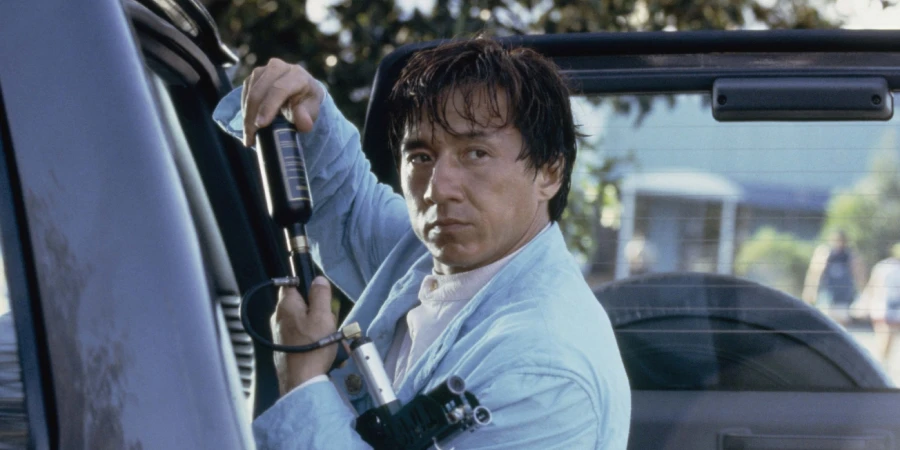

Police Story 4: First Strike is the fourth main entry in Jackie Chan’s legendary Police Story franchise and the first to be fully designed for an international (especially Western) audience. Directed by Stanley Tong, the film blends Hong Kong action cinema with global espionage, outrageous stunts, and Jackie Chan’s trademark physical comedy.
Detailed Summary (Critical Moments)
Global Threat and CIA Involvement
The film opens with Hong Kong inspector Chan Ka-Kui being recruited by the CIA for a high-risk international mission. A stolen nuclear warhead is in play, and intelligence suggests it may be connected to Russian mobsters and arms dealers.
Right from the start, the movie signals a tonal shift from earlier Police Story films: this is less grounded police work, more globe-trotting spy action.
Mission in Ukraine: Ice, Explosions, and Betrayal
Ka-Kui travels to Ukraine, where he infiltrates a criminal operation involving arms traffickers. This section includes one of the film’s most memorable action sequences: a massive factory explosion and an extended fight scene on icy terrain.
As expected, the mission goes sideways. Double-crosses occur, loyalties shift, and Ka-Kui is left to clean up the mess while being chased by both criminals and authorities.
Underwater Facility and Nuclear Secrets
The investigation leads Ka-Kui to Australia, where the nuclear warhead is rumored to be hidden in an underwater research facility. This portion of the film leans heavily into James Bond-style espionage, complete with scuba gear, high-tech bases, and exotic villains.
The underwater fight scenes are particularly notable, pushing physical stunt work into an environment rarely used so extensively at the time.
Escalation and Personal Stakes
As the criminals become more desperate, Ka-Kui finds himself increasingly isolated. The CIA proves unreliable, and Ka-Kui realizes that he is essentially disposable in the eyes of international intelligence agencies.
This reinforces a recurring theme in the franchise: Ka-Kui may work with powerful institutions, but he ultimately relies on his own moral compass and physical endurance.
Movie Ending
In the final act, Ka-Kui confronts the main villains at the underwater base, where the nuclear device is secured. The situation becomes critical when the criminals attempt to escape with the weapon, threatening catastrophic consequences.
Ka-Kui manages to single-handedly sabotage their escape, fighting multiple enemies while navigating confined underwater spaces. Through a combination of improvisation, brute force, and near-suicidal courage, he prevents the nuclear warhead from falling into the wrong hands.
The climax transitions to a spectacular jet-ski chase, one of the film’s most famous sequences. Ka-Kui uses a jet ski to chase a fleeing speedboat through a public harbor, eventually riding the jet ski up a ramp, across land, and into a moving building—a stunt that Jackie Chan performed himself and which resulted in real injuries.
The villains are finally defeated, the nuclear threat neutralized, and Ka-Kui survives once again, battered but victorious. The ending reinforces the character’s identity: he is not a spy, not a superhero, just a man who refuses to quit.
The film closes on a triumphant but understated note, with Ka-Kui walking away bruised, exhausted, and very much alive.
Are There Post-Credits Scenes?
No. There are no post-credits scenes in Police Story 4: First Strike. However, as with many Jackie Chan films, the end credits include bloopers and behind-the-scenes stunt footage, showcasing failed takes, injuries, and rehearsal clips. These are not narrative scenes but are absolutely worth watching.
Type of Movie
Police Story 4: First Strike is an action-comedy martial arts film with strong elements of spy thriller and international adventure, designed to appeal to both Eastern and Western audiences.
Cast
- Jackie Chan as Inspector Chan Ka-Kui
- Jackson Lou as Tsui
- Annie Wu as Annie Tsui
- Bill Tung as Uncle Bill
- Nonna Grishaeva as Natasha
Film Music and Composer
The score was composed by Nathan Wang, who delivers a soundtrack that mixes traditional action scoring with light comedic beats. The music supports the film without overpowering the stunt-driven storytelling, allowing the action to remain front and center.
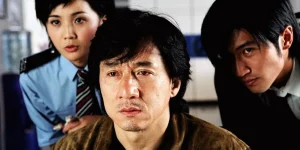
Filming Locations and Their Importance
- Ukraine – Used to establish the film’s global scale and Cold War remnants.
- Australia (Queensland) – Major action sequences, including the underwater base and jet-ski chase, were filmed here. The open spaces allowed for large-scale stunts.
- Hong Kong – Brief sequences maintain continuity with the franchise’s roots.
These locations emphasize that this is not a local crime story, but a world-spanning threat.
Awards and Nominations
The film did not receive major international awards, but it was praised for:
- Stunt coordination
- Action choreography
- Jackie Chan’s physical performance
It also performed strongly at the box office, particularly overseas.
Behind-the-Scenes Insights
- Jackie Chan suffered multiple real injuries, including a broken foot, during the jet-ski stunt.
- Many underwater scenes were filmed without stunt doubles.
- The film was heavily re-edited and partially dubbed to suit Western audiences.
- This was Jackie Chan’s first Police Story film marketed aggressively in the U.S.
Inspirations and References
- Classic James Bond films
- Cold War spy thrillers
- The earlier Police Story films, though with a more international tone
Alternate Endings and Deleted Scenes
There are no known alternate endings. Some character-development scenes were removed to keep the pacing fast, especially in international cuts of the film.
Book Adaptations and Differences
The film is not based on a book. It is an original screenplay created for the Police Story franchise.
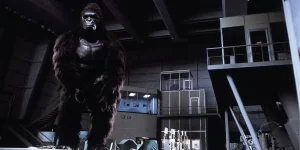
Memorable Scenes and Quotes
Key Scenes
- The ice factory fight in Ukraine
- Underwater combat inside the nuclear facility
- The jet-ski stunt through the harbor and building
Iconic Quotes
- “I’m a cop, not a secret agent.”
- “Why is it always me?”
Easter Eggs and Hidden Details
- References to earlier Police Story films appear in dialogue.
- Uncle Bill’s scenes echo comedic beats from the original trilogy.
- Some props reused from Supercop (1992) appear in background shots.
Trivia
- Jackie Chan performed the jet-ski stunt despite medical advice not to.
- The U.S. release edited out some violence but kept the stunts intact.
- The film was titled simply First Strike in some international markets.
Why Watch?
If you enjoy real stunts, global action, and a lead actor who genuinely risks his body for entertainment, this film is essential. It represents Jackie Chan at the peak of his physical daring, even if the story takes a backseat to spectacle.
Director’s Other Works (Movies)
- Rumble in the Bronx (1995)
- Supercop (1992)
- Mr. Magoo (1997)
- The Myth (2005)
Recommended Films for Fans
- Police Story (1985)
- Police Story 3: Super Cop (1992)
- New Police Story (2004)
- Rumble in the Bronx (1995)
- Who Am I? (1998)
- Rush Hour (1998)