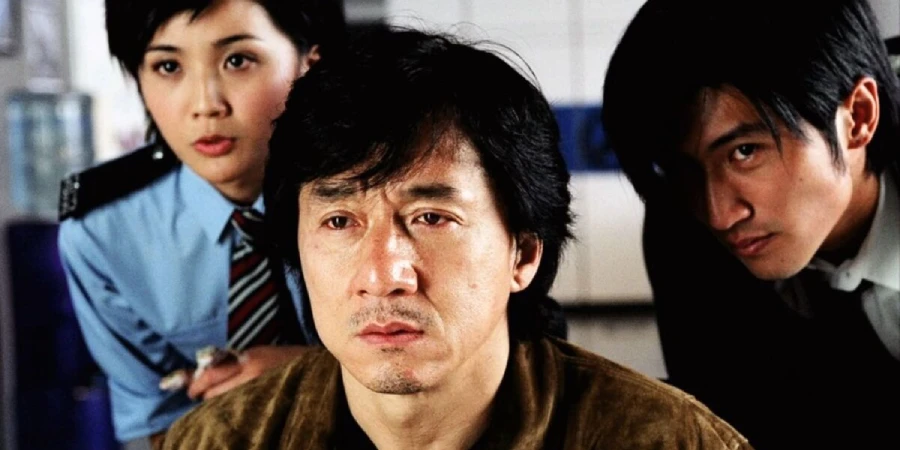
New Police Story is a darker, more emotional reboot of the classic Police Story franchise, marking a turning point in Jackie Chan’s career. Released in 2004 and directed by Benny Chan, the film strips away much of the light comedy associated with earlier entries and replaces it with guilt, trauma, and redemption. This is Jackie Chan as you may not expect him: broken, alcoholic, and haunted by failure.
Detailed Summary
The Fall of a Legendary Cop
Inspector Wing (Jackie Chan) is introduced as a near-mythical police officer, admired by colleagues and young recruits alike. His reputation is built on flawless operations and leadership. However, everything changes when he underestimates a group of young, highly intelligent criminals who call themselves “The Gang.”
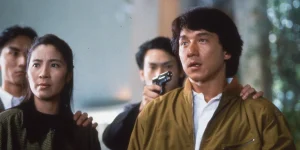
During a disastrous ambush inside an abandoned building, Wing’s entire team is systematically trapped and killed one by one. The villains turn the operation into a cruel game, forcing Wing to watch helplessly. This sequence is one of the film’s most brutal moments and clearly signals that this is not a typical Police Story movie.
Guilt, Alcohol, and Disappearance
After the massacre, Wing collapses psychologically. He quits active duty, becomes an alcoholic, and drifts aimlessly through Hong Kong, consumed by guilt. His once-proud image is replaced by a man who has lost his identity and purpose.
This section of the film focuses heavily on emotional weight rather than action, showing the consequences of failure rather than glossing over it.
Enter Frank Cheng
Frank (Nicholas Tse), a mysterious young man, begins helping Wing while pretending to be his fiancée’s cousin. He encourages Wing to rejoin the police force and face his past. Over time, Frank becomes Wing’s emotional anchor, though his true motivations remain unclear.
The relationship between Wing and Frank is central to the film, touching on themes of mentorship, generational conflict, and redemption.
The Gang and Their Philosophy
The antagonists are revealed to be wealthy, privileged youths who see crime as a form of intellectual entertainment. Led by Joe (Daniel Wu), they despise authority and target police officers specifically, believing the system is corrupt and outdated.
Their crimes are meticulously planned, filmed, and treated as competitive games. This generational clash between old-school honor and nihilistic youth gives the film much of its tension.
The Final Confrontation
As Wing slowly regains his confidence, he uncovers the identities of The Gang and prepares for one final confrontation. This leads to a tense showdown in an abandoned school, symbolizing both lost innocence and unresolved trauma.
Wing is forced to face Joe not just physically, but morally, as Joe challenges everything Wing once believed about justice and heroism.
Movie Ending
In the final act, Wing confronts Joe atop the school building. Joe reveals that his hatred of police stems from his father, a former officer who committed suicide after being exposed for corruption. He blames the police system for destroying his family, which fuels his twisted sense of justice.
Joe attempts to force Wing into killing him, believing that would prove all cops are the same. Instead, Wing refuses to cross that line. During the struggle, Joe falls from the building and dies, not by execution, but as a result of his own actions.
Wing survives, both physically and emotionally. He accepts responsibility for his past mistakes without letting them define him. Frank is revealed to be the younger brother of one of the officers killed in the opening massacre. Rather than seeking revenge, Frank chooses to honor his brother by helping Wing return to the force.
The film ends with Wing back in uniform, not as a flawless legend, but as a wiser, humbler man who understands the cost of being a hero.
Are There Post-Credits Scenes?
No. New Police Story does not include any post-credits or mid-credits scenes. The story ends definitively, reinforcing its grounded and serious tone.
Type of Movie
New Police Story is a crime action thriller with strong elements of psychological drama. Unlike earlier entries in the franchise, it prioritizes emotional depth and character study over spectacle-driven action.
Cast
- Jackie Chan – Inspector Wing
- Nicholas Tse – Frank Cheng
- Daniel Wu – Joe
- Charlene Choi – Sa Sa
- Andy On – Fire
- Terence Yin – Max
Film Music and Composer
The score was composed by Tommy Wai, blending somber orchestral themes with modern electronic elements. The music emphasizes despair, tension, and eventual catharsis rather than adrenaline-fueled excitement.
Filming Locations
The film was shot entirely in Hong Kong, using real urban environments rather than stylized sets. Abandoned buildings, night streets, and industrial zones were deliberately chosen to reflect Wing’s mental state and the moral decay explored in the story. The school used in the finale symbolizes corrupted youth and broken ideals.
Awards and Nominations
- Hong Kong Film Awards – Best Film (Nominated)
- Hong Kong Film Awards – Best Actor (Jackie Chan, Nominated)
- Golden Horse Awards – Best Action Choreography (Won)
The film was widely praised for reinventing Jackie Chan’s on-screen persona.
Behind the Scenes Insights
- Jackie Chan insisted on portraying Wing as unlikable and broken, something studios initially resisted.
- This was one of the first times Chan played a character who fails catastrophically at the beginning.
- Daniel Wu trained extensively in firearms and tactical movement to contrast with Chan’s traditional physical combat style.
- The tone was intentionally influenced by Hollywood crime thrillers to modernize the franchise.
Inspirations and References
The film draws inspiration from:
- The original Police Story series
- Western crime thrillers like Se7en (1995)
- Themes of generational conflict common in early-2000s Hong Kong cinema
Alternate Endings and Deleted Scenes
An alternate ending reportedly featured Wing leaving the police force permanently. This was cut in favor of a more hopeful conclusion that emphasized healing rather than escape. Several character moments involving The Gang were shortened to maintain pacing.
Book Adaptations and Differences
New Police Story is not based on a book or novel. It is an original screenplay that reinterprets characters from the existing franchise rather than adapting a specific source.

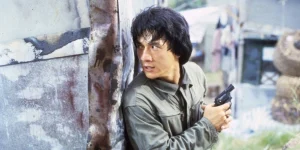
Memorable Scenes and Quotes
Key Scenes
- The opening ambush and systematic killing of Wing’s team
- Wing’s drunken breakdown in a public restroom
- The rooftop confrontation between Wing and Joe
Iconic Quotes
- “Being a cop doesn’t make you a hero.”
- “You taught us the rules. We just learned how to break them.”
Easter Eggs and Hidden Details
- Wing’s badge number matches Jackie Chan’s badge number in the original Police Story (1985)
- Photos of fallen officers reference characters from earlier franchise entries
- Joe’s school uniform subtly resembles elite private academies in Hong Kong, reinforcing class privilege themes
Trivia
- This is one of the few Jackie Chan films where he performs fewer large-scale stunts to focus on acting.
- The movie revived interest in serious Hong Kong action cinema after a period of decline.
- Daniel Wu’s performance is often cited as one of the best villain portrayals in modern Hong Kong films.
Why Watch?
If you think Jackie Chan only does comedy-action, New Police Story will prove you wrong. It’s a mature, emotionally heavy crime film that explores failure, responsibility, and redemption without sacrificing tension or intensity.
Director’s Other Works (Movies)
- Gen-X Cops (1999)
- Invisible Target (2007)
- Connected (2008)
- Shaolin (2011)